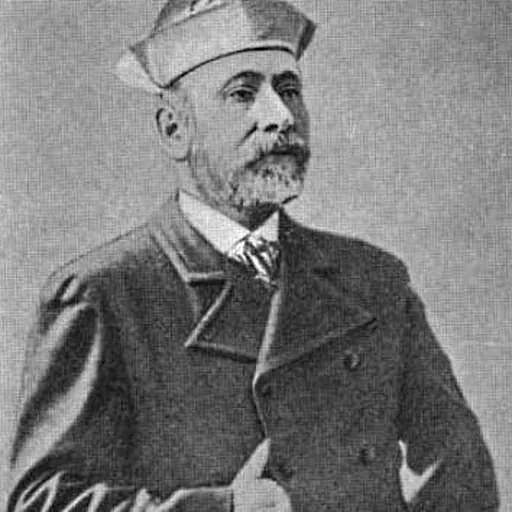
About Carl Rohl-Smith
Lived 1848 – 1900 (aged 52). Carl Rohl-Smith was a Danish sculptor.
Carl Wilhelm Daniel Rohl-Smith (April 3, 1848- August 20, 1900) was a Danish American sculptor who was active in Europe and the United States from 1870 to 1900. He sculpted a number of life-size and small bronzes based on Greco-Roman mythological themes in Europe as well as a wide number of bas-reliefs, busts, funerary monuments, and statues throughout Denmark, the German Confederation, and Italy. Emigrating to the United States in 1886, he once more produced a number of sculptures for private citizens. His most noted American works were a statue of a soldier for a Battle of the Alamo memorial in Texas, a statue of Benjamin Franklin for the World's Columbian Exposition in 1893, a statue group in Chicago commemorating the Fort Dearborn Massacre, and the General William Tecumseh Sherman Monument in Washington, D.C.
Early life
Rohl-Smith was born on April 3, 1848, in Roskilde, Denmark, to Caspar Wilhelm Smith and Johanne Marie Frederikke Sophie Röhl Smith. His father was a philologist at the University of Copenhagen. As a child, Rohl-Smith exhibited an artistic nature and was making sculptures out of any materials he could find. He then studied under Albert Wolff at the Prussian Academy of Arts in Berlin from 1870 to 1872. His 1872 bronze Wounded Philoctetes won a gold medal, and was purchased by the King of Greece. While in Rome, he executed another major work, Bellerophon, in 1872. It was purchased by the Danish embassy in Rome.
At some point before leaving Denmark for the United States, he married his wife, Sara.
American career In 1886, Between 1886 and 1889, he executed numerous sculptures of famous people in bas-relief and busts. He also designed a number of larger-than-life funerary statues and monuments for famous and wealthy individuals in Boston, Massachusetts; Memphis, Tennessee; and Louisville, Kentucky.
Rohl-Smith moved to Louisville, Kentucky, in 1889.
Rohl-Smith's most important works prior to 1892 were his Alamo soldier and statue of Judge Reid. Rohl-Smith's other notable American work at this time was a statue of Kentucky Superior Court Judge Richard Reid.
Franklin statue and rise to fame Electricity Building at the 1893 World's Fair, with Rohl-Smith's statue of Benjamin Franklin in front of the apse. Rohl-Smith moved to Chicago in 1891. His next important American work came in 1892. Rohl-Smith's prestige was such that he was also named Royal Danish Commissioner to the fair. Around this time, Rohl-Smith became associated with Peter Emil Dreier, a Danish American lawyer and Danish consul in Chicago. Dreier's large circle of friends included many prominent painters and sculptors, and Rohl-Smith's fame began to spread in the artistic community. After researching the event with his wife, Rohl-Smith decided that the most important and dramatic part of the narrative was the incident in which a rogue warrior is prevented from killing Margaret Helm and her child by the Potawatomi chief Black Partridge. Dr. Isaac Van Voorhees lies dying beneath Helm's feet. Two members of the Lakota nation, Kicking Bear and Short Bull, were imprisoned at nearby Fort Sheridan for having fired at United States Army troops during the Wounded Knee Massacre in 1890. Short Bull posed as the less muscular, younger warrior attempting to kill Helm, while Kicking Bear posed as Black Partridge. Pullman donated the sculpture to the city of Chicago. Pullman was so pleased with the memorial that in 1895 he commissioned Rohl-Smith to sculpt bas-relief portraits of his parents for Pullman Memorial Universalist Church in Albion, New York.
From 1891 to 1897, Rohl-Smith continued to produce an extensive number of bas-reliefs, busts, and statues of famous people. In 1895, the Sherman Memorial Commission issued a call for proposals for an equestrian statue of Sherman. A committee of the National Sculpture Society agreed to judge the submissions. When the competition closed on December 31, 1894, 23 sculptors had submitted proposals. Models of all the proposed statues were exhibited in Washington, D.C., to large crowds. The submission by Carl Rohl-Smith generated the most popular acclaim. The National Sculpture Society (NSS) narrowed the submissions down to a short list of four. The submission by Rohl-Smith did not make the short list; indeed, it was ranked almost dead last by the NSS committee. On May 27, the Sherman Memorial Commission overruled the judging committee and chose Rohl-Smith's design. Senator Edward O. Wolcott sponsored legislation to investigate the award process. Although his resolution was not successful, the Senate debate over the award process was rancorous and showed the Senate's deep distrust of "art experts". Rohl-Smith was accused of using political influence to win the commission, an accusation he vehemently denied. After two months of protests, the National Sculpture Society ceased to contest the award.
Carl Rohl-Smith never saw his Sherman Monument completed. He died in Copenhagen in August 1900, and was buried in Vestre Cemetery.
Although the government determined that the contract with Rohl-Smith was null after his death, the memorial commission agreed to allow Rohl-Smith's assistant and wife, Sara, to oversee the statue's completion. Mrs. Rohl-Smith asked sculptors Theo Kitson, Bush Brown, and Jens Ferdinand Willumsen to help with the statue's completion. Later reports do not mention Brown or Willumsen's work on the monument, but Lauritz Jensen worked on the main statue, while Danish sculptor Stephen Sinding modelled the War and Peace figures. Sinding created plaster models for these pieces from Rohl-Smith's sketches. But upon review, the postures and sizes of the two figures were found not to harmonize with the rest of the monument. Sigvald Asbjornsen remodelled them. Kitson completed the medallions which depicted the corps commanders who served under Sherman. The design for the stone pedestal was complete at the time of Rohl-Smith's death.
Death Rohl-Smith fell ill with malaria and returned to Europe in June 1896, where he stayed until the fall. Although Rohl-Smith returned to the United States, his ongoing ill health (due to another attack of malaria) Ill health continued to plague him. By March 1900, he had only completed the design for the pedestal (which had been erected) and three of the four corner "sentry" figures. Only sketches had been made for the equestrian statue itself, the side panels, the "War" and "Peace" statue groups, and the medallions. In August 1900, Rohl-Smith became suddenly ill. He died of Bright's disease at St. Josef's Hospital in Copenhagen on August 22, 1900, with his wife at his side.
Sara Rohl-Smith died in Copenhagen in August 1921.
Notable works Bellerophon, Danish embassy, Rome, Italy, 1872. Akroterie and Winged Nike, Austrian Parliament Building, Vienna, Austria, c. 1874 to 1883. Ajax, Christiansborg Palace, Copenhagen, Denmark, 1878 (now lost). Apollo and Diana, Pan and Daphne, Summer, Winter (architectural sculpture), Eremitage Palace, Dyrehaven, Denmark, 1881–1886. Saint Athanasius, Saint Irenaeus of Lyon, John the Baptist, Moses (architectural sculpture), Marmorkirken (The Marble Church), Copenhagen, Denmark, 1883–1884. Bacchante Group, private collection, United States, 1885. Young Benjamin Franklin With Kite, World's Columbian Exposition, Chicago, Illinois, United States, 1893 (now lost). The Fort Dearborn Massacre Monument, Chicago History Museum, Chicago, Illinois, United States, 1893. Bas-relief portraits of Emily Caroline Pullman and James Lewis Pullman, Pullman Memorial Universalist Church, Albion, New York, United States, 1895. Equestrian Statue of General John M. Corse, Crapo Park, Burlington, Iowa, 1896. William W. Belknap Monument, Arlington National Cemetery, Arlington County, Virginia, United States, 1897. General William Tecumseh Sherman Monument, President's Park, Washington D.C., United States (unfinished)
Gallery
Don’t just read it —
keep it.
Full-length biographies made to live with: read them, listen on the way to work, watch them tonight.
- E-book
- Audio
- Video
Instant download · yours to keep · every purchase keeps this site free
Important facts
People in Carl Rohl-Smith's life
Named in this biography and alive at the same time






Related people
Same field, nearest in time


Contemporaries
People whose lives overlapped Carl Rohl-Smith's



Frequently asked questions
Who was Carl Rohl-Smith?
Danish-American sculptor (1848–1900)
When was Carl Rohl-Smith born?
Carl Rohl-Smith was born on 3 April 1848 in Roskilde.
When did Carl Rohl-Smith die?
Carl Rohl-Smith died on 20 August 1900 in Copenhagen.
What was Carl Rohl-Smith's occupation?
Carl Rohl-Smith was a sculptor.
What nationality was Carl Rohl-Smith?
Carl Rohl-Smith was Danish.
Sources & further reading
Cite this page
APA: Biography.guide. (2026). Carl Rohl-Smith. https://biography.guide/carl-rohl-smith/
MLA: "Carl Rohl-Smith." Biography.guide, https://biography.guide/carl-rohl-smith/.
Chicago: "Carl Rohl-Smith." Biography.guide. https://biography.guide/carl-rohl-smith/.
Data last updated: 2026-09-24 · Spot an error? Report a correction.
Portrait: Wikimedia Commons · author & licence
Page generated 2026-09-27 05:08 UTC