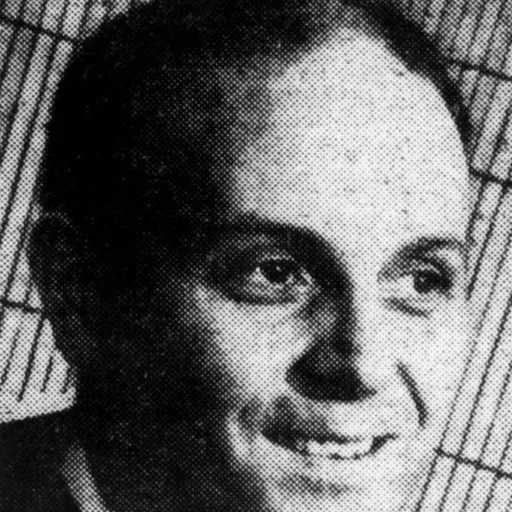
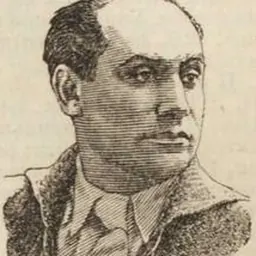
Carl Marzani
Italian-American communist activist, documentary filmmaker, writer, publisher
About Carl Marzani
Lived 1912 – 1994 (aged 82). Carl Marzani was an Italian journalist, politician, author, economist and film producer, known for Documentary film.
Carl Aldo Marzani (March 4, 1912 – December 11, 1994) was an Italian-born American political activist with a series of careers as a volunteer soldier in the Spanish Civil War, organizer for the Communist Party USA (CPUSA), United States intelligence official, documentary filmmaker with an Academy Award nomination, author, and publisher. During World War II he served in the federal intelligence agency, the Office of Strategic Services (OSS), and later the U.S. Department of State. He picked the targets for the Doolittle Raid on Tokyo, which took place on April 18, 1942.
Background
Carl Aldo Marzani was born on March 4, 1912, in Rome, Italy. The family immigrated to the United States in 1924 and settled in Scranton, Pennsylvania. Carl entered the first grade at the age of twelve, not knowing English. He graduated from high school in 1931 with a scholarship to Williams College. There, Marzani became a Socialist and joined the League for Industrial Democracy. He began writing and became the editor of the school's literary magazine. In 1935, he graduated summa cum laude from Williams College with a BA in English.
In 1937 Marzani returned to Oxford and married Edith Eisner (stage name Edith Emerson). Then Abraham Lazarus brought him into the Communist Party of Great Britain (CPGB), Marzani later wrote that the immediate effect of his conversation with Nehru "was to broaden my horizons, show me the relationship between the industrial revolution and colonialism, revise my understanding of both, and give me a solid grounding in the economics of imperialism."
After their world tour, the Marzanis returned to the United States, and went on relief, the New Deal term for government assistance. Soon they got jobs with the New Deal program, the Works Progress Administration (WPA). The WPA assigned Marzani to teach economics at New York University. Marzani joined the Communist Party USA on August 25, 1939, two days after the Nazi-Soviet Pact was signed, under the alias Tony Wales. An informant wrote that he was also known later by this name "in party circles".
While a WPA instructor at New York University, he served as district organizer for the Communist Party on the Lower East Side of New York. After the German invasion of the Soviet Union in mid 1941, Marzani became director of a popular front anti-fascist organization, and resigned from the Communist Party in August 1941. Several authors have speculated that Kollega was Marzani, though it has been disputed. Another posited code name for Marzani was NORD. He was convicted on June 22, 1947.
Arthur Garfield Hays represented Marzani pro hac vice with Allan R. Rosenberg with Charles E. Ford and Warren L. Sharfman. Following conviction, Belford V. Lawson Jr. filed a brief on behalf of the National Lawyers Guild and Joseph Forer filed a brief on behalf of the Civil Rights Congress as amicus curiae urging reversal. Nine counts were overturned on appeal, while the Supreme Court split 4-4 on a rare rehearing of the last two charges. Marzani served all but four months of a thirty-six-month sentence. In August 1947, Despres again "testified emphatically" for his loyalty before the House Committee on Un-American Activities.
In December 1947, Time magazine reported Marzani among other "unwelcome guests" to speak at six US colleges, whether "Republicans, Democrats, Communists, Buchmanites, Zoroastrians, or ecdysiasts". The article mentioned Gerhart Eisler and Marzani ("dismissed by the State Department for concealing his Communist card") together and that it was the University of Wisconsin which had barred him.
Despite the adversity of this period, Marzani continued actively making documentaries through his Union Films organization. In 1948, he made some dozen political campaign films for the Progressive Party presidential candidate, Henry A. Wallace, as well as a film for the American Labor Party incumbent candidate for Congress, Vito Marcantonio of East Harlem. He later wrote of serving time in Danbury Federal Prison with former House Un-American Activities Committee (HUAC) chairman J. Parnell Thomas, as well as Ring Lardner, Jr. and Lester Cole of the Hollywood Ten, who had been convicted for refusing to testify at HUAC hearings. In prison, Marzani began work on a book blaming President Harry S. Truman for starting the Cold War. W.E.B. DuBois summarized its argument in his introduction, dated August 17, 1952: The unquestioned desire of the American people for peace can be translated into action only by basic knowledge of how the present crisis has come about and how Roosevelt's peace policy became the Cold War. This book brings the reader undisputed proof of Truman's apostacy to the New Deal; of Churchill's machiavellian plans against the Soviet Union and of the sinister roles of Forrestal, Harriman, Dulles, Byrnes and Vandenberg, and of the murderous conspiracy which started the Korean War.
Union Films went out of business during his stay in prison. After his release in 1951, Marzani edited UE Steward for the United Electrical Workers until 1954. The same year he joined Cameron Associates and partnered with Angus Cameron to run Liberty Book Club. Liberty Book Club eventually became Marzani & Munsell which operated the Library-Prometheus Book Club. The two book clubs, with some 8,000 members, published and distributed many books following their progressive ideology. The amounts were $15,000 in 1960, then a two-year grant in 1961 of $55,000. It was one of the first two translations in English of this seminal political theorist. Marzani's translation comprised about half of the book, while his introduction and annotations supplied the other half. A contemporaneous reviewer found Marzani's translation "remarkably fine" but disapproved both the format, with Marzani's interspersed annotations, and occasionally his comments' tone as well. A 1992 review of a later academic biography of Gramsci adopts Marzani's title of 35 years previous as the review's own. Opening with a discussion of Marzani's book, it quotes Marzani's introduction:
Marzani traveled to Europe and the Soviet Union in September 1960, returning to New York in January. He was working on a Spanish translation of We Can Be Friends for publication in Cuba. Cuba's UN delegation arranged for him to visit Havana the following month. While he was there, Cedric Belfrage, a British friend from Marzani's OSS days, introduced him to Jacobo Árbenz, the former President of Guatemala overthrown by the CIA in 1954. Another OSS friend arranged a meeting with Che Guevera, with whom Marzani anticipated a US invasion of Cuba, six weeks before the US-financed, US-directed Bay of Pigs Invasion. These experiences provided background for Cuba Versus CIA, cowritten with Robert E. Light, an associate editor with Belfrage's newspaper, the National Guardian. This book was one of the first to list major covert CIA operations, including against Guatemala, and overthrowing the Mossadegh government in Iran in 1953. Like the other interviewees, Marzani was concealed by a pseudonym; his was "Eric Lanzetti". Gornick described the impression he made on her while she was researching this work, in her review of the first volume of his autobiography:
Personal life and death
In 1937, Marzani married his first wife, Edith Eisner, an actress whose stage name was Edith Emerson. They had two children, Anthony Marzani and Judith Cutler. Pomerantz's father was a well-known lawyer, Abraham Pomerantz, a former Nuremberg Trials prosecutor whom Congressman George A. Dondero alleged to have communist sympathies.
Carl Marzani died age 82 on December 11, 1994, in Manhattan. a well-respected book on environmental matters, at that time an unusual interest for a man associated with orthodox Marxism. In a 1976 article for the periodical In These Times, he spoke respectfully of the Club of Rome, a think-tank formed by a group of Italian industrialists in 1968; "it is a highly sophisticated group, the most thoughtful representatives of European capitalism". In a note appended to the article he commented "I have only two claims to fame: that I was the first political prisoner of the Cold War and that I wrote the first revisionist history of it." He continued to propound his later revisionism of a different sort, in his 1981 book The Promise of Eurocommunism.
Books by or co-written by Marzani John Gore, miner; a tragedy in 3 acts (1936) We Can Be Friends (1952) The Survivor: A Novel (1958) Dollars and Sense of Disarmament (1960) Cuba versus CIA (1961) The Shelter Hoax and Foreign Policy (1962) The Conscience of the Senate on the Vietnam War (1965) Withdraw!: From an Indochina War That Dishonors Our Country and Threatens Nuclear Disaster (1970) The Wounded Earth; an Environmental Survey (1972) The Threat of American Neo-Fascism: A Prudential Inquiry (1972) "Towards Eurocapitalism" (1976) Beyond 1984: Spain, Orwell and the Neo-Orwellians (1984) On Interring Communism and Exalting Capitalism The Education of a Reluctant Radical Book 1: Roman Childhood (1992) Book 2: Growing Up American (1993) Book 3: Spain, Munich and Dying Empires (1994) Book 4: From Pentagon to Penitentiary (1995) Book 5: Reconstruction. Monthly Review Press, 2001
Translated by Marzani The Open Marxism of Antonio Gramsci (1957) Inside the Khrushchev Era (1960)
Published by Marzani & Munsell
Books by Marzani Cuba Versus CIA (1961) Dollars and Sense of Disarmament (1961) The Shelter Hoax and Foreign Policy (1962) The Conscience of the Senate on the Vietnam War (1965)
Books by other authors See Marzani & Munsell
Filmography A number of these are available for online viewing. See External links, below, for those. War Department Report, 1943, nominated for an Academy Award for Best Documentary Feature Air Force Report, 1945 The Great Swindle, 1948 People's Congressman (The Vito Marcantonio Story), 1948 Failure in Germany, 1949 Rome Divided, 1949 Industry's Disinherited, 1949 Men Against Money, 1949 Solidarity, 1950 The Sentner Story, 1953
Don’t just read it —
keep it.
Full-length biographies made to live with: read them, listen on the way to work, watch them tonight.
- E-book
- Audio
- Video
Instant download · yours to keep · every purchase keeps this site free
Important facts
Family & relationships
People in Carl Marzani's life
Named in this biography and alive at the same time





Related people
Same field, nearest in time



Contemporaries
People whose lives overlapped Carl Marzani's





Frequently asked questions
Who was Carl Marzani?
Italian-American communist activist, documentary filmmaker, writer, publisher
When was Carl Marzani born?
Carl Marzani was born on 4 March 1912 in Rome.
When did Carl Marzani die?
Carl Marzani died on 11 December 1994 in New York City.
What was Carl Marzani's occupation?
Carl Marzani was a journalist, politician, author, economist and film producer.
What was Carl Marzani known for?
Carl Marzani was known for Documentary film.
What nationality was Carl Marzani?
Carl Marzani was Italian.
Sources & further reading
Cite this page
APA: Biography.guide. (2026). Carl Marzani. https://biography.guide/carl-marzani/
MLA: "Carl Marzani." Biography.guide, https://biography.guide/carl-marzani/.
Chicago: "Carl Marzani." Biography.guide. https://biography.guide/carl-marzani/.
Data last updated: 2026-09-22 · Spot an error? Report a correction.
Portrait: Wikimedia Commons · author & licence
Page generated 2026-09-27 05:04 UTC