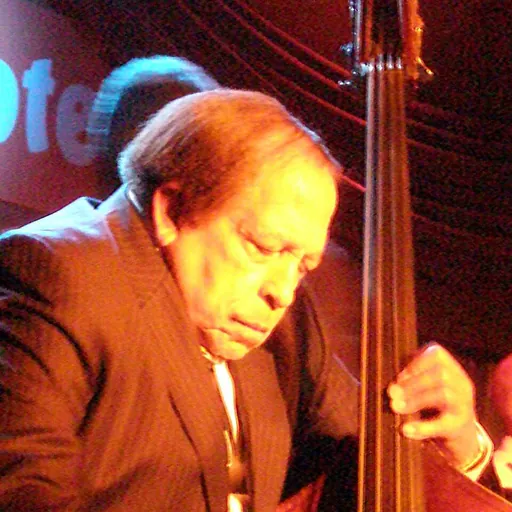
About Cachao
Lived 1918 – 2008 (aged 89). Cachao was a Cuban composer, conductor, jazz musician, musician and bandleader.
Israel López Valdés (September 14, 1918 – March 22, 2008), better known as Cachao , was a Cuban double bassist and composer. Cachao is widely known as the co-creator of the mambo and a master of the descarga (improvised jam sessions). Throughout his career he also performed and recorded in a variety of music styles ranging from classical music to salsa. An exile in the United States since the 1960s, he only achieved international fame following a career revival in the 1990s.
Born into a family of musicians in Havana, Cachao and his older brother Orestes were the driving force behind one of Cuba's most prolific charangas, Arcaño y sus Maravillas. As members of the Maravillas, Cachao and Orestes pioneered a new form of ballroom music derived from the danzón, the danzón-mambo, which subsequently developed into an international genre, mambo. In the 1950s, Cachao became famous for popularizing improvised jam sessions known as descargas. He emigrated to Spain in 1962, and moved to the United States in 1963, starting a career as a session and live musician for a variety of bands in New York during the rise of boogaloo, and later, salsa.
In the 1970s, Cachao fell into obscurity after moving to Las Vegas and later Miami, releasing albums sporadically as a leader. In the 1990s, he was re-discovered by actor Andy García, who brought him back to the forefront of the Latin music scene with the release of a documentary and several albums. Before his death in 2008, Cachao had earned a star on the Hollywood Walk of Fame and several Grammy Awards. He is ranked number 24 on Bass Player magazine's list of "The 100 Greatest Bass Players of All Time".
Biography Arcaño y sus Maravillas at Radio CMQ, c. 1945: Arcaño on flute, Orestes López on cello, Cachao on bass (right)
Early life and career Cachao was born on September 14, 1918, in Belén, a neighbourhood in Old Havana, into a family of musicians, many of them bassists—around 40 or more in his extended family. He was born and raised in the same house in which José Martí was born. His nickname and stage name Cachao was given to him by his grandfather Aurelio López, from the Spanish word "cachondeo" (banter).
Cachao began his musical career in 1926, taught by his father, Pedro López, and his older brother, multi-instrumentalist Orestes López, nicknamed "Macho". Work at the cinema ended in 1930 when talkies began to be shown in Cuba.
His parents made sure he was classically trained, first at home and then at a conservatory. In his early teens he was already playing contrabass with the Orquesta Filarmónica de La Habana (of which Orestes was a founding member), under the baton of guest conductors such as Herbert von Karajan, Igor Stravinsky and Heitor Villa-Lobos. In their vast repertoire were also compositions by other songwriters such as "Isora Club", written by their sister Coralia López, as well as arrangements of standards such as "Somewhere Over the Rainbow" and songs by George Gershwin and Jelly Roll Morton. The need to constantly write music sheets for each member of the band was one of the reasons why Cachao left the group in 1949. He then joined Blanquita Theater orchestra, whose fifty members played in Broadway-style revues. The Maravillas went on for another ten years. which followed the longer descargas by Julio Gutiérrez (Cuban Jam Sessions Vol. 1 and 2), released also by Panart. They have been named by many critics as one of the most essential Cuban records of the 1950s, including being cited by the book 1000 Recordings to Hear Before You Die. Between 1957 and 1959 he recorded many more descargas at Panart studios. These recordings were released in the following years by Kubaney and Maype, and re-released by EGREM. He also recorded descargas with Tojo's orchestra and Chico O'Farrill's All-Stars Cubano amongst other ensembles. He worked alongside Peruchín, Tata Güines and Alejandro "El Negro" Vivar.
Exile In 1958, at the height of the Cuban Revolution, Cachao's wife left Cuba for New Jersey, and in 1962, three years into Fidel Castro's communist regime, Cachao crossed the Atlantic on a ship along with 13 other musicians. where he played at events such as baptisms, comuniones, quinceañeras and weddings. Despite his lower profile, Cachao recorded several albums with pianist Paquito Hechevarría for the Tania record label, including one as a leader in 1986, Maestro de Maestros: Cachao y su Descarga '86.
Late career
In 1989, actor Andy García contacted Cachao at the San Francisco Jazz Festival, where he was playing with John Santos and Carlos Santana. The success of the concert and film spurred the recording of two new albums, Master Sessions Vol. 1 (1994) and Vol. 2 (1995), as well as international tours. His last concert took place in Miami in September 2007 and was released as a posthumous live album, The Last Mambo, by Sony Music in 2011. In February 2008, Cachao signed a contract with Penguin Books to write a book about his life,
Death Cachao died on the morning of March 22, 2008, in Coral Gables, Florida, at the age of 89. On March 27, he was buried at Vista Memorial Gardens in Miami Lakes.
Family Cachao was part of a large musical family which at one time had "35 bassists" across multiple generations, although many played other instruments as well. They were survived by their only daughter, María Elena. He was a recipient of a 1995 National Heritage Fellowship awarded by the National Endowment for the Arts, which is the highest honor in the folk and traditional arts in the United States. In 1999, Cachao was inducted into the International Latin Music Hall of Fame. He also received a Lifetime Achievement Award a year later. In 2003, Cachao was awarded the 2,219th star on the Hollywood Walk of Fame. On November 7, 2006, Cachao received an Honorary Doctorate of Music from Berklee College of Music during Berklee's Latin Culture Celebration. At the time of his death, the University of New Haven had also decided to award an Honorary Doctorate to Cachao. Although the event gathered many of the major exponents of Afro-Cuban music in the country, it received little attention from the press.
In 1993, the Puerto Rican salsa supergroup Descarga Boricua recorded the track "Homenaje a Cachao" for the album ¡Esta sí va!, while pianist Hilario Durán recorded a different piece with the same name for his 2001 album Havana Remembered. Bebo Valdés composed and recorded the piece "Cachao, creador del mambo" in 2004, and re-recorded a segment of the song for the film Chico & Rita in 2010.
In November 2005, a tribute performance dedicated to Cachao took place during the 6th Annual Latin Grammy Awards. It was presented by Andy García and featured Bebo Valdés, Generoso Jiménez, Arturo Sandoval, Johnny Pacheco, as well Cachao himself.
In February 2008, Paquito D'Rivera premiered Conversaciones con Cachao, a symphonic suite dedicated to Cachao, during the Festival de Música de Canarias (Canary Islands Music Festival). The orchestra was directed by Pablo Zinger.
A month after Cachao's death, a second documentary film by Andy García was released; Cachao: Uno Más premiered in April 2008 at the San Francisco International Film Festival. The inspiration for Cachao: Uno Más, made by San Francisco State University's DOC Film Institute, came largely from a concert Cachao played at Bimbo's 365 Club in San Francisco in 2005. The film's premiere was followed by a tribute concert with the John Santos Band at Yoshi's Jazz Club SF.
After Cachao's death, his backing band continued to perform as Cachao's Mambo All-Stars and they recorded an album in his honour, Como siempre.
On March 15, 2019, a concert titled Mambo: 100 Years of the Master - Cachao was held in Miami, 100 years after Cachao's birth. It featured 97-year-old Cándido Camero and 89-year-old Juanito Márquez, among others. The latter arranged some of the songs Cachao was preparing to record in 2008 at the time of his passing, which were performed for the first time 11 years later at the concert.
Discography
As leader
1957: Cuban Jam Sessions in Miniature "Descargas" (Panart) 1958: Con el ritmo de Cachao (Duarte/Kubaney), reissued as Camina Juan Pescao (Duher, 1974) 1959: El gran Cachao (Duarte/Kubaney), reissued as Cachao y su Típica Vol. 2 (Duher, 1974) 1962: Jam Session with Feeling (Maype, recorded in 1958) 1963: Descarga (Maype, recorded in 1961) 1966: Cuban Music in Jam Session (Bonita, recorded in 1961) 1974: Descargas con el ritmo de Cachao (Modiner, recorded in 1961) 1977: Cachao y su Descarga 77 (Salsoul) 1977: Dos (Salsoul) 1986: Maestro de Maestros: Cachao y su Descarga '86 (Tania) 1994: Master Sessions, Volume 1 (Crescent Moon) 1995: Master Sessions, Volume 2 (Crescent Moon) 1997: Superdanzones (EGREM, recorded in 1961), reissued as part of Jazzcuba, Volumen 2 (Warner Music, 2007) 2000: Cuba linda (EMI) 2004: Ahora sí (Univisión) 2011: The Last Mambo (Sony)
Collaborations with Paquito Hechevarría & Tany Gil 1981: Walpataca (Tania), reissued as Latin Jazz Descarga Part 1 (1994) 1981: Típica Pata (Tania) 1985: Walpataca II (Tania), reissued as Latin Jazz Descarga Part 2 (1994)
Singles 1957: Descarga cubana / Goza mi trompeta (Panart) 1957: A gozar timbero / Sorpresa de flauta (Panart) 1957: Pamparana / Cógele el golpe (Panart) 1957: Trombón criollo / Oye mi tres montuno (Panart) 1958: La cayuga / Cuarenta que son uno (Duarte) 1958: Camina Juan Pescao / Jóvenes de la defensa (Duarte) 1961: Descarga general / El manicero (Discos Latino) 1962: Cachao en España Pt. 1 / Cachao en España Pt. 2 (Duque)
As sideman
With All-Stars Cubano Descarga número uno / Descarga número dos (Gema, 1957)
With Arcaño y sus Maravillas El que sabe, sabe / Chanchullo (Gema, 1957)
With Joe Cain Latin Explosion (Time, 1964)
With Charanga Caribe Vol. II (Caney, 1980)
With Conjunto Yumurí La paella (Caney, 1980) Estampas de mi tierra (Caney, 1981)
With Kako Tributo a Noro (Alegre, 1964)
With Chano Montes y su Conjunto Recuerdan a Chappottín (Caney, 1982)
With Carlos Montiel Distinto y diferente (Discos Suyo)
With Orquesta Oriental Con sasón! (Caney, 1980)
With Patato & Totico Patato y Totico (Verve, 1967)
With Eddie Palmieri Champagne (Tico, 1968)
With Tito Rodríguez Tito Tito Tito (Westside, 1964)
With The Salsa All Stars The Salsa All Stars (Salsa, 1968)
With Bebo Valdés El arte del sabor (Blue Note, 2001)
Filmography Cachao... como su ritmo no hay dos (1993) Cachao: Uno más (2008)
Don’t just read it —
keep it.
Full-length biographies made to live with: read them, listen on the way to work, watch them tonight.
- E-book
- Audio
- Video
Instant download · yours to keep · every purchase keeps this site free
Important facts
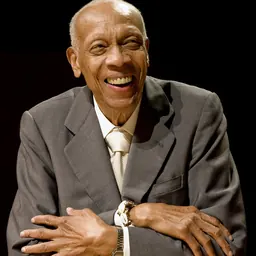
People in Cachao's life
Named in this biography and alive at the same time





Related people
Same field, nearest in time



Contemporaries
People whose lives overlapped Cachao's


Frequently asked questions
Who was Cachao?
Cuban double bassist and composer (1918–2008)
When was Cachao born?
Cachao was born on 14 September 1918 in Havana.
When did Cachao die?
Cachao died on 22 March 2008 in Coral Gables.
What was Cachao's occupation?
Cachao was a composer, conductor, jazz musician, musician and bandleader.
What nationality was Cachao?
Cachao was Cuban.
Sources & further reading
Cite this page
APA: Biography.guide. (2026). Cachao. https://biography.guide/cachao/
MLA: "Cachao." Biography.guide, https://biography.guide/cachao/.
Chicago: "Cachao." Biography.guide. https://biography.guide/cachao/.
Data last updated: 2026-09-23 · Spot an error? Report a correction.
Portrait: Wikimedia Commons · author & licence
Page generated 2026-09-27 05:06 UTC