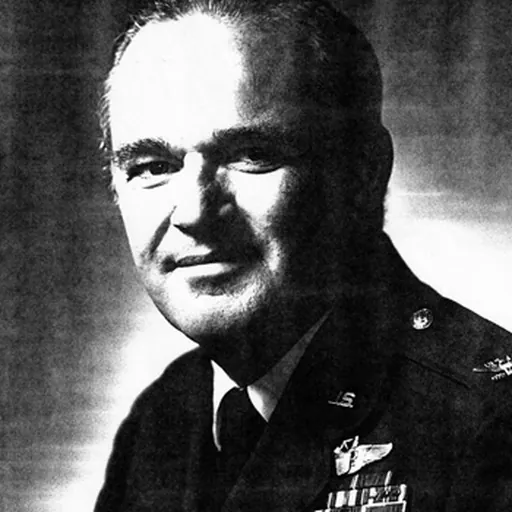
About Bud Mahurin
Lived 1918 – 2010 (aged 91). Bud Mahurin was an American military officer and military aviator.
Colonel Walker Melville "Bud" Mahurin (December 5, 1918 – May 11, 2010) was a United States Air Force officer and aviator. During World War II, while serving in the United States Army Air Forces, he was a flying ace.
Mahurin was the first American pilot to become a double ace in the European Theater. During World War II he was credited with 20.75 aerial victories, making him the sixth-highest American P-47 ace. He was credited with shooting down 3.5 MiG-15s in Korea, giving him a total of 24.25 aircraft destroyed in aerial combat. He joined the United States Army Air Forces as an aviation cadet on September 29, 1941, after several years as an engineering student at Purdue University. Mahurin graduated from pilot training on April 29, 1942.
World War II Captain Mahurin of the 56th Fighter Group standing on the port wing of his P-47 Thunderbolt aircraft, conversing with its crew chief, Staff Sergeant John E. Barnes Mahurin was assigned to the 63d Fighter Squadron, 56th Fighter Group, and deployed to England with them in January 1943. Based at Halesworth, England, then-Captain Mahurin became a flight leader in the 63rd FS and began flying missions in May 1943. His first plane was P-47C-5-RE serial number 41-6334, that bore the squadron code UN:M.
The first aircraft he downed was unfortunately his own P-47 fighter. On a mission on August 12, 1943, he decided to inch closer and closer to within feet of a B-24 bomber that was nearby. He was caught in the B-24's prop wash and sucked under its wing, and when he tried to pull away, the tail and fuselage of his airplane was shredded by one of the B-24's propellers, forcing him to bail out. The B-24 had to crash-land.
On August 17, 1943, he scored his first aerial victories while flying a temporary replacement plane, P-47C-2-RE 41-6259, coded UN:V (normally assigned to Capt. Glen Schiltz ) on November 29, 1943. On March 8, 1944, he destroyed three Fw 190s. He eventually went on to score 19.75 confirmed victories in combat in Europe, with three more enemy planes probably destroyed, and one damaged, before being shot down himself. Because of his knowledge of the French Resistance and the risk of interrogation if he was shot down again, Mahurin was barred from flying over Europe and returned to the United States in June 1944.
In October, he again shipped overseas as commander of the 3rd Fighter Squadron, the combat element of the composite 3rd Air Commando Group in the Philippines. While based at Mangaldan, Luzon, in January 1945 he was credited with destroying a Japanese bomber while flying a P-51 Mustang.
After the war, Mahurin returned to Purdue University and completed a degree in aeronautical engineering in 1949.
Mahurin died of "complications from a stroke" American Defense Service Medal American Campaign Medal Asiatic-Pacific Campaign Medal with four bronze campaign stars European-African-Middle Eastern Campaign Medal with two bronze campaign stars World War II Victory Medal Army of Occupation Medal with 'Japan' clasp National Defense Service Medal with one bronze service star Korean War Service Medal with two bronze campaign stars
Air Force Longevity Service Award with silver and bronze oak leaf clusters
Distinguished Service Cross citation
Mahurin, Walker Captain, U.S Army Air Corps 63d Fighter Squadron, 56th Fighter Group, 8th Air Force Date of Action: October 4, 1943 Headquarters, European Theater of Operations: General Orders No. 96 (December 16, 1943) Citation:
The President of the United States of America, authorized by Act of Congress July 9, 1918, takes pleasure in presenting the Distinguished SERVICE Cross to Captain (Air Corps) Walker M. Mahurin, United States Army Air Forces, for extraordinary heroism in connection with military operations against an armed enemy while serving as Pilot of a P-47 Fighter Airplane in the 63d Fighter Squadron, 56th Fighter Group, EIGHTH Air Force, over enemy occupied continental Europe on 4 October 1943, while serving as flight leader on a mission escorting withdrawing bombers. Though confronted with superior numbers of enemy aircraft and at a disadvantage because of altitude, he vigorously and aggressively attacked the enemy, destroying two planes and assisted in the dispersal of the enemy formation. Immediately thereafter Captain Mahurin chased an enemy fighter far into Germany, where he destroyed it. The heroism displayed by Captain Mahurin on this occasion reflects the highest credit upon himself and the armed forces of the United States.
Don’t just read it —
keep it.
Full-length biographies made to live with: read them, listen on the way to work, watch them tonight.
- E-book
- Audio
- Video
Instant download · yours to keep · every purchase keeps this site free
Important facts
People in Bud Mahurin's life
Named in this biography and alive at the same time

Related people
Same field, nearest in time




Contemporaries
People whose lives overlapped Bud Mahurin's


Frequently asked questions
Who was Bud Mahurin?
American World War II flying ace
When was Bud Mahurin born?
Bud Mahurin was born on 5 December 1918 in Ann Arbor, Benton Harbor.
When did Bud Mahurin die?
Bud Mahurin died on 11 May 2010 in Newport Beach.
What was Bud Mahurin's occupation?
Bud Mahurin was a military officer and military aviator.
What nationality was Bud Mahurin?
Bud Mahurin was American.
Sources & further reading
Cite this page
APA: Biography.guide. (2026). Bud Mahurin. https://biography.guide/bud-mahurin/
MLA: "Bud Mahurin." Biography.guide, https://biography.guide/bud-mahurin/.
Chicago: "Bud Mahurin." Biography.guide. https://biography.guide/bud-mahurin/.
Data last updated: 2026-09-23 · Spot an error? Report a correction.
Portrait: Wikimedia Commons · author & licence
Page generated 2026-09-27 05:04 UTC