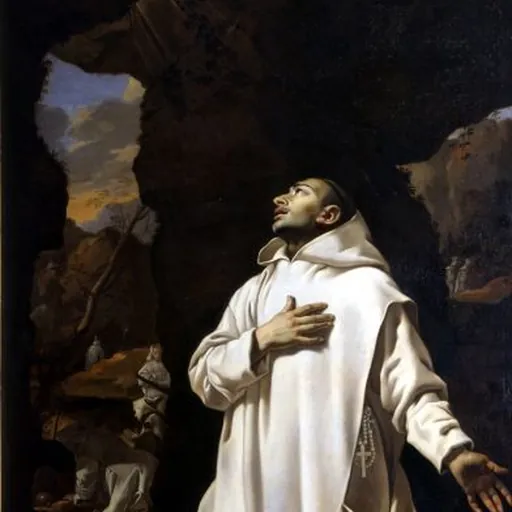
About Bruno of Cologne
Lived 1030 – 1101 (aged 70–71). Bruno of Cologne was a German catholic priest, writer, anchorite and founder of Catholic religious community.
Bruno of Cologne (; ; – 6 October 1101), venerated as Saint Bruno, was the founder of the Carthusians. He personally founded the order's first two communities. He was a celebrated teacher at Reims and a close advisor of his former pupil, Pope Urban II. His feast day is 6 October.
Life Bruno was born in Cologne about the year 1030. According to tradition, he belonged to the family of Hartenfaust, or Hardebüst, one of the principal families of the city. Among his students were Eudes of Châtillon, afterwards Pope Urban II, Rangier, Cardinal and Bishop of Reggio, Robert, Bishop of Langres, and a large number of prelates and abbots.
Chancellor of the Diocese of Reims In 1075, Bruno was appointed chancellor of the Archdiocese of Reims, which involved him in the daily administration of the diocese. Meanwhile, the pious Bishop Gervais de Château-du-Loir, a friend to Bruno, had been succeeded by Manasses de Gournai, a violent aristocrat with no real vocation for the Church. In 1077, at the urging of Bruno and the clergy at Reims, de Gournai was suspended at a council at Autun. Manasses responded, in typical eleventh-century fashion, by having his retainers pull down the houses of his accusers. He confiscated their goods, sold their benefices, and even appealed to the pope. Bruno discreetly avoided the cathedral city until, in 1080, a definite sentence, confirmed by popular riot, compelled Manasses to withdraw
Bruno and his companions spent time in religious community with Robert of Molesme, who had in 1075 settled at Sèche-Fontaine, near Molesme in the Diocese of Langres, together with other hermits who would become the first Cistercians in 1098. After a short stay, Bruno went with six of his companions to Hugh of Châteauneuf, Bishop of Grenoble. The bishop installed them in 1084 in a mountainous and uninhabited spot in the lower Alps of the Dauphiné, in a place named Chartreuse,
Bruno resisted efforts to name him Archbishop of Reggio Calabria, deferring instead in favour of one of his former pupils nearby in a Benedictine abbey near Salerno. Instead, Bruno begged to return again to his solitary life. His intention was to rejoin his brethren in Dauphiné, as a letter addressed to them makes clear.
Saint Bruno has long been regarded as the patron saint of Calabria and one of the patron saints of Germany.
A writer as well as founder of his order, Bruno composed commentaries on the Psalms and on the Epistles of Paul the Apostle. Two letters of his also remain, his profession of faith, and a short elegy on contempt for the world, which shows that he cultivated poetry. Bruno's Commentaries reveal that he knew a little Hebrew and Greek; he was familiar with the Church Fathers, especially Augustine of Hippo and Ambrose. "His style", said Dom Rivet, "is concise, clear, nervous and simple, and his Latin as good as could be expected of that century: it would be difficult to find a composition of this kind at once more solid and more luminous, more concise and more clear."
In Catholic art, Saint Bruno can be recognised by a skull that he holds and contemplates, with a book and a cross. He may be crowned with a halo of seven stars; or with a roll bearing the device .
Don’t just read it —
keep it.
Full-length biographies made to live with: read them, listen on the way to work, watch them tonight.
- E-book
- Audio
- Video
Instant download · yours to keep · every purchase keeps this site free
Important facts
People in Bruno of Cologne's life
Named in this biography and alive at the same time

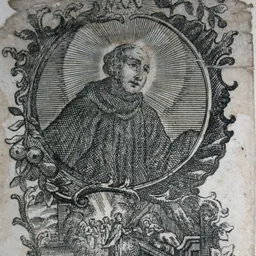

Related people
Same field, nearest in time


Contemporaries
People whose lives overlapped Bruno of Cologne's



Frequently asked questions
Who was Bruno of Cologne?
founder of the Carthusian Order (1030–1101)
When was Bruno of Cologne born?
Bruno of Cologne was born in 1030 in Cologne.
When did Bruno of Cologne die?
Bruno of Cologne died on 6 October 1101 in Certosa di Serra San Bruno.
What was Bruno of Cologne's occupation?
Bruno of Cologne was a catholic priest, writer, anchorite and founder of Catholic religious community.
What nationality was Bruno of Cologne?
Bruno of Cologne was German.
Sources & further reading
Cite this page
APA: Biography.guide. (2026). Bruno of Cologne. https://biography.guide/bruno-of-cologne/
MLA: "Bruno of Cologne." Biography.guide, https://biography.guide/bruno-of-cologne/.
Chicago: "Bruno of Cologne." Biography.guide. https://biography.guide/bruno-of-cologne/.
Data last updated: 2026-09-20 · Spot an error? Report a correction.
Page generated 2026-09-27 05:09 UTC