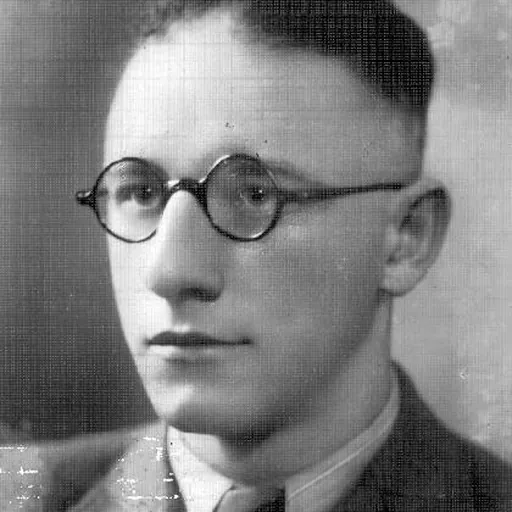
About Bronius Krivickas
Lived 1919 – 1952 (aged 32). Bronius Krivickas was a Lithuanian translator, literary criticism, partisan (military), poet, translation and writer.
Bronius Krivickas (17 November 1919 – 21 September 1952) was a Lithuanian writer, poet, literary critic, and anti-Soviet partisan. His work is mainly characterized by satire and literary criticism against the occupying Soviet state. Among the partisans he was also widely known by his codename Vilnius.
Having enjoyed writing at an early age, Krivickas studied Lithuanian and French languages and literature at the Vytautas Magnus University. He participated in the activities of Vincas Mykolaitis-Putinas's Šatrija art circle and Balys Sruoga's theater seminar. Krivickas established himself as a literary and theater critic, as well as poet and novella writer, and also developed a friendship with Mamertas Indriliūnas. He joined the Lithuanian partisan movement in 1945 and participated in their activities as a communicator, being dubbed by fellow partisans as "the professor" until his death in 1952 when he was found hiding in a bunker and subsequently executed. Krivickas and his works were one of the main voices of anti-Soviet resistance.
Krivickas went to the Suostas primary school, and in 1938 he finished the Antanas Smetona gymnasium in Biržai,
Activity in Vilnius When Lithuania received the capital Vilnius after the Soviet–Lithuanian Mutual Assistance Treaty in 1939, Krivickas and his colleagues moved there to study at Vilnius University, participating in various social activities and establishing himself as a theatre critic. From 1947 to 1948, Krivickas would stay in bunkers, such as his wife's parents' homestead bunker in in the winters, and would hide in the forests in the summers. In 1948, a priest in Suostas quietly wed Krivickas and a school teacher from Smilgiai. The partisans reportedly respected Krivickas. Working as a communicator between them, intensely studying languages, keeping a large amount of books in his bunkers, About a thousand soldiers surrounded the forest of Raguva, and after finding one of the three bunkers in which Krivickas hid, they executed him immediately.
On April 6, 1953, Bronius' brother, Jonas Krivickas (also known as Jonas or Kirvis), was killed in the Skaistakalnis forest (Surgieniai), in the Bauska district of Latvia.
Literary style At the time of studying, he established himself as a critic, novelist, and dramaturg. Krivickas upheld the strict aesthetic qualities of his critical literature throughout his literary career. Krivickas's short stories are characterized by psychologically resilient characters and philosophical undertones. His poetry mainly focused on a person's relationship with existence, the world, and death.
Krivickas's first poem from the partisan period is dated 1945. At first, his works, which were poems, sonnets, and satires, were only spread by word of mouth or transcripts among the partisans or their supporters. His work was characterized by the promotion of classical values, as well as heroism and the fearlessness of death, which were values he himself upheld. Because of his time as a partisan, many of his works include describing the life of living with partisans – hiding in bunkers and forests, the death of close friends and family, and most importantly – leaving the last bullet to yourself. Some of his works are characterized by religion as in multiple poems he mentions the wrath of god, describing also that through pain and death one can achieve peace and come to god. His satires included elements of grotesque and absurdism, and in them he chooses to mock the Soviet government and reveal the truth of its occupation, propaganda, and cruelty, also ironizing the supposed "allies" of the Soviet Union.
Krivickas compared the partisan struggle for freedom with the Israelite fight for the promised land and various other heroic medieval tales. In such context, however, Krivickas realizes that there is very little hope, and embraces a stoic mindset in his poems, which are now one of his most famous works, Pralaimėjimas, Migla, Partizano mirtis, and Deividas prieš Goliatą (David versus Goliath).
Legacy Krivickas is mainly remembered as a poet-partisan.
His surviving works and pictures are displayed at the Maironis Museum of Lithuanian Literature.
In 1996, a sculpture of Krivickas was uncovered in the Putiliškiai cemetery. In 1998, he was recognized as a war volunteer, was given the rank of captain, and was awarded the Commander's Grand Cross of the Order of the Cross of Vytis. In 1999, a collection of Krivickas's works titled Broniaus Krivicko raštai was published by Virginijus Gasiliūnas. In 2008, a remembrance sign was built at the death site.
Don’t just read it —
keep it.
Full-length biographies made to live with: read them, listen on the way to work, watch them tonight.
- E-book
- Audio
- Video
Instant download · yours to keep · every purchase keeps this site free
Important facts
People in Bronius Krivickas's life
Named in this biography and alive at the same time

Related people
Same field, nearest in time





Contemporaries
People whose lives overlapped Bronius Krivickas's





Frequently asked questions
Who was Bronius Krivickas?
Lithuanian translator (1919-1952)
When was Bronius Krivickas born?
Bronius Krivickas was born on 17 November 1919 in Pervalkai.
When did Bronius Krivickas die?
Bronius Krivickas died on 21 September 1952 in Raguva.
What was Bronius Krivickas's occupation?
Bronius Krivickas was a translator, literary criticism, partisan (military), poet, translation and writer.
What nationality was Bronius Krivickas?
Bronius Krivickas was Lithuanian.
Sources & further reading
· Wikipedia: Bronius Krivickas
Cite this page
APA: Biography.guide. (2026). Bronius Krivickas. https://biography.guide/bronius-krivickas/
MLA: "Bronius Krivickas." Biography.guide, https://biography.guide/bronius-krivickas/.
Chicago: "Bronius Krivickas." Biography.guide. https://biography.guide/bronius-krivickas/.
Data last updated: 2026-09-21 · Spot an error? Report a correction.
Portrait: Wikimedia Commons · author & licence
Page generated 2026-09-27 04:59 UTC