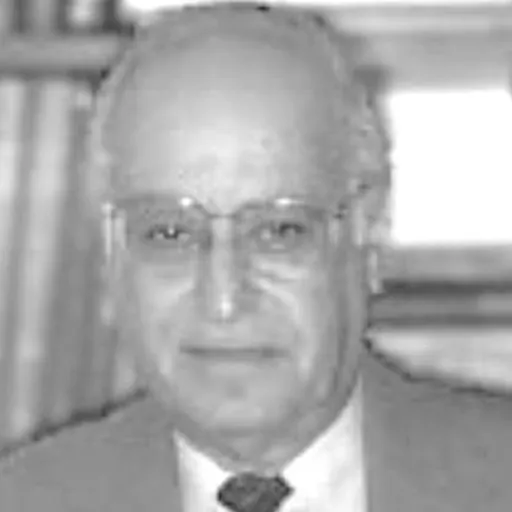
About Boris Rotman
Lived 1924 – 2021 (aged 96). Boris Rotman was an immunologist, known for Biology and Single molecule experiment.
Marcos Boris Rotman (December 4, 1924 – July 11, 2021) was a Chilean American immunologist–molecular biologist and professor emeritus of Medical Science at Alpert Medical School of Brown University. He is widely recognized for performing the first single molecule experiments in biology. He died in July 2021 at the age of 96.
Education Rotman attended elementary and high school at the Instituto Nacional of Chile. In 1942, he won a scholarship to attend the Universidad Técnica Federico Santa Maria, from where he graduated with a chemical engineering degree in 1948. In 1950, he entered the University of Illinois and in 1952 earned a PhD in biochemistry/microbiology. His mentors at University of Illinois were Salvador E. Luria (Nobel laureate 1969) and Sol Spiegelman (Albert Lasker Award for Basic Medical Research, 1974). After graduation, Rotman was a postdoctoral researcher in the group of Joshua Lederberg (Nobel laureate 1958) at University of Wisconsin-Madison, and later, in the laboratory of Bernard D. Davis at Harvard Medical School.
Research career In 1961, Rotman developed a system capable of measuring the enzymatic activity of individual molecules of beta-galactosidase and used it to conduct the first single-molecule experiment in biology.
These early experiments remained obscure for more than 30 years, but they are now recognized as pioneering and highly influential. (d) A point mutation in the lacZ gene alters beta-galactosidase activity producing uniform populations of beta-galactosidase molecules with individual partial activity. The latter, fluorogenic substrates are non-fluorescent compounds yielding fluorescent products upon enzymatic action. Fluorogenic substrates serve to increase the sensitivity of enzyme assays and many are commercially available.
In 1966, Rotman and Papermaster discovered fluorochromasia, a universal cellular phenomenon characterized by the immediate appearance of bright green fluorescence inside viable cells upon exposure to certain membrane permeable fluorogenic substrates such as fluorescein diacetate, fluorescein dibutyrate, and fluorescein dipropionate. The phenomenon is commonly used to measure cellular viability of many different species including animals, embryos, plants, and microorganisms.
In 1968, Rotman and Celada reported existence of a subset of antibodies with the unprecedented ability to restore the activity of mutated molecules of defective beta-galactosidase by conformational change. Subsequently, this exceptional ability of some antibodies has been subject of many studies.
Awards In 1990, Rotman received the State of Rhode Island Governor's Award for Scientific Excellence.
Selected publications
Don’t just read it —
keep it.
Full-length biographies made to live with: read them, listen on the way to work, watch them tonight.
- E-book
- Audio
- Video
Instant download · yours to keep · every purchase keeps this site free
Important facts
People in Boris Rotman's life
Named in this biography and alive at the same time




Related people
Same field, nearest in time





Contemporaries
People whose lives overlapped Boris Rotman's



Frequently asked questions
Who was Boris Rotman?
Chilean American immunologist–molecular biologist
When was Boris Rotman born?
Boris Rotman was born on 4 December 1924 in Buenos Aires.
When did Boris Rotman die?
Boris Rotman died on 11 July 2021.
What was Boris Rotman's occupation?
Boris Rotman was an immunologist.
What was Boris Rotman known for?
Boris Rotman was known for Biology and Single molecule experiment.
Sources & further reading
Cite this page
APA: Biography.guide. (2026). Boris Rotman. https://biography.guide/boris-rotman/
MLA: "Boris Rotman." Biography.guide, https://biography.guide/boris-rotman/.
Chicago: "Boris Rotman." Biography.guide. https://biography.guide/boris-rotman/.
Data last updated: 2026-09-21 · Spot an error? Report a correction.
Portrait: Wikimedia Commons · author & licence
Page generated 2026-09-27 05:00 UTC