
About Borden Chase
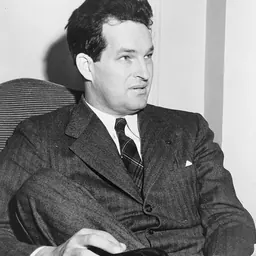
Lived 1900 – 1971 (aged 71). Borden Chase was an American screenwriter, writer and television writer.
Borden Chase (January 11, 1900 – March 8, 1971) was an American writer.
Early life He was born Frank Fowler in New York, the son of an English couple who emigrated to Brooklyn. His father abandoned his wife and child, and Chase was raised by a set of grandparents who lived in Bensonhurst. He briefly serived in the Navy during World War One. Chase later adapted it into the novel East River. (It was later filmed as "High Air" for Screen Directors Playhouse in 1956.) He also wrote regularly for magazines, later saying "I used to do a million words per year. My pulp market was Argosy and Detective Fiction, and I used to bat those things out, serials; and the slick market was American Magazine, The Saturday Evening Post and Liberty.”
Fox bought another story by Chase, Midnight Taxi (1937). Universal bought his novel Hells' Kitchen Has a Pantry and filmed it as The Devil's Party (1938). Fox bought another Chase story, Blue White and Perfect (1937) and turned it into a Michael Shayne film, Blue, White and Perfect (1942). His 1939 story Dr Broadway provided the basis for Anthony Mann's first film, Dr. Broadway (1942). Another 1939 story Pay to Learn was filmed as The Navy Comes Through (1942). Harrigan's Kid (1943) was based on his novel.
Screenwriter Chase worked on the screenplay for Destroyer (1943). For Republic Pictures he wrote the John Wayne film The Fighting Seabees (1944) based on his own story.
In 1944, Chase signed a contract with RKO to write a screenplay based on his unpublished story That Man Malone at $10,000 a week. He provided the story and screenplay for MGM's This Man's Navy (1945) starring Wallace Beery, then did another original for Wayne at Republic, Flame of the Barbary Coast (1945).
Republic also made I've Always Loved You (1946), from screenplay by Chase based on his story Concerto, which in turn was based on the career of his first wife. Chase wrote Tycoon (1947) for Wayne at RKO, based on a novel by C E Scoggins, then provided the story for a Columbia Western, The Man from Colorado (1949).
Red River Chase received great critical acclaim for Red River (1948), where he contributed to the screenplay, based on his novel Blazing Guns on the Chisholm Trail. Directed by Howard Hawks and starring Wayne and Montgomery Clift, the film was a huge success and earned Chase an Academy Award nomination as well as a $50,000 fee.
For most of the 1950s Chase worked on Westerns. He was one of many writers on the Errol Flynn saga Montana (1950). More notable was Winchester '73 (1950), directed by Mann and starring James Stewart. He also wrote The Great Jewel Robber (1950) for Warners. At Universal, Chase worked on the script for the remake of Iron Man (1951), a boxing film. He wrote another Western for Mann and Stewart, Bend of the River (1952), and did Lone Star (1952) for Clark Gable at MGM; MGM paid $60,000 for his story for the latter. That film was directed by Vincent Sherman who Chase said "was the only one [director] who destroyed a picture of mine completely."
Chase wrote The World in His Arms (1952), a sailing adventure, for Raoul Walsh at Universal. He did something in a similar vein, Sea Devils (1953), based on a Victor Hugo novel. Chase did a south seas adventure tale for Burt Lancaster, His Majesty O'Keefe (1954) which involved him going on location to Fiji.
He returned to Westerns with Rails Into Laramie (1954), with John Payne; The Far Country (1954) for Mann and Stewart; Vera Cruz (1954) for Lancaster and director Robert Aldrich; and Man Without a Star (1955) for King Vidor and Kirk Douglas. He did some uncredited writing on Mutiny on the Bounty (1962) and wrote Gunfighters of Casa Grande (1964). Chase's final movie credits include A Man Called Gannon (1968) (a remake of Man Without a Star) and Backtrack! (1969) (a theatrical release of his 1965 The Virginian episode "We've Lost a Train", which was the backdoor pilot for the 1965–67 series Laredo).
Television Chase began writing for TV with "The Windmill" for General Electric Theatre (1955). He wrote the screenplay for Backlash (1956), directed by John Sturges and Night Passage (1957) for Mann and Stewart. The latter also starred Audie Murphy who was in Ride a Crooked Trail (1958), written by Chase.
Chase wrote several episodes of Tales of Wells Fargo (1959), Overland Trail (1960), The Detectives (1961), The Tall Man (1961), Whispering Smith (1961), Bonanza (1962), Route 66 (1962) and The Roy Rogers and Dale Evans Show (1962). Chase continued working for TV shows such as Daniel Boone, The Virginian (1964), and Branded (1965).
In 1970 Chase said "I don't think that I've forgotten how to write, but nobody seems to be interested in my writing, which is quite all right. I can dish it out and I can take it too. I hope when I get to Spain, there'll be some work for me, and I think I'll enjoy it there."
Reception
According to Jeanine Basinger, the films that "typify the characters and conflicts associated with Chase's work" were Winchester 73, Bend of the River and The Far Country:First of all, two strong men are involved in an arduous journey across the western terrain, with units of society either contained within the journey itself (as a wagon train) or as various stops along the way (western towns, mining towns, etc.). The primary involvement of the movie is the conflict between two men, who tend to be deeply linked by some common bond... In some cases the conflict is internal, the hero against the evil inside himself. Although Chase created strong females in films... most Chase stories are male conflicts. Chase once said "That I believe is the greatest love story in all of the world. I don't mean sexual. I have always believed that a man can actually love and respect another man more so than he can a woman."... Straightforward dialogue, and absence of pretentious philosophizing, and clearly delineated action mark the story progressions, which culminate in unambiguous resolutions. Any ambiguities lie in the maturity of the characterizations, in which the two men are neither totally good nor totally bad. In this regard, Chase made a major contribution to what is thought of as the "adult" or "psychological" Westerns of the 1950s. Basinger elaborated:The Chase Western story is presented in a physical progression across a larger-than-life landscape, an epic journey west which allows forces of good and evil to interact... The issue of the Chase Western script is not whether man will settle the West and live in it. It is assumed he will, or that he already has. The question is more universal and appropriate to modern life: Will the uncivilized forces within man create a Wild West in perpetuity by winning out over his better instincts? That year he was reportedly writing a film for James Cagney, Far Island. Lee claimed he had an affair with his step-daughter Pat, and that detectives found them in a hotel room together, naked. Chase went on to marry Pat. Barrie Chase recalled after her mother "went public" about her father's affair with her step sister "he threatened both our lives." Chase suffered a stroke on December 12, 1970. He died on March 8, 1971.
The Borden Chase cocktail is named after him.
Chase supported Thomas Dewey in the 1944 United States presidential election.
Filmography Films
Television
Fiction East River, New York, 1935. Sandhog, New York, 1938. Lone Star, New York, 1942. Diamonds of Death, New York, 1947. Blazing Guns on the Chisholm Trail, New York, 1948, as Red River, New York, 1948. Viva Gringo!, New York, 1961.
Short stories Blue White and Perfect (1937) Dr Broadway (1939) The Called Him Mister (1940) Concerto
Non fiction Sandhog: The Way of the Life of the Tunnel Builders, Evanston, Illinois, 1941.
Don’t just read it —
keep it.
Full-length biographies made to live with: read them, listen on the way to work, watch them tonight.
- E-book
- Audio
- Video
Instant download · yours to keep · every purchase keeps this site free
Important facts
People in Borden Chase's life
Named in this biography and alive at the same time





Related people
Same field, nearest in time


Contemporaries
People whose lives overlapped Borden Chase's



Frequently asked questions
Who was Borden Chase?
American writer (1900–1971)
When was Borden Chase born?
Borden Chase was born on 11 January 1900 in New York City.
When did Borden Chase die?
Borden Chase died on 8 March 1971 in Los Angeles.
What was Borden Chase's occupation?
Borden Chase was a screenwriter, writer and television writer.
What nationality was Borden Chase?
Borden Chase was American.
Sources & further reading
Cite this page
APA: Biography.guide. (2026). Borden Chase. https://biography.guide/borden-chase/
MLA: "Borden Chase." Biography.guide, https://biography.guide/borden-chase/.
Chicago: "Borden Chase." Biography.guide. https://biography.guide/borden-chase/.
Data last updated: 2026-09-20 · Spot an error? Report a correction.
Page generated 2026-09-27 05:31 UTC