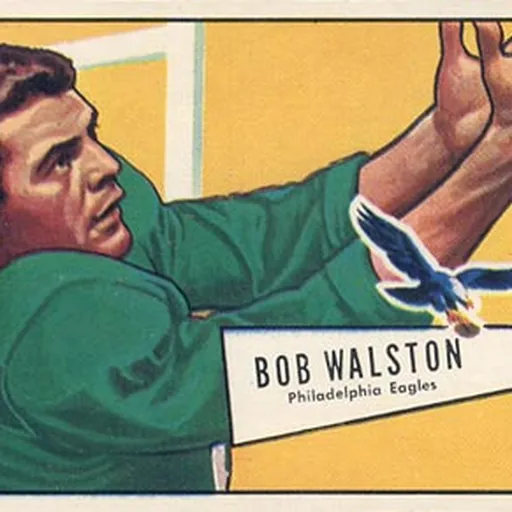
About Bobby Walston
Lived 1928 – 1987 (aged 58). Bobby Walston was an American american football player.
Robert Harold "Bobby" Walston (October 17, 1928 – October 7, 1987) was an American professional football player who was a wide receiver and placekicker for the Philadelphia Eagles of the National Football League (NFL). Walston was selected by the Pro Football Hall of Fame as a member of the NFL 1950s All-Decade Team. He played college football for the Georgia Bulldogs in the Southeastern Conference (SEC), and was selected in the 14th round of the 1951 NFL draft. He was the Rookie of the Year in 1951, led the NFL in scoring in 1954, and led the NFL in field goal percentage in 1957 and 1960. He was a member of the 1960 Eagles NFL championship team.
At the time Walston retired in 1962, only Lou Groza had more points in NFL history. He holds the Eagles' record for most points in a game. In 2019, he became a member of the Eagles Hall of Fame. Hall of Fame writer Ray Didinger once called Walston the most underrated player in Eagles' history. At Georgia, he was twice named second-team All-SEC. He never missed a game in college, or with the Eagles (including over 200 total preseason, regular season, and playoff games in the NFL).
After his playing career ended, Walston became the Eagles' player personnel director for two years, and served as head scout. In mid-1966, he was hired by the expansion Miami Dolphins to coach receivers and kickers, serving in that role for two seasons. In early 1968, Walston was hired as the Chicago Bears' player personnel director, and in mid-1971 also became assistant to Bears' president George Halas Jr., a role functionally equivalent to being general manager. Soon after Jim Finks became the team's general manager in 1974, Walston no longer held those positions; formally announcing his resignation in December 1974.
Early life Walston was born on October 17, 1928, in Columbus, Ohio. He attended Linden-McKinley High School in Columbus. He played on the school's football team, and was All-State at halfback. He had a 50-yard touchdown reception from Johnny Rauch in a late-October game against Clemson, and a 30- to 32-yard touchdown reception against Oklahoma A & M in mid-October.
In 1948, Walston caught 25 passes for 525 yards, scoring four touchdowns. He led the SEC in pass receptions, and was 13th nationally in most receptions. He had a 19-yard touchdown reception in a 35–0 win over Alabama in late October; a 28-yard touchdown pass against Furman in a 33–0 win; and a 44-yard touchdown pass for the first touchdown of the game in a 42–14 win over Auburn. Georgia was the SEC champion in 1948, and had a 9–2 record. The Associated Press (AP) ranked Georgia No. 8 that year. Georgia lost to Texas in the January 1, 1949 Orange Bowl, 41–28. Walston had multiple receptions in the game, including one for a touchdown. He made the All-SEC sophomore team.
As a junior in 1949, Walston had 17 receptions for 382 yards. He missed the season's last two games with a broken foot, but still had the fifth most receptions in the SEC. After three years, he had 45 receptions for 1,015 yards (averaging 22.3 yards per reception); and had scored 10 touchdowns and kicked 14 extra points over that time.
In 1950, he had 12 receptions for 168 yards and one touchdown; second on the team to Zippy Morocco. The International News Service (INS) named Walston second-team All-SEC in 1950. Over his four year career at Georgia, Walston had 57 receptions for 1,183 yards, and 11 touchdowns. He never missed a game during his Bulldogs' career.
Walston was also a college light-heavyweight boxing champion, and a golden gloves finalist.
Professional career The Philadelphia Eagles selected Walston in the 14th round of the 1951 NFL draft, 166th overall. Walston doubled as receiver and kicker for the Philadelphia Eagles for twelve seasons. He was tied for third in the NFL for most receiving touchdowns, and tied for seventh in yards per reception (16.5). Walston also served as the team's kicker, making six of 11 field goal attempts, and 28 or 31 extra point attempts. Walston was named Rookie of the Year in 1951.
In 1952, he started nine games, with 26 receptions for 469 yards and three touchdowns. He kicked eleven field goals and was a perfect 31-for-31 on extra point attempts; totaling 82 points on the season, sixth most in the NFL. In a late November game against the Cleveland Browns, he caught four passes for 121 yards with one touchdown; including a 65-yard reception on a pass from halfback Fred Enke. He also had four extra point conversions in that game.
Before the 1953 season Walston was in a contract dispute with the Eagles and received an offer from a Canadian football team. Eagles' general manager Vince McNally met with Walston in Georgia to negotiate his return to the Eagles. During the negotiations, Walston called his wife in Philadelphia who was crying because her pet chihuahua had died. When he told McNally, McNally said he would include a chihuahua puppy in the deal, which led to Walston's teammates nicknaming him "Chihuahua", which nickname became "Cheewa" over time. He was fourth in the NFL in scoring (87 points). The Eagles finished the season 7–4–1, second in the NFL East Division. His best game was on November 8 against the New York Giants when he had eight receptions for 176 yards and two touchdowns, plus a field goal and three extra points. This included a 62-yard touchdown reception from Bobby Thomason who passed for 437 yards in that game.
The next season (1954), Walston had 581 yards on 31 receptions, but he scored 11 touchdowns as the Eagles once again went 7-4-1. He made four field goals and 36 extra points, scoring a total of 114 points during that 12-game season, the most in the NFL that year. On October 3, he had three touchdown catches on five receptions, 110 receiving yards and five extra point conversions (23 points in total) against the Chicago Cardinals. Two weeks later he had another game with three receiving touchdowns against the Washington Redskins, and kicked seven extra points.
His 25 points scored against Washington was a single game Eagle record (through at least 2019). His 114 points in now 20th all-time for an Eagles' season, but all of the 19 players ahead of him played in 16 or 17 game seasons (as of 2025). During the 1954 season he suffered a broken jaw. A doctor wired his mouth shut and prescribed three weeks of rest. The next day Walston took a pair of pliers and removed the wiring himself, and continued to play in every game for the remainder of the season, without missing a game. In 1956, Walston led the Eagles with 39 receptions (tied for sixth best in the NFL) for 590 yards and three touchdowns. He became the team's primary kicker again, and made six field goals and 17 extra points.
In 1957, although he started all 12 games, Walston had only 11 receptions for 266 yards. Walston suffered a broken ring finger that season, and took Novocaine injections that allowed him to play with the injury and not miss a game. The Eagles were 4–8 that second, one game out of last place in the East Division.
In 1958, Walston had 21 receptions for 298 yards and three touchdowns. He was six of 14 in field goal attempts, and made all 31 of his extra point conversions. His 67 points tied for seventh in the NFL. The following season Walston had only 16 receptions for 279 yards and three touchdowns; starting only five games as a receiver. He made 33 or 34 extra point attempts, but was only used once as a field goal kicker that season. The Eagles were 7–5 and finished second in the NFL East Division.
The Eagles had a resurgence in the 1960 season, finishing the regular season 10–2 for first place in the NFL East, ahead of the second place Cleveland Browns. Walston's last-second field goal against the favored Browns in the season's fifth game gave the Eagles an upset victory, and instilled the confidence in the team that they could beat any team and win a championship.
During the 1960 season, Walston went 14 out of 20 in field goal kicking (70 percent) and led the NFL in field goal percentage for the second time. He also made 39 out of 40 in extra point conversions that season. He was second in the NFL in points scored that season (105), behind only Paul Hornung. In his 10th NFL season, Walston was selected to play in the Pro Bowl for the first time.
The Eagles met the NFL West champion Green Bay Packers for the 1960 NFL championship. In his lone playoff appearance, Walston caught three passes for 38 yards while making a 15-yard field goal and two extra points as the Eagles won the 1960 NFL Championship Game, 17–13, their first title since 1949. Walston threw the key block on Ted Dean's game-winning touchdown run in the fourth quarter for the Eagles. The Eagles were 10–4, but came in second place in the NFL East to the New York Giants. Walston had 34 receptions for 569 yards and two touchdowns. He had 14 field goals in 25 attempts and was 43 for 46 on extra point conversions. His 97 points were second best in the NFL that season, again behind the Packers' Paul Hornung.
After starting the 1962 season at tight end, Walston was replaced before the second game by Dick Lucas. When Pete Retzlaff suffered a broken arm at the end of September, Walston replaced him at wide receiver. Howard Cassady replaced Walton at wide receiver on October 28. Walston returned as the starting tight end on November 18, 1962 against the New York Giants, and suffered a broken arm (with Cassady suffering a broken leg in the same game). After breaking his arm, Walston remained the team's placekicker for the remaining four games, wearing a sling. He was only four of 15 in field goal attempts that year, but made 36 or 38 extra point conversions. This was his worst career field goal percentage, other than 1959 when he missed his only attempt.
After the Eagles had earlier granted Walston's request to be made a free agent, Walston announced his retirement in early May 1963. During his 12-year Eagles' career Walston scored 881 points, Walston ranks third all-time on the Eagles in points scored, behind Akers and Jake Elliot (as of 2025).
Walston ranks second on the Eagles all-time in extra points made (365), behind only David Akers; and seventh all-time for the Eagles in made field goals (as of 2025). He ranks eighth all-time as an Eagles receiver in receptions (311) and yards receiving (5,363) (as of 2025). At the time he retired in 1962, he was 11th all-time in NFL history in receptions (311), receiving yards (5,363), and yards per reception (17.2).
Legacy and honors Walston was named by voters of the Pro Football Hall of Fame to the National Football League 1950s All-Decade Team. Walston is one of only four players named to that team not yet inducted in the Pro Football Hall of Fame. He was inducted into the Eagles Hall of Fame on September 22, 2019. In 2014, he was named to the Philadelphia Sports Hall of Fame. In September 2022, a group of present and former sportswriters for The Philadelphia Inquirer named Walston the 46th greatest Eagle in the team's history. In 2020, a writer for The Athletic named him the best Eagle ever to wear jersey No. 83, as did a writer for Sports Illustrated.
When Walston successfully fended off the challenge of faster receivers to remain a starter at Georgia in 1950, Georgia coach Wallace Butts said "'Bob has that important ability of getting open for a pass under any conditions . . . We have faster flankmen but none can fake his way clear for a pass as good as Walston'". Hall of Fame writer Ray Didinger once called Walston the most underrated player in Eagles' history.
In 12 years with the Eagles, Walston never missed a regular season game (148), playoff game (1), or preseason game (70), and played with a broken jaw, broken finger, and broken arm during that streak. said of Walston "'He'll play until he's 60'". In June 1966, he left the Eagles to become a pass receiving and kicking coach with the Miami Dolphins for their inaugural 1966 season, and stayed in that role with the Dolphins for the 1967 season. As player personnel director he was in charge of the annual NFL draft selection process for the Bears, and supervised college scouting for the Bears. It is reported that he functioned as the equivalent of a general manager while holding the position as Halas's assistant, negotiating player salaries and making trades. In October 1974, Finks reportedly moved Walston from the personnel director to solely evaluating college players. It is also reported that Walston announced his resignation as player personnel director and assistant to Halas in early December 1974, stating it was in the Bears' best interest and that "I realize some of my previous services will fall under Finks' direction and I feel duplication of them will crowd the program". Walston reportedly stayed on in the role of a scout with the Bears,
Canadian Football League and World Football League Walston later served as a scout for the Edmonton Eskimos in the Canadian Football League, from 1978 to 1980; and scouted for the United States Football League from 1983 to 1985. Over time he had other fitness centers in New Jersey.
Don’t just read it —
keep it.
Full-length biographies made to live with: read them, listen on the way to work, watch them tonight.
- E-book
- Audio
- Video
Instant download · yours to keep · every purchase keeps this site free
Important facts
People in Bobby Walston's life
Named in this biography and alive at the same time






Related people
Same field, nearest in time


Contemporaries
People whose lives overlapped Bobby Walston's



Frequently asked questions
Who was Bobby Walston?
American football player (1928-1987)
When was Bobby Walston born?
Bobby Walston was born on 17 October 1928 in Columbus.
When did Bobby Walston die?
Bobby Walston died on 7 October 1987 in Illinois.
What was Bobby Walston's occupation?
Bobby Walston was an american football player.
What nationality was Bobby Walston?
Bobby Walston was American.
Sources & further reading
Cite this page
APA: Biography.guide. (2026). Bobby Walston. https://biography.guide/bobby-walston/
MLA: "Bobby Walston." Biography.guide, https://biography.guide/bobby-walston/.
Chicago: "Bobby Walston." Biography.guide. https://biography.guide/bobby-walston/.
Data last updated: 2026-09-23 · Spot an error? Report a correction.
Portrait: Wikimedia Commons · author & licence
Page generated 2026-09-27 05:07 UTC