
About Bob Windle
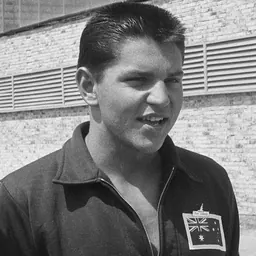
Born 1944. Bob Windle is an Australian swimmer.
Robert George Windle (born 7 November 1944) is an Australian freestyle swimmer of the 1960s, who won four Olympic medals, including an individual gold medal. Windle won the 1500 m freestyle and took bronze in the 4 × 100 m freestyle relay at the 1964 Summer Olympics in Tokyo, and silver and bronze in the 4 × 200 m and 4 × 100 m freestyle relays respectively at the 1968 Summer Olympics. Known for his versatility, he is the only male swimmer to represent Australia at the Olympics in all freestyle distances from 100 m to 1500 m. During his career, Windle set six world records and won six Commonwealth Games gold medals. He won 19 Australian championships in all distances from 220 yd to 1650 yd.
Growing up in eastern Sydney, Windle was trained by Frank Guthrie from the age of 12. Windle's first major swimming competition was the 1960 Australian Championships. Aged 15, his second-place finish in the 1650 yd freestyle earned him a place on the team for the 1960 Summer Olympics in Rome. However, the Australian coaches only took him along to gain experience and he did not compete. He won his first national title in 1961—the 1650 yd freestyle—and claimed the 220–440–1650 yd treble in 1962. Windle made his international debut at the 1962 British Empire and Commonwealth Games in Perth, winning gold in the 4 × 220 yd freestyle and silver and bronze in the 1650 and 440 yd freestyle respectively. In 1963, he won four individual national titles, adding the 880 yd event to the successful defence of his three titles. He won three individual titles in 1964 and proceeded to the Tokyo Olympics where he was eliminated in the heats of the 400 m freestyle after attempting to save energy for the final. In response, Windle took an aggressive approach in the 1500 m and set Olympic records in the heats and final to win gold. He added a bronze in the 4 × 100 m freestyle relay.
After the Olympics, Windle enrolled at Indiana University, where he trained under Doc Counsilman. While in the United States, Windle converted to sprint swimming. He competed in the 1966 British Empire and Commonwealth Games in Kingston, Jamaica, winning the 440 yd freestyle, 4 × 110 yd and 4 × 220 yd freestyle relays, all in world-record times. He competed in his second Olympics in Mexico City in 1968, racing the 100 m and 200 m freestyle and the corresponding relays, having completed his transition to sprinting. He won a bronze and silver in the respective relays and retired after the games. In retirement, he worked for Allis-Chalmers in the United States, before being transferred to their Australian division.
Early years Born in Sydney on 7 November 1944, Windle grew up in the eastern Sydney suburb of Waverley. Windle and his sister Norma learnt to swim at nearby Bronte Beach. His family later relocated to Bexley North, and he swam for his school team at Marist College Kogarah. Windle was coached by Frank Guthrie at the Enfield pool from the age of 12. After a fortnight of training, he entered the district age group championships and won a place in the top three. On his return to Australia, he switched to the tutelage of Don Talbot, who also coached Konrads.
Talbot nicknamed Windle "the greyhound" because of his thin and angular build. Talbot lamented to "never [being] astute enough to realise that he [Windle] didn't have the subtleties of pace that would have added to his armament as a swimmer".
First national title and international medals At the 1961 Australian Championships, Windle won the 1500 m in a time of 17 min 37.7 s to claim his first Australian title at the age of 16. Selected for the 1962 British Empire and Commonwealth Games in Perth, he marked his international debut with silver and bronze in the 1650 yd and 440 yd freestyle respectively. Murray Rose, who had returned from competition in the United States college system, won both events. Rose won the 1650 yd event, finishing in 17 min 18.1 s, with Windle 26.4 s in arrears. In the 440 yd event, Rose finished in a time of 4 min 20.0 s, 3.1 s ahead of the third-placed Windle.
Olympic gold Windle's performances qualified him for the 1964 Summer Olympics in Tokyo, where he was slated to swim four events: the 400 m and 1500 m freestyle and the 4 × 100 m and 4 × 200 m freestyle relays.
In the 400 m freestyle heats, Windle and Talbot made a misjudgement; in an attempt to conserve his energy for the final they decided that Windle should not go flat out, and Windle was four seconds slower than he was at the Australian Championships. However, he swam too slowly and missed the final completely. Although he won his heat by seven seconds in a time of 4 min 21.6 s, he was the ninth fastest overall, so he missed the final by one position with a time deficit of 0.5 s. The slowest qualifier was Tsuyoshi Yamanaka, who had been prevented from withdrawing from the race by his coaches.
In the 1500 m, Talbot decided that Windle would attack from the outset and attempt to hang on in the latter stages of the race. In the final, Windle repeated the strategy of sprinting from the start, leading throughout to lower his own Olympic record to 17 min 1.7 s and holding off American John Nelson by 1.3 s.
Windle later combined with Wood, Ryan and Dickson in the 4 × 200 m freestyle relay final. Having rested their two individual medalists—Wood and Windle—in the heats, Australia struggled to fourth place and were the slowest qualifier for the final. In the decider, Australia were fourth when Windle dived in for the anchor leg, 3.7 s behind the third-placed Japan. Windle posted a time of 1 min 58.7 s, the sixth fastest split in the race and the fastest Australian leg by 3.0 s. Although he made up 1.8 s on the Japanese anchor swimmer, it was not enough and Australia finished fourth, 1.9 s out of the medals.
US college career After the Olympics, Windle enrolled at Indiana University—whose Indiana Hoosiers swimming team was coached by Doc Counsilman—on an athletic scholarship. He did so after getting advice from Australian teammate, Olympic gold medallist and Indiana student Kevin Berry. He studied business while competing for the university, where he switched his focus to shorter sprint distances. Windle did not enjoy as much success at short-course swimming in the United States as he did in long-course swimming. He cited the lack of enjoyment for switching to shorter distances, In the 200 m freestyle, Windle came second in his heat behind Wenden and scraped into the final by 0.3 s as the seventh fastest qualifier. He improved his time by 0.1 s in the final to finish sixth in 2 min 0.9 s. Wenden won both events.
In the 4 × 100 m freestyle, Windle combined with Wenden, Robert Cusack and Greg Rogers to win bronze behind the United States and the Soviet Union. Australia used the same team and swimming order in both the heats and finals, with Windle doing the third leg. Australia came second in their heat behind the United States and qualified third overall, and the Soviet Union were the second fastest. It was a similar story in the final; Australia were third at every change. Despite Wenden anchoring the Australians with the fastest split among all 32 swimmers in the race, the Australians missed the silver medal by just 0.5 s. In the 4 × 200 m freestyle relay, Windle won a silver along with Wenden, Rogers and Graham White. The quartet won their heat and qualified fastest, while the Americans qualified second with their second-choice team. However, using their full-strength team in the final, the Americans won by 1.4 s. Australia were 2.5 s behind at the halfway point of the race, but the Americans were able to hold on, despite the gains made by Windle and Wenden in the last two legs.
Windle retired after the Games, noting that "I have swum to that point when I could hardly lift myself out of the water. I have seen John Konrads to that point also. I would always give 110%. There is no substitute for hard and honest work". Windle was inducted into the Sport Australia Hall of Fame in 1987 and the International Swimming Hall of Fame in 1990.
Don’t just read it —
keep it.
Full-length biographies made to live with: read them, listen on the way to work, watch them tonight.
- E-book
- Audio
- Video
Instant download · yours to keep · every purchase keeps this site free
Important facts
People in Bob Windle's life
Named in this biography and alive at the same time







Related people
Same field, nearest in time



Contemporaries
People whose lives overlapped Bob Windle's



Frequently asked questions
Who is Bob Windle?
Australian swimmer, Olympic gold medallist, former world record-holder
When was Bob Windle born?
Bob Windle was born on 7 November 1944 in Sydney.
What is Bob Windle's occupation?
Bob Windle is a swimmer.
What nationality is Bob Windle?
Bob Windle is Australian.
Sources & further reading
Cite this page
APA: Biography.guide. (2026). Bob Windle. https://biography.guide/bob-windle/
MLA: "Bob Windle." Biography.guide, https://biography.guide/bob-windle/.
Chicago: "Bob Windle." Biography.guide. https://biography.guide/bob-windle/.
Data last updated: 2026-09-20 · Spot an error? Report a correction.
Page generated 2026-09-27 05:15 UTC