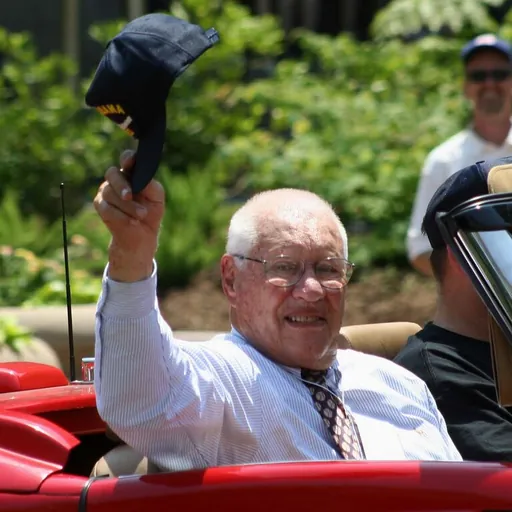
About Bob Feller
Lived 1918 – 2010 (aged 92). Bob Feller was an American baseball player.
Robert William Andrew Feller (November 3, 1918 – December 15, 2010), nicknamed "the Heater from Van Meter", "Bullet Bob", and "Rapid Robert", was an American professional baseball player who was a pitcher for 18 seasons in Major League Baseball (MLB) for the Cleveland Indians between 1936 and 1956. In a career spanning 570 games, Feller pitched 3,827 innings and posted a win–loss record of 266–162, with 279 complete games, 44 shutouts, and a 3.25 earned run average (ERA). His career 2,581 strikeouts were third all-time upon his retirement.
A prodigy who bypassed baseball's minor leagues, Feller made his debut with the Indians at the age of 17. His career was interrupted by four years of military service (1942–1945) as a United States Navy Chief Petty Officer aboard during World War II. Feller became the first pitcher to win 24 games in a season before the age of 21. He threw no-hitters in 1940, 1946, and 1951, and 12 one-hitters, both records at his retirement. He helped the Indians win a World Series title in 1948 and an American League-record 111 wins and the pennant in 1954. Feller led the American League in wins six times and in strikeouts seven times. In 1946 he recorded 348 strikeouts, the most since 1904 and then believed to be a record.
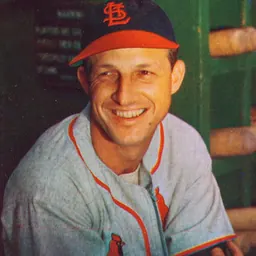
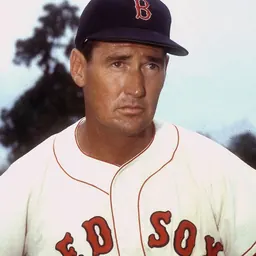
An eight-time All-Star, Feller was ranked 36th on Sporting Newss 1999 list of the 100 Greatest Baseball Players and was named the publication's "greatest pitcher of his time". He was a finalist for the Major League Baseball All-Century Team in 1999. Baseball Hall of Fame member Ted Williams called Feller "the fastest and best pitcher I ever saw during my career." Hall of Famer Stan Musial believed he was "probably the greatest pitcher of our era." From the age of 15, he began to pitch for the Oakviews after a starting pitcher was injured; while doing so, Feller continued to play American Legion baseball. His catcher during this period was Nile Kinnick, who later won the Heisman Trophy in 1939 and became a member of the College Football Hall of Fame. He also was the starting center for the high school basketball team. Feller was assigned to the Fargo-Moorhead Twins and was to report there after finishing the high school semester. Feller elected to remain with the Indians but Henrich joined the New York Yankees. Sports columnist Joe Williams wrote, "For $7500 the Cleveland Indians received $500,000 [] worth of publicity. ... I feel pretty sure Mr. Alva Bradley, president of the Indians, will admit this is the cheapest investment he ever made in publicity."
Feller joined the Indians and made his Major League debut on July 19, 1936, in a relief appearance against the Washington Senators. A month later on August 23, Feller made his first career start against the St. Louis Browns. Indians manager Steve O'Neill had Denny Galehouse warmed up in the bullpen in case the 17-year-old Feller had early troubles, but he struck out all three batters he faced in the first inning, and recorded 15 strikeouts in earning his first career win. His strikeout total was the highest for a (starting) pitching debut. Three weeks later, he struck out 17 batters, tying a single-game strikeout record previously set by Dizzy Dean, in a win over the Philadelphia Athletics. He finished the season with a 5–3 record, having appeared in 14 games; he had 47 walks and 76 strikeouts in 62 innings. Feller's entrance to the big leagues was later described:
It is difficult to imagine now what a marvel Feller was when he burst upon the scene in 1936, a callow youth of 17. Many athletes are great. Bob Feller was seminal. In the long-ago time, unlike nowadays, it was unheard of for teenagers to succeed in the big top of athletics. Children politely waited their turn in the sunshine. Perhaps in all the world only Sonja Henie had previously excelled at so young an age in any sport that mattered, and, after all, she was but a little girl wearing tights and fur trim, performing dainty figure eights. Feller dressed in the uniform of the major league Cleveland Indians, striking out – fanning! – American demigods ... in the only professional team sport that mattered then in the United States. — Frank Deford, Sports Illustrated, August 2005 In his first appearance of the season on April 24, Feller suffered an injury to his elbow while throwing a curveball. He spent April and May healing the arm, and in May graduated from high school; the ceremony aired nationally on NBC Radio. In mid-May, the Indians considered ending Feller's season early. "We're not taking any chances on that arm and we're not going to allow him to pitch again until the last trace of soreness has disappeared", said Slapnicka. On May 18, Feller appeared in his first game since April 24 but did not record an out. He did not pitch again until June 22, when he recorded two innings, then returned to normal pitching duties on July 4.
On October 2, 1938, Feller was the starting pitcher of a season-ending double-header against the Detroit Tigers. Detroit's Hank Greenberg was two home runs short of Babe Ruth's then-single-season record of 60 home runs. By the ninth inning, Feller had recorded 16 strikeouts, one fewer than the MLB record in a nine-inning game. He tied the record when he struck out Detroit's Pete Fox and, when he struck out Chet Laabs for the fifth time that day, broke the record, to set the modern major league record of 18. Greenberg went 1–4 with a double, then 3–3 in the nightcap, all singles. He later said of the game, "Feller's curve was jumping wickedly and with that and his fast ball, he was murder." Feller did not earn a win, however, as the Indians lost, 4–1. "It was one of those days when everything feels perfect, your arm, your coordination, your concentration, everything. There was drama in the air because of Greenberg's attempt to break Ruth's record, and the excitement grew even greater when my strikeouts started to add up", Feller said. For the 1938 season, Feller led all pitchers with 208 walks and 240 strikeouts. Feller finished the 1939 season leading the AL in wins (24), complete games (24) and innings pitched , and led the majors for a second consecutive year in both walks (142) and strikeouts (246).
Opening Day of the 1940 season featured a no-hitter from Feller against the Chicago White Sox. Feller was assisted by Indians second baseman Ray Mack when he made a diving play to record the final out. This is the only no-hitter to be thrown on Opening Day in major league history. However, he followed his no-hitter with a six-run, three-inning performance in his next start, in a game against the Detroit Tigers. By the end of the season, he had a 27–11 record, with his win total the best in the majors that season, and a career-high for Feller. Feller also led the majors with 31 complete games and innings pitched, and won the Sporting News Player of the Year Award.
To publicize Feller's extraordinary pitching speed, the Office of the Commissioner of Baseball commissioned sports film analysis pioneer and former major leaguer Lew Fonseca to pit Feller's fastball against a motorcycle in a "100 mph" speed trial. The test was conducted in Chicago's Lincoln Park, with Feller in street shoes, suit pants, dress shirt, and tie, pitching without a mound on an asphalt roadway. He was required to hit a target in diameter from away, "as control is as important as speed". The still-accelerating Harley-Davidson passed Feller going , yet even with a generous head start the ball beat the bike to the target by several feet. Feller's throw was calculated at the time to have reached 98.6 mph (158.7 km/h), later raised to 104 mph (167 km/h) using updated measuring methods.
Military service (1941–1945) The United States entered World War II with the attack on Pearl Harbor on December 7, 1941. Feller heard about the bombing while returning from a visit to his terminally ill father at Des Moines to Chicago where he was to sign a new Indians contract. Originally he tried to enlist as a fighter pilot but failed hearing tests. Feller attended basic training at Norfolk Naval Base and served as a physical fitness instructor there. He also pitched in baseball games hosted by the military. Although he had received a military exemption owing to his father's failing health, he wanted to serve in combat missions. Feller said, "I told them I wanted to ... get into combat; wanted to do something besides standing around handing out balls and bats and making ball fields out of coral reefs." Feller was assigned to ; he had hoped to serve on , but it would not be commissioned for another six months after Alabama, joining the fleet February 22, 1943. Feller and the Alabama crew spent most of 1943 in the British Isles along with , but in August were reassigned to the Pacific Theater of Operations. and later for the Naval Station Great Lakes team.
In 1945, from early spring to late summer, Feller's naval duties were again at Great Lakes Naval station, where he replaced Mickey Cochrane as manager of the baseball program, as well as performed as an active pitcher for the team.
Return to Cleveland (1945–1948) Upon arrival in Cleveland after his discharge, Feller was honored with a civic luncheon on August 24, 1945, at the Carter Hotel. Feller said to the thousand-plus crowd: "The real heroes didn't come home."
Before the 1946 season, Feller signed a $37,500 contract for that year, including a bonus for attendance, as the Indians felt many were attending baseball games primarily to see him; he was offered $100,000 by Jorge Pasquel to play in the Mexican League, but declined to leave the States again. Feller said of the game, "The no-hitter on opening day in Chicago is the one that gets all the attention. But my no-hitter at Yankee Stadium was against a much better team than the White Sox. There was no comparison. I had to pitch to Tommy Henrich, Charlie Keller and Joe DiMaggio in the ninth inning to get the Yankees out." At one point during the season (as he thought he might be nearing Rube Waddell's AL record for strikeouts of 344), Feller claims he confirmed Waddell's total with the AL office. In his last appearance of the season he fanned five Detroit Tigers on September 29 to set what was then believed to be the then-AL single-season strikeout record of 348. Later research into box scores for Waddell's 1904 pitching appearances credited him with five additional strikeouts, moving the mark to 349 and bumping Feller from the top spot. Waddell's tally proved the highest for 62 years, until passed by Sandy Koufax's then-record 382 in 1965.
During the 1946 season Feller registered career-highs in strikeouts (348), games started (42), games pitched (48), shutouts (10), complete games (36), and innings pitched –– all major league bests that season. Feller finished 26–15 with an ERA of 2.18, the latter a career best. Nearly 20 years later, Feller recalled, "For the 1946 season, though, the Indians were so thin in pitching that [player-manager] Boudreau decided I was to pitch every fourth day, regardless of rainouts, open dates, or anything else." In a June 13 game against the Philadelphia Athletics, having already amassed 10 strikeouts through four innings, Feller fell from the mound, which rain had made slippery, and injured his back. "My fastball was never the same after that", Feller said. Later, photographs showed that Boudreau had tagged Masi out by two feet. Feller said, "Stewart was the only guy in the park who thought he was safe."
Later years (1949–1956)
After taking a pay cut to start the 1949 season, Feller pitched on Opening Day against the St. Louis Browns. During the game, he injured his shoulder and missed the rest of April. His performances were mixed during the rest of the season, and he finished the year with a 15–14 record and a 3.75 ERA. In a win over the Detroit Tigers in the second game of a doubleheader, Feller became the 53rd pitcher to win 200 games. Feller was the third pitcher, after Larry Corcoran and Cy Young, to record three career no-hitters. Along with Early Wynn and Mike Garcia, Feller reached the 20-win mark during the season; they were the first trio of pitchers on the same staff to earn 20 wins since 1931.
Feller went 22–8 in 1951, leading the AL both in wins and with a .733 win percentage. He was named the Sporting News Pitcher of the Year.
Feller started the 1952 season with three wins in his first five starts; one of the losses was an April 23 one-hitter against Bob Cain, who also allowed only one hit. Feller struggled for the rest of the season, and after an argument with an umpire over a strike call in late August, manager Al López shut Feller down for the season, In 1955, Feller spent part of the season as a starter, then was moved to the bullpen later in the season. He went 4–4 in 25 appearances. In December 1956, Feller told The Plain Dealer: "I will return to Cleveland later this week and plan to confer with Hank Greenberg before Christmas. I hope to reach a decision at that time." Greenberg had also offered Feller his release or a job with the Indians in their front office. Greenberg said, "We sincerely want Feller to remain with us. As far as I'm concerned, there will always be a job waiting for Bob in the Cleveland organization." Announcing his retirement, Feller said, "I could have gone with a couple other ball clubs, but anything I might have done with them would have taken the edge off the success I have had with the Cleveland club the last 20 years." He continued, "What if I did pitch another year, so what? I would have to come to the decision I am making now, some time."
He spent his entire career of 18 seasons with the Indians, being one of "The Big Four" in the Indians' pitching rotation in the 1950s, along with Bob Lemon, Early Wynn and Mike Garcia. Feller shares the Major League record of 12 one-hitters with Nolan Ryan, and was the first pitcher to win 20 or more games before the age of 21. and held the major league record for most walks in a career (1,764), and holds the 20th-century record for most walks in a season (208 in 1938). The Indians retired his jersey number, 19, on December 27, 1956.
As a hitter, Feller posted a .151 batting average (193-for-1282) with 99 runs, 28 doubles, 13 triples, 8 home runs, 99 RBI and 100 bases on balls. Defensively, he recorded a .963 fielding percentage.
Dispute with Commissioner Chandler Throughout his career, Feller played exhibition games during the off-season, playing in towns unaccustomed to seeing major league ballplayers. His exhibition tours often featured other big leaguers and Negro league players, like Satchel Paige, who was also a teammate of Feller's with the Indians. Other players included Stan Musial, Mickey Vernon, and Jeff Heath. During a barnstorming tour in 1945, Feller pitched against Jackie Robinson after he had been signed by the Brooklyn Dodgers. He told a reporter in Los Angeles that he believed Robinson was too muscle-bound to succeed against pitching in the major leagues, although Robinson recorded two hits off Feller. Players had to notify the Commissioner of Baseball, A.B. "Happy" Chandler, before participating in exhibition games and were not allowed to begin games before the conclusion of the major-league season. Feller wrote to Chandler, challenging the league's limit on the number of games that were allowed to be played and proposing an increase; the Commissioner agreed to Feller's proposal. To minimize travel time, Feller employed airplanes, such as two Douglas DC-3s in 1947, to transport players from town to town. Feller's involvement, as well as that of other major league players, was the subject of meetings between the Commissioner and AL and NL presidents.
In 1947, Feller announced that he would pitch in the Cuban winter league during the off-season, but Commissioner Chandler ruled no major-leaguer could play in Cuba. Feller said he would donate his profits from playing in the Cuban winter league to the American Major League players' pension fund: "I want to prove I'm not going to Cuba for any selfish interest but because there is a principle involved and that is the right of any ball player to work at his chosen profession". Feller also believed it was "grossly unfair" that major leaguers who were U.S. citizens could not play in winter leagues but Latin Americans were permitted. Indians owner and president Bill Veeck said, "I have no comment on Bob's outside activities. I don't know whether they've hurt him or not. But I do know this. The great majority of the people of Cleveland think they've hurt him." when he served in the Navy; he missed more than three major league seasons.
Records
Feller, who averaged over 25 wins for the three seasons preceding his military service and won 26 his first year out, estimated that the nearly four years he missed while in the U.S. Navy cost him at least 100 career wins. Given his proven performance on both sides of his hitch it is likely that Feller would have finished his career with more than 350 wins and perhaps 3,800 strikeouts. The always plain-speaking Feller said, "I know in my heart I would have ended up a lot closer to 400 than 300 if I hadn't spent four seasons in the Navy. But don't take that as a complaint. I'm happy I got home in one piece." With primitive equipment, Feller was at one point measured at . He also is credited with throwing the second fastest pitch ever officially recorded, at , in a game in 1946 at Griffith Stadium.
Although subjective, an extremely telling assessment of just how hard Feller was to hit – even for a left-handed hitter, who had an advantage compared to right-handers – was the tribute from Ted Williams, regarded by many as the greatest hitter in baseball history. He confessed, Three days before he pitched I would start thinking about Robert Feller, Bob Feller. I'd sit in my room thinking about him all the time. God I loved it ... Allie Reynolds of the Yankees was tough, and I might think about him for 24 hours before a game, but Robert Feller: I'd think about him for three days. Each year, American Legion Baseball presents the "Bob Feller Pitching Award" to the pitcher "with the most strikeouts in regional and national competition."
Later life
Feller was elected the inaugural president of the Major League Baseball Players' Association in 1956. As president, he appeared before Congress to speak about baseball's reserve clause. Feller was the first player to get a franchise to agree to a share of game receipts when he was the starting pitcher for Indians' games. He was also the earliest player to incorporate himself (as Ro-Fel, Inc.). He was also one of the first players to work for the right of a player to enter free agency. In retirement, Feller lived with his second wife, Anne (née Thorpe), in Gates Mills, a suburb of Cleveland. and was such a frequent guest at such events that one ESPN writer speculated that he had signed more autographs than any other person.
In 1990, Feller received the Golden Plate Award of the American Academy of Achievement. In June 2009, at the age of 90, Feller was one of the starting pitchers at the inaugural Baseball Hall of Fame Classic, which replaced the Hall of Fame Game at Cooperstown, New York. Feller was treated for leukemia in August 2010. By October, Feller was fitted with a pacemaker and was diagnosed with pneumonia and thrush, an infection of the mucous membrane lining the mouth and throat. He was transferred on December 8 from the Cleveland Clinic to hospice care. On December 15, Feller died of complications from leukemia at 92. In 2010, the "Cleveland Indians Man of the Year Award" was renamed the "Bob Feller Man of the Year Award".
The Bob Feller Museum opened in Feller's birthplace, Van Meter, Iowa, on June 10, 1995. Designed by Feller's son Stephen, on land donated by Brenton Banks, the museum had two rooms that contained Feller memorabilia and items from his own collection. The Feller bat used by Babe Ruth when he made his last public appearance at Yankee Stadium is at the museum. Feller said a teammate had stolen the bat and eventually it was purchased by the Upper Deck sports card company for $107,000. Feller later offered the company $95,000 in return for the bat. Following Feller's death in 2010, the museum faced serious funding issues. In 2015, with family approval, the Bob Feller Museum was donated to the city of Van Meter for use as the city hall. Some artifacts remain on permanent exhibit and can be viewed free of charge.
In 2013, the Bob Feller Act of Valor Award was created to honor the life of Feller. The award recognizes "individuals that possess the values, integrity, and dedication to serving our country that Bob Feller himself displayed."
Don’t just read it —
keep it.
Full-length biographies made to live with: read them, listen on the way to work, watch them tonight.
- E-book
- Audio
- Video
Instant download · yours to keep · every purchase keeps this site free
Important facts
People in Bob Feller's life
Named in this biography and alive at the same time


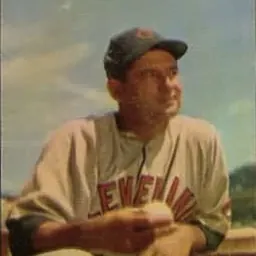
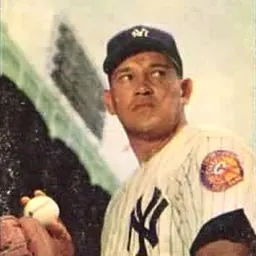
Related people
Same field, nearest in time
Contemporaries
People whose lives overlapped Bob Feller's


Frequently asked questions
Who was Bob Feller?
Major League Baseball player (1918–2010)
When was Bob Feller born?
Bob Feller was born on 3 November 1918 in Van Meter.
When did Bob Feller die?
Bob Feller died on 15 December 2010 in Cleveland.
What was Bob Feller's occupation?
Bob Feller was a baseball player.
What nationality was Bob Feller?
Bob Feller was American.
Sources & further reading
Cite this page
APA: Biography.guide. (2026). Bob Feller. https://biography.guide/bob-feller/
MLA: "Bob Feller." Biography.guide, https://biography.guide/bob-feller/.
Chicago: "Bob Feller." Biography.guide. https://biography.guide/bob-feller/.
Data last updated: 2026-09-23 · Spot an error? Report a correction.
Portrait: Wikimedia Commons · author & licence
Page generated 2026-09-27 05:05 UTC