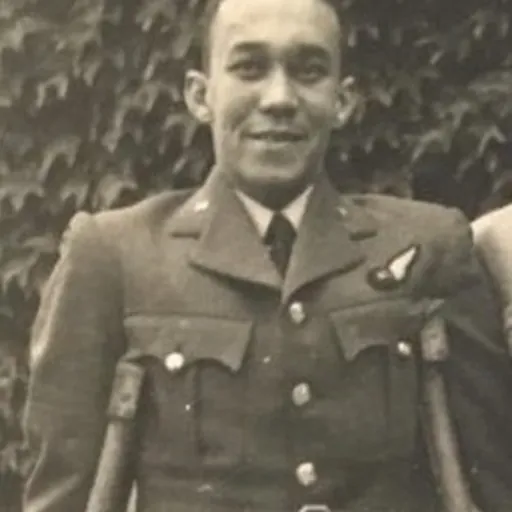
Billy Strachan
Jamaican air force officer, legal administrator and political activist
About Billy Strachan
Lived 1921 – 1998 (aged 77). Billy Strachan was a publisher.
William Arthur Watkin Strachan (16 April 1921 – 26 April 1998) was a British communist, civil rights activist, and pilot. He is most noted for his achievements as a bomber pilot with the Royal Air Force (RAF) during the Second World War, and for his reputation as a highly influential figure within Britain's black communities.
As a teenager in Jamaica at the outbreak of the Second World War, Strachan sold all his possessions and travelled alone to Britain to join the RAF. He survived 33 bombing operations against Nazi Germany during a time when the average life expectancy for an RAF crew was seven operations. He survived numerous life-threatening situations including being shot by the Nazis, a training crash, the Nazi bombing of the hotel he was staying at during his honeymoon, and a near mid-air collision with Lincoln Cathedral. Rising to the rank of flight lieutenant, an extremely rare achievement for a Black person in Britain during the 1940s, he was charged with investigating incidents of racism on RAF bases throughout Britain, boosting the morale of many Caribbean men in the British military.
Postwar, Strachan became a communist and a human rights activist, campaigning for universal suffrage and worker's rights, and promoting anti-colonial and anti-imperialist politics. He was a leading member of the Communist Party of Great Britain (CPGB), an admirer of both the Cuban Revolution and the Viet Minh, and a committed communist activist for the rest of his life. His communist beliefs saw him become the victim of political persecution, once kidnapped by the United States for his communist politics, and being banned from legally travelling to multiple countries, including British Guiana, St Vincent, Grenada, Trinidad, and even his home country of Jamaica.
Between 1952 and 1956, Strachan published the newspaper Caribbean News, one of the first monthly Black newspapers in Britain. He was a mentor to many leading black civil rights activists in Britain, including Trevor Carter, Dorothy Kuya, Cleston Taylor, and Winston Pinder, and was a close personal friend of the president of Guyana, Cheddi Jagan. In later life, Strachan was called to the bar, becoming an expert on British laws regarding drink driving and adoption. He also helped found a charity that taught disabled people how to ride horses. He is recognised by numerous historians, activists, and academics as one of the most influential and respected black civil rights figures in British-Caribbean history, and a pioneer of black civil rights in Britain.
Early life (1921–1938) Billy Strachan was born in Jamaica on 16 April 1921 to a family of former slaves and was raised within a predominantly white and wealthy area of Kingston. Strachan recalled in interviews during his later life that his family had all been admirers of the British monarchy and the British Empire, all standing up in salute whenever the national anthem "God Save the King" was played. As a young boy, Strachan once stole his father's car, before his father then reported him to the police. During his school days, Strachan played the saxophone in a band with his friends. This incident had a profound effect on Billy's worldview, leading to a lifelong hatred of racism. During this meeting, Strachan witnessed the founding of the People's National Party.
Military career (1939–1946) Travelling to Britain In 1939, after leaving school, Strachan gained employment as a civil service clerk in Jamaica. Struggling to afford the trip to England, he became the only passenger on a merchant ship which had previously arrived in Jamaica full of wealthy passengers escaping the war in Europe for the safety of the Caribbean. spending his time smashing tin cans to provide metal for Britain's war effort against Germany. He was the only passenger on the entire ship during the approximately month-long trip, being given a first-class cabin and the honour of dining with the ship's captain.
After this exchange with the guard, a sergeant passed by and told Strachan that Adastral House was not the correct place to enlist in the RAF. When the sergeant asked where he came from, Strachan told him he was from Kingston in Jamaica. alt=A photograph of a museum display containing items once belonging to Billy Strachan. On this display there are flight goggles, a flight helmet, and a photograph of Billy Strachan
Eventually, a young officer came to Strachan's aid, telling Strachan that he was educated and knew that Jamaica was in West Africa. Strachan decided it was best not to correct the young officer on Jamaica's actual location. Later in life, he described the young officer as a "Hooray Henry type", a pejorative British term for an arrogant upper-class man. He undertook 15 operations as a pilot with No. 576 Squadron, flying Avro Lancasters from RAF Fiskerton in Lincolnshire. thumb alt= Colour photograph of a black and white biplane flying above a rural area. Tiger Moth aircraft, similar to the one Strachan crashed during a training accident.
Training flight crash Recalling his youth, Strachan described himself during the war as being at his peak of both physical and mental health, and very self-assured and cocky. suffered a broken nose, broken cheekbones, a fractured right hip, and was in a semi-coma for three weeks. He was promoted to war-substantive flying officer on 1 October.
Near collision with Lincoln Cathedral Having survived more than 30 missions, Strachan's nerves were finally shattered by a near collision with Lincoln Cathedral during a flight in which he was the pilot. This incident occurred while he was piloting an aeroplane carrying a bomb weighing 12,000 lb (6,000 kg) intended to be dropped on German ships. He recalled the events of this incident, the stress of which ended his ability to continue his career as a pilot: Following this incident, Strachan was sent to a large country house in Coventry where he stayed for 48 hours. was sent to an RAF base in Bedfordshire to investigate racial tensions between black and white military personnel. At the request of Una Marson, whose ideas on race and politics exerted substantial influence on Strachan's worldview, he was made an RAF liaison officer charged with investigating incidents of racial discrimination within the RAF. During this time, he once sat as a member of courts-martial, and in incidents he worked as an advocate on behalf of black servicemen – experiences that his biographer, David Horsley, theorised inspired Strachan's future career in law. Another influential moment for him during his time in the RAF was when a fellow Caribbean RAF member gave him a copy of Capitalism and Slavery, written by Eric Williams. He completed 33 missions against Nazi Germany when statistically most bomber crew did not survive their (30 operation) tours. Strachan was demobilised on 30 October 1946 with the rank of flight lieutenant.
Political activism
Brief return to Jamaica (1946–1947) By 1946, Strachan had become the father of three sons: Christopher, Jeremy, and Mark.
Communist and black activism in Britain (1947–1998) Returning to Britain in 1947, Strachan joined the Communist Party of Great Britain (CPGB) and quickly became an active member, holding weekly street meetings and selling the Daily Worker. Strachan would from then on support the communist movement for the rest of his life and was an avid supporter of both the Soviet Union and the Chinese Communist Party. Carter in later life recalled the Strachan family fondly, saying that he felt "a true affection in the Strachan family." Cleston Taylor, another Caribbean communist who worked closely with Strachan, claimed that Strachan would visit local cinemas and would stand on the stage and denounce the movie to the audience if the film showed a racist scene. Among other black civil rights activists and communists Strachan knew, included Winston Pinder and Phil Sealey. In 1954, Strachan wrote the chapter "Terror in the West Indies" for the Report of the Second Conference of Workers Parties Within the Sphere of British Imperialism, from their conference held in London.
In 1954, a cartoon titled "Family Portrait?" appeared in the Daily Sketch, mocking Strachan for his anti-colonial and anti-imperialist beliefs, depicting him with devil horns representing the Caribbean Labour Congress, and posing with Hewlett Johnson, Paul Robeson, all posing with a portrait of Stalin.
Following the Cuban Revolution in 1959, Strachan helped to organise a fleet of buses to be sent to Cuba.
Caribbean Labour Congress (CLC) (1948–1956) In 1948, Strachan helped to found the London branch of the Caribbean Labour Congress (CLC), a socialist organisation dedicated to promoting worker's rights and universal suffrage in the Caribbean. The CLC sought to create an alliance of left-wing nationalists and communists across the British Empire, and was associated with the World Federation of Trade Unions. supporting Sudanese and Egyptian independence, anti-Apartheid activism, expressing solidarity with the victims of racist American courts such as the Martinsville Seven and Willie McGee, and supporting the Viet Minh in their war of national liberation against the French Empire.
Under Strachan's leadership, the London branch of the CLC held regular educational classes for its members, reading books such as Eric William's Negro in the Caribbean, Cheddi Jagan's Forbidden Freedom, Harold Moody's Negro Victory, Andrew Rothstein's A People Reborn, Learie Constantine's Colour Bar, and Richard Hart's Origin and development of the People of Jamaica.
Aside from political events, Strachan encouraged the CLC to host social events such as dances, which were advertised in the both Daily Worker and Caribbean News.
One issue that particularly bothered Strachan and the CLC was the British government's removal of the administration of Cheddi Jagan in British Guiana in 1953.
In 1956, the London branch of the Caribbean Labour Congress reformed into a new organisation called the Caribbean National Congress, without Strachan serving as secretary. most famous for helping to desegregate Birmingham's transport. Articles published in Caribbean News often stressed the importance of trade unions for all British workers. and in 1954 publicising an instance where white coal miners in Derbyshire refused to accept the colour bar (segregation) used against a Jamaican miner. In 1952, Strachan and Smith embarked on their speaking tour of the Caribbean, organised by the World Federation of Trade Unions, an organisation in which Smith was a leading member. The tour of Jamaica was a success; however, when Strachan and Smith attempted to return to Europe via the United States, they were kidnapped by the United States government and were imprisoned on Ellis Island, before being deported. He earned his Bachelor of Law degree from the University of London in 1967. He worked as Clerk of Court and held several important positions as the Chief Clerk at Clerkenwell Magistrates' Court, and he then held the same position at Hampstead Magistrates' Court, becoming the Clerk to the Betting and Gaming Committee. According to the Morning Star, Strachan strategically allowed the British princess Anne, daughter of British Queen Elizabeth, to serve as the charity's president, while he himself served as the charity's vice-president. the first chief minister of Guyana and the first person of Indian descent to become the leader of a country outside Asia, and Guyana's president and wife of Cheddi, Janet Jagan. Strachan was cared for by his wife during his final years, and died on 26 April 1998. Strachan's biographer, David Horsley, characterises him as a "civil rights pioneer", and a "remarkable and often overlooked figure in British Caribbean history". Strachan was also praised by many Caribbean leaders whom he had known during his life, among them Richard Hart, John La Rose, and Cheddi Jagan.
Strachan played a role in supporting the work of Dorothy Kuya, a Black British civil rights leader and communist activist; she was Liverpool's first community relations officer, and Strachan travelled to Liverpool to speak for Kuya when she was applying for the job of community relations officer in the city. In January 2020, the Marx Memorial Library in London held an event to piece together the facts of Strachan's life, with the event attended by historical researchers and members of the Strachan family.
Television, radio, and fiction As a public and influential figure within Britain's black communities, Strachan made several notable appearances in British media. In 1955, Strachan was interviewed by Pathé News for a report titled Our Jamaican Problem, where he acted as a spokesperson for black people in Britain.
According to the British newspaper the Daily Mail, British television presenter Lenny Henry was set to star in a biographical film based on Strachan's life, titled A Wing and a Prayer; however, the script was never turned into a movie.
Comments on his life Britain's Black History Month Magazine described Strachan as "a World War 2 R.A.F. hero, a Civil Rights pioneer and leader, a life long Communist, a prominent law officer, and a gifted writer." Strachan's son, Chris Strachan, cited his father as an inspiration in the fight against racism in 21st-century Britain: "Himself a victim of prejudice and discrimination, he fought hard for a world of tolerance and equality. With the rise of the far-Right today, the work of Billy Strachan remains today an example but also largely unfinished business." The Imperial War Museum also holds physical items used by Strachan during WWII, including a leather flying helmet, and flying goggles. One display in the museum's Second World War galleries created by History Professor Richard Overy featured objects relating to Strachan. The UK National Archives hold records relating to Trinidad barring Strachan from entering the country, and further archival material relevant to Strachan's life, including 40 boxes from his personal collections, is held at the University of London. thumb
Works written by Strachan The Story of a Colony: Sugar (1955) Natural Justice: Principle and Practice (1976) The Drinking Driver and the Law (1973) Matrimonial Proceedings in Magistrates' Courts (1982) Adoption (1992)
Don’t just read it —
keep it.
Full-length biographies made to live with: read them, listen on the way to work, watch them tonight.
- E-book
- Audio
- Video
Instant download · yours to keep · every purchase keeps this site free
Important facts
People in Billy Strachan's life
Named in this biography and alive at the same time




Related people
Same field, nearest in time


Contemporaries
People whose lives overlapped Billy Strachan's




Frequently asked questions
Who was Billy Strachan?
Jamaican air force officer, legal administrator and political activist
When was Billy Strachan born?
Billy Strachan was born on 16 April 1921 in Kingston.
When did Billy Strachan die?
Billy Strachan died on 26 April 1998.
What was Billy Strachan's occupation?
Billy Strachan was a publisher.
Sources & further reading
Cite this page
APA: Biography.guide. (2026). Billy Strachan. https://biography.guide/billy-strachan/
MLA: "Billy Strachan." Biography.guide, https://biography.guide/billy-strachan/.
Chicago: "Billy Strachan." Biography.guide. https://biography.guide/billy-strachan/.
Data last updated: 2026-09-22 · Spot an error? Report a correction.
Page generated 2026-09-27 05:10 UTC