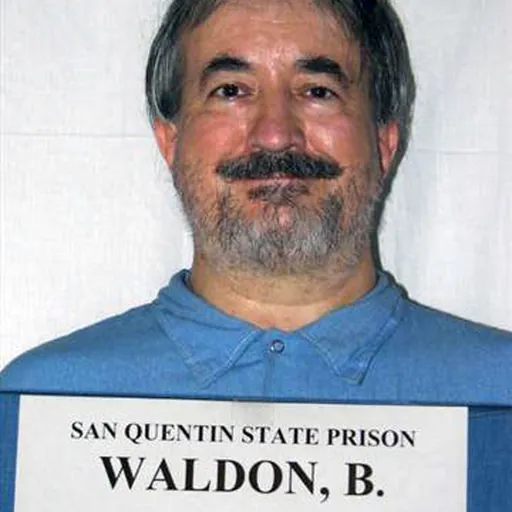
Billy Ray Waldon
American fugitive
About Billy Ray Waldon
Born 1952. Billy Ray Waldon is an American esperantist and language inventor.
Billy Ray Waldon (born January 3, 1952), also known as Billy Joe Waldon or Nvwtohiyada Idehesdi Sequoyah (Cherokee: ᏅᏙᎯᏯᏓ ᎢᏕᎮᏍᏗ ᏎᏉᏯ, Nvdohiyada Idehesdi Sequoya), is an American former fugitive, American Indian Movement activist, and Esperantist who, in 1986, became the 399th fugitive listed by the FBI to the Ten Most Wanted Fugitives List. Waldon was convicted of the murders of three people during a crime spree in 1985.
A native of Oklahoma, Waldon was apprehended on June 16, 1986, after San Diego, California police attempted to pull him over for a routine traffic citation. In 1992, Waldon was convicted of three counts of murder and sentenced to death in California. In 2023, Waldon's convictions were overturned by the California Supreme Court on grounds that he was denied representation by competent counsel.
Criminal history
Crimes The crime spree which Waldon was convicted of began in Tulsa, Oklahoma on October 10, 1985, when a man was robbed and wounded. On November 15, a 28-year-old woman was shot in the head. However, the bullet grazed her skull and she survived. On December 19, a man later identified as Waldon was spotted fleeing a robbery in his car by police, who soon gave chase. Waldon managed to evade the police and abandoned the car, soon after running to the residence of 59-year-old Gordon Wells, who was shot and killed. Waldon was reported to be one-fourth Cherokee Indian and to have an interest in Cherokee history and culture.
Legal proceedings Pre-trial and charges In California, Waldon faced charges on three counts of murder as well as 19 other counts, including rape, armed robbery, and arson. Waldon was additionally charged in Oklahoma with first-degree murder in the November 17, 1985 shooting in Tulsa, as well as three counts of attempted murder, two counts of armed robbery, and two counts of attempted robbery. Waldon was arraigned on June 20, 1986, and plead not guilty to the charges. His bail was set at $2 million. Waldon attempted to escape from his jail cell on September 21, 1986, by attempting to chip away at the cell's wall using a metal bar. Prior to a hearing to determine whether or not Waldon was mentally competent to stand trial, Jack Levitt, the judge who was set to preside over the hearing, was challenged by Waldon's attorney Charles Khoury Jr., who alleged him to be unfair. Levitt would be removed from presiding over Waldon's criminal trial in October 1987, but continued to preside over Waldon's mental competency hearing. The hearing began on August 18, 1987. Waldon remained completely silent during proceedings and refused to answer any questions. On September 21, 1987, Waldon was judged competent to be criminally tried. Waldon's criminal trial was delayed by Judge Levitt's removal, and was further delayed by his insistence that he represent himself. Waldon wished to represent himself in court, but a judge denied this motion, stating that Waldon could not understand the risks of self-representation. However, a second judge granted his request to represent himself. During his trial, Waldon alleged that he had been beaten by federal agents and framed for the crimes over his 'promotion of Indian autonomy'. Waldon additionally claimed that during his fugitive state, he had hid in the crawlspace of a house in Imperial Beach, fearing that he would be convicted anyway if he pleaded innocent. Waldon was convicted of three counts of first degree murder, as well as multiple counts of attempted murder, rape, burglary, robbery, and animal cruelty in December 1991 and was sentenced to death in February 1992.
Conviction overturned On January 23, 2023, Waldon's murder convictions and death sentences were overturned on grounds of courtroom behavior, his 'delusional' self-representation and a trial court judge's decision that had improperly allowed him to represent himself "without considering (the other judge's) denial or the evidence on which it was based" had deprived him of competent legal representation.
Goals The principle of creation for Poliespo was Waldon's belief that certain languages contain words that made communication quicker, which he referred to as "lightning bolts" or "lightning words", and the goal was to combine as many of these as possible into one language.
Bilabial Dental Alveolar Post-alveolar Palatal Velar Glottal Nasal Stop Preaspirated Nasal Preaspirated Stop Labialized Stoppw Affricate Fricative tv Approximant Trill
Front Central Back Close Mid q /ɜ~ɝ/ Open
Front Central Back Close Mid q̂ /ɜ̃~ɝ̃/ Open
Orthography Poliespo's alphabet consists of 54 letters: a, â, ⱥ, ⱥ̂, b, b̆, c, ĉ, d, e, ê, f, g, ĝ, h, ĥ, i, ĭ, ĭ:, ĭ́, î, î:, î́, j, ĵ, k, k̆, l, m, m̆, n, n̆, o, ô, p, pw , s, ŝ, t, t̂, tv , u, û, ŭ, v, z, ẑ, z̆, q, q́, q̂, q̂́, w, ẃ, ŵ, ŵ́, x, x́, y, 2, 2́. In addition, the consonant ẑ represents , while the consonant z̆ represents . pw is p overstruck with w, and tv is t overstruck with v.
Grammar The structure is more similar to Ido than to Esperanto, since radicals are inflected. Unlike Ido, Poliespo has only one prefix in addition to those of Esperanto: , which is used to indicate the "neuter" gender. Besides the accusative case, there is also a subject suffix, as in Korean and Japanese. In Poliespo, there are two forms of oral speech. If one does not understand what someone says in Poliespo (referred to as ), they should repeat themselves in Esperanto (referred to as ). banant̂ⱥn2plaĉqlx! banana-PL.SING-like-DAT-HAB
Don’t just read it —
keep it.
Full-length biographies made to live with: read them, listen on the way to work, watch them tonight.
- E-book
- Audio
- Video
Instant download · yours to keep · every purchase keeps this site free
Important facts
People in Billy Ray Waldon's life
Named in this biography and alive at the same time


Related people
Same field, nearest in time



Contemporaries
People whose lives overlapped Billy Ray Waldon's


Frequently asked questions
Who is Billy Ray Waldon?
American fugitive
When was Billy Ray Waldon born?
Billy Ray Waldon was born on 3 January 1952 in Tahlequah.
What is Billy Ray Waldon's occupation?
Billy Ray Waldon is an esperantist and language inventor.
What nationality is Billy Ray Waldon?
Billy Ray Waldon is American.
Sources & further reading
Cite this page
APA: Biography.guide. (2026). Billy Ray Waldon. https://biography.guide/billy-ray-waldon/
MLA: "Billy Ray Waldon." Biography.guide, https://biography.guide/billy-ray-waldon/.
Chicago: "Billy Ray Waldon." Biography.guide. https://biography.guide/billy-ray-waldon/.
Data last updated: 2026-09-23 · Spot an error? Report a correction.
Portrait: Wikimedia Commons · author & licence
Page generated 2026-09-27 05:06 UTC