
About Bill Watkins
Lived 1858 – 1937 (aged 79). Bill Watkins was a Canadian baseball player and baseball manager.
William Henry Watkins (May 5, 1858 – June 9, 1937), sometimes known as "Wattie," or "Watty," His parents, John Harton Watkins and Eliza Jane (Tyler) Watkins, were immigrants to Canada from Wales and Ireland, respectively. His mother died in 1868, and he was thereafter raised by his maternal grandparents in Erin, Ontario. Watkins attended Upper Canada College in Toronto for one year, He also held jobs as an apprentice for a manufacturer of novelty games and with a branch of the Ingles Corliss Engine Works. In 1879, at age 21, Watkins moved to Port Huron, Michigan, where he lived for the next 40 years.
Professional baseball
Guelph and St. Thomas (1879–81) From 1879 to 1880, Watkins played for the Maple Leafs of Guelph in Southwestern Ontario. The Maple Leafs won the Canadian amateur championship while Watkins was a player. He led Bay City to a tie for first place in the Northwest League when the team disbanded in July 1884.
On August 26, 1884, Watkins was hit on the head by a pitch from Gus Shallix, at Cincinnati. The Cincinnati Enquirer described the incident as follows:With two out, Watkins came to bat and fell a victim to one of the swift curves of Shallix. The poor fellow ducked his head, but it was too late, and the ball caught him on the temple. He rolled over into the diamond, while a thrill of horror passed through the hearts of those in the stands. He was half carried, writhing nervously with pain, to the directors' room, where it was found that though the shock to his system had been great, no bones were broken.
Newspaper accounts indicate that he "hovered between life and death" for five days. Watkins returned briefly as a player after the injury, but his performance was substantially diminished. He appeared in his final game as a player on October 13, 1884.
By mid-June, the Hoosiers were the dominant team in the Western League, compiling an .880 winning percentage.
Sam Thompson later told the colorful story of the Hoosiers' acquisition by Detroit. Detroit sent two representatives (Marsh and Maloney) to Indianapolis, principally to sign the Hoosiers' battery of Larry McKeon and Jim Keenan. The Wolverines were outbid by the Cincinnati Reds for McKeon and Keenan but wound up with Watkins and the rest of the team's starting lineup. The only catch was that a 10-day waiting period would allow other teams to outbid Detroit. Marsh and Maloney promptly sent the players to Detroit and quartered them in a hotel there. The next morning, the players were told that the team had arranged a fishing trip for them. The players boarded the steamship Annette and enjoyed the first day and night of successful fishing. After three days, the players became suspicious, but the ship captain laughed when asked when they would return to Detroit. As the players became mutinous on the sixth day, the captain admitted he had been ordered to keep them "out at sea" for 10 days. The players were only later presented with their accumulated mail which included scores of offers from other clubs.
Late in the 1885 season, Detroit acquired four players from the Buffalo baseball club (Jack Rowe, Dan Brouthers, Hardy Richardson, and Deacon White) who were known as the "Big Four." The "Big Four" were "regarded for many years as the greatest quartette in the history of the national pastime." The "Big Four" joined Detroit for the 1886 season. With the addition of the "Big Four", the Wolverines improved substantially, finishing in second place with an 85–38 record in 1886.
The 1887 season was the pinnacle in the history of the Detroit Wolverines. The team was loaded with hitters, including six regulars who hit above .300: Sam Thompson (.372 and 166 RBIs in 127 games), Dan Brouthers (.338 and 101 RBIs in 123 games), Larry Twitchell (.333), Hardy Richardson (.328), Jack Rowe (.318) and Deacon White (.303). The pitching staff was led by "Pretzels" Getzien, a curveball specialist who compiled a 29–13 (.690) win–loss records and a 3.73 earned run average. Outfielder Larry Twitchell also started 12 games as pitcher and compiled an 11–1 record. The Wolverines won the National League pennant with a 79–45 record and then defeated the St. Louis Browns in the 1887 World Series.
During the 1888 season, the Wolverines fell to fifth place. In late August 1888, the Detroit club fired, or accepted the resignation of, Watkins as their manager, and Robert Leadley was hired as "acting manager" in his place. The Wolverines compiled a 49–44 record in their final year under Watkins.
Kansas City (1888–89) After parting ways with the Wolverines in late August 1888, Watkins was hired in early September 1888 as the manager of the Kansas City Cowboys of the American Association. He led the club to an 8–17 record in the final month of the 1888 season and a 55–82 record in 1889.
St. Paul (1890–91) In June 1890, Watkins was hired as the mid-season replacement manager for the St. Paul Apostles of the Western Association. Watkins had little success in turning the St. Paul club around, and in August 1890, The Sporting Life reported that Watkins had been forced to release players and cut salaries to reduce expenses, and that he was "running the St. Paul team economically according to instructions", though he hoped to have a stronger team in 1891. The Apostles finished in last place in 1890 with a 37–84 record.
In September 1890, with the St. Paul club losing money, C. L. Flatley, a personal friend of Watkins, purchased the club and promptly signed Watkins to serve as the club's manager again in 1891. However, Flatley had sold the club by December 1890. Two months later, in August 1891, the club disbanded, and Watkins was left with financial responsibility for half of the Duluth team's unpaid player salaries.
Rochester (1892) In April 1892, Watkins was hired as the manager of the Rochester Flour Cities in the Eastern League and was described by The Sporting Life as "a cuckoo" who "will not be handicapped by meddling directors." By the end of the season, the Rochester correspondent for The Sporting Life commended Watkins for his efforts with a "misfit team" that had a "scarcity of good men", was "badly crippled", suffered "internal dissension", and drew small crowds. The correspondent noted that Watkins had turned the club around with his emphasis on discipline: He has been as watchful of his men in the dark hours of the night as any man with self-respect could be, he has been always safe in his financial policy, his judgment of players has never gone wrong, he has been a stickler for finished team work ... He has been a dignified gentleman throughout and, considering the circumstances, the highest success as a manager... Local cranks will wish him unlimited success in every undertaking, and bear on with the hope that he may again pilot base ball in Rochester in 1893.
St. Louis (1893) In 1893, Watkins was hired as the manager of the St. Louis Browns (later renamed the Cardinals) of the National League. Under owner Chris von der Ahe, the Browns had gone through five managers during the 1892 season, finishing in 11th place with a 56–94 (.373) record. Watkins remained the manager for the entire 1893 season and led the club to a 57-75 (.432) record and a 10th-place finish in 1893. but the Sporting Life gave much of the credit for the Huskers' championship to Watkins:Watkins' success as a manager is largely due to the discipline which he enforces and to his knowledge of the intricate points of the game. With him the national game has become as easy as the moves to an expert chess player. With the diamond in front of him every correct move of the men on the field is quickly discerned, and with the signals used so advantageously he is always in communication with the captain and players. Many of the Husker victories this season have been won by the silent man on the bench ... By 1894, Watkins had won pennants as a manager in St. Thomas, Port Huron, Detroit and Sioux City, and had led teams in Indianapolis and Bay City to first place in seasons that ended prematurely; the Sporting Life at the time asserted that Watkins had "the distinction of piloting more pennant winners than any other manager before the public to-day." As he had been with other clubs, Watkins remained a strict disciplinarian as manager of the Pirates. The Sporting Life wrote: Watty is a firm base ball man, knows the practical side of the sport, and in the writer's recollection one of the few chiefs in the Pittsburg Club's employ who had courage to rebuke with spirit and determination players violating edicts, etc. Discipline prevails in his club. His iron-bound policy of directing plays of course cannot be popular with players, but if dictation is absent and appeal impossible the method may be pushed to success.
Watkins returned as the Pirates' manager in 1899 at an annual salary of $4,500, but he resigned in May 1899 after the team began the season with a 7–15 record. Watkins said at the time that he had other business to attend to, that he intended to quit baseball for good,
Indianapolis, Parts IV (1900–01) In November 1899, Watkins purchased the Indianapolis Hoosiers of the American League from John T. Brush for "something like $10,000." Watkins also leased land on the east side of Indianapolis and announced plans to build a new baseball field there. The efforts to establish a new American Association were unsuccessful, and Watkins' Indianapolis club joined the Western Association for the 1901 season. He sold the club in July 1901, and it was moved to Matthews, Indiana. The 1902 Indians compiled a 96–45 record and won the first American Association pennant. After the pennant was secured, The Indianapolis Journal described Watkins' reaction:It is useless to mention him as Mr. W. H. Watkins. There are others of that name, while there is only one Watty. The exuberance of his eye, the thrill of enthusiasm in his voice and the general air of conquest surrounds him, told eloquently that Watty was happy. He leaned back in his mahogany chair in the pennant office in the Majestic building and illuminated every part of the room with his sunny countenance. He was in a benign mood, loquacious and enthusiastic.
Watkins' 1903 team drew only 88,000 spectators, the lowest attendance in the American Association. Watkins also served as the manager of the Minneapolis club during the 1904 and 1905 seasons. In October 1905, Watkins authored a lengthy article for The Minneapolis Journal outlining his views on the value of baseball as a game wherein "brains must be combined with skill", a game that "demands temperance and proper living", and "as an element of great good in American life."
In December 1905, Watkins sold his ownership interest in the Minneapolis baseball club to Mike Kelley. The sale price was not disclosed but was "said to be in the neighborhood of $50,000."
Indianapolis, Part VI (1906–12)
Watkins returned to Indianapolis in 1906 as manager of the Indianapolis Indians of the American Association. The Indianapolis Morning Star reported that local baseball fans were "rejoicing", and that Watkins was "regarded as the most competent manager in the American Association." He was also president of the club from 1906 to 1912. He stepped down as bench manager in May 1906, turning over responsibility of bench manager to Charlie Carr. In February 1912, the Sporting Life reported that Watkins actually had a say in four minor league clubs and referred to him as the "monarch of the minors."
In the spring of 1912, the Sporting Life published a report that Watkins had sold his interest in the Indianapolis club, and the Indianapolis Star reported that Watkins had been "deposed" as president of the Indianapolis team, tendering his resignation after refusing the demand from club owners to remove the manager, Jimmy Burke. The Star noted at the time:For more than thirty years he has been a prominent figure in baseball. He was one of the organizers of the American Association ... Mr. Watkins is a baseball man of the old school and he has been in the thick of all the grueling battles through which organized baseball has passed to bring it up to its present standard as one of the greatest amusement enterprises in the country. He has been through five baseball wars, and, as he says, 'went broke' in every one of them.
Indianapolis, Part VII: Federal League (1914) In February 1914, Watkins was hired, at a salary reported to be $8,000, as the business manager for the Indianapolis Hoosiers team in the newly formed Federal League. Upon his hiring, The Sporting Life opined: "William H. Watkins has served the game as player, manager, and magnate for three decades, with credit to himself and the sport, and his re-entrance in the Indianapolis field, where he labored for the greater part of his brilliant career, is absolutely certain to redound to the advantage of his new club and league." Watkins told the press: "I know that Indianapolis, with its large suburban population, is large enough and has enough enthusiastic fans to support two base ball teams so long as there is no serious confliction in dates. I am glad to get back into the harness and particularly glad to return to Indianapolis." However, in late March 1915, a deal was struck that resulted in the Indianapolis club being moved to Newark, New Jersey. Watkins did not follow the team to Newark.
In all, Watkins was affiliated with Indianapolis baseball clubs in seven different leagues: the 1884 Hoosiers in the American Association, the 1885 Hoosiers in the first version of the Western League, the 1895–98 Hoosiers/Indians in the second version of the Western League, the 1900 Hoosiers in the American League, the 1901 Hoosiers in the Central League,
Port Huron, Part II (1920–22) From 1920 to 1922, Watkins served as president of the Port Huron baseball club.
Managerial record Team Year Regular season PostseasonGamesWonLostWin %Finish Won Lost Win % ResultIND 23418 11th in NA – – – –DET 703436 6th in NL – – – –DET 1268736 2nd in NL – – – –DET 1277945 1st in NL 10 5 .667 Won World Series (STL)DET 944944 5th in NL – – – –KC 25817 8th in AA – – – –KC 1395582 7th in AA – – – –STL 1355775 10th in NL – – – –PIT 1517276 8th in NA – – – –PIT 24715 7th in NA – – – –Total 914 452 444 10 5 .667
Family and later years Watkins was married in 1884 to Edna Buzzard. They apparently had no children. Watkins became a naturalized United States citizen in 1897.
Watkins died from diabetes in 1937 at age 79 in Port Huron. He was survived by his wife, Edna, and was buried at Lakeside Cemetery in Port Huron. The field used by both the Port Huron semipro and high school baseball teams was named Watkins Field in his honor, though it ceased being used in the early 1940s. Watkins was inducted into the Port Huron Sports Hall of Fame in 2008.
Don’t just read it —
keep it.
Full-length biographies made to live with: read them, listen on the way to work, watch them tonight.
- E-book
- Audio
- Video
Instant download · yours to keep · every purchase keeps this site free
Important facts
People in Bill Watkins's life
Named in this biography and alive at the same time

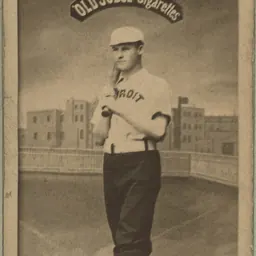
Related people
Same field, nearest in time



Contemporaries
People whose lives overlapped Bill Watkins's


Frequently asked questions
Who was Bill Watkins?
Canadian baseball manager (1858-1937)
When was Bill Watkins born?
Bill Watkins was born on 5 May 1858 in Brantford.
When did Bill Watkins die?
Bill Watkins died on 9 June 1937 in Port Huron.
What was Bill Watkins's occupation?
Bill Watkins was a baseball player and baseball manager.
What nationality was Bill Watkins?
Bill Watkins was Canadian.
Sources & further reading
· DBpedia: Bill Watkins (baseball)
Cite this page
APA: Biography.guide. (2026). Bill Watkins. https://biography.guide/bill-watkins-baseball-player/
MLA: "Bill Watkins." Biography.guide, https://biography.guide/bill-watkins-baseball-player/.
Chicago: "Bill Watkins." Biography.guide. https://biography.guide/bill-watkins-baseball-player/.
Data last updated: 2026-09-20 · Spot an error? Report a correction.
Page generated 2026-09-27 05:20 UTC