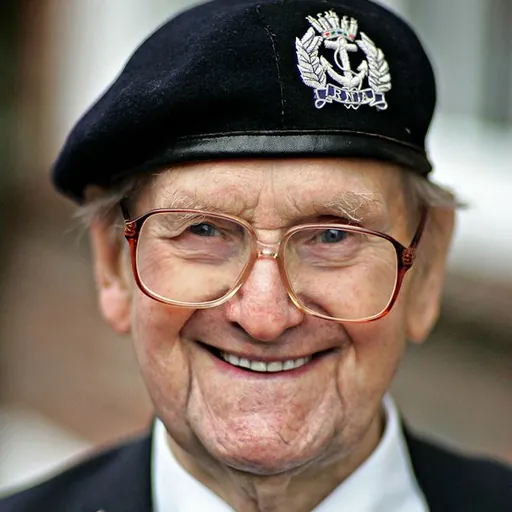
About Bill Stone
Lived 1900 – 2009 (aged 108). Bill Stone was a British military personnel and barber.
William Frederick Stone (23 September 1900 – 10 January 2009) was one of the last five surviving First World War veterans who served in the United Kingdom's armed forces and one of the last two surviving seamen worldwide, along with Claude Choules. They were also the last two to have also served in the Second World War, although Stone saw action only in the Second World War as he was still in training when the First World War ended.
Stone was born in Ledstone, Kingsbridge, Devon and enlisted in the Royal Navy on his 18th birthday. He served on board shortly after the end of the First World War, before serving on a number of ships including . At the beginning of the Second World War Stone was serving on the minesweeper HMS Salamander before moving onto the light cruiser in 1941. After the war, he ran his own barber's shop. In his later years Stone was present at many memorial services including the 90th anniversary commemorations at the Cenotaph in London. He died on 10 January 2009.
Early life
Stone was born in Ledstone, Devon, as the tenth of fourteen children, and enlisted into the Royal Navy on his 18th birthday.
Naval service The first record of his naval service describes him as being tall, with a chest, brown hair and blue eyes, and his prior occupation as stationary engine driver. He trained as a Stoker in Plymouth, and could remember the dancing in the streets on Armistice Day. By the outbreak of the Second World War he was Chief Stoker of the HMS Salamander. On her he participated in the evacuation of Dunkirk, with Salamander making five shuttle trips and picking up over a 1,000 men from the beaches. He was Mentioned in Despatches on 21 December 1943 for his service on this occasion. He served with the occupation forces in north Germany, and was a Stoker Chief Petty Officer when he left the navy in 1945.
Anne married Michael J Davidson in Kensington, London in 1967. The couple had two children: Christopher and Susan.
Later life
Following the end of the Second World War in 1945, Stone left the Navy. After the war, he ran his own barber's shop, where he also sold cigarettes and smoking tobacco, he retired in 1968. As the years passed by, Lily became more disabled by her arthritis eventually becoming unable to walk; however, Bill said that "mentally she was always bright. I was happy that she was able to stay at home and that I was able to look after her. At that time we had a cottage hospital – Watlington Hospital – where eventually she used to go each month to give us both a rest". Oxfordshire and move into a retirement facility in Sindlesham, a suburb of Winnersh, which lies between Reading and Wokingham, in 2007. Stone's son-in-law, Michael Davidson issued a statement about his father-in-law's condition:
"He had a fall and developed a small infection, so doctors gave him antibiotics which seem to be working. He is obviously being observed very closely because of his age, but we have no reason to believe his condition will worsen"
On 11 November 2008, Stone along with fellow veterans, Henry Allingham and Harry Patch laid commemorative wreaths at the Cenotaph in London to mark the ninetieth anniversary of the end of the First World War.
Stone died on 10 January 2009 at Lord Harris Court Care Home in Sindlesham in Berkshire. His daughter described him as a "very determined character [...] a man of great faith and his recipe for long life was: 'Clean living, contented mind and trust in God.' His motto: 'Keep going.'" In September 2009, memoirs detailing Stone's experience of the two world wars were published.
Medals
Stone received many medals in his 27-year career in the Navy. These included campaign medals and commemorative medals issued on anniversaries and commemorations. and should not be worn on formal occasions. However, it is usual to wear official medals on the left chest lapel and have unofficial medals form a second row underneath. Bill Stone wore his medals in this manner.
Ships
The following is a list of the seagoing vessels on which Stone served. At various times he was posted to shore establishments for training or other duties. Smaller vessels were also officially assigned to a depot ship. HMS Tiger Battle cruiser – 1919–1922 Battle cruiser – 1922–1924 HMS Chrysanthemum Sloop – 1925–1927 HMS P40 Submarine Chaser – 1928–29 HMS Eagle Aircraft carrier – 1929–1931 HMS Harebell Sloop – 1931–1933 HMS Thanet Destroyer – 1933–1934 HMS Tenedos Destroyer – 1933–1934 HMS Carlisle Light cruiser – 1934–1937 HMS Salamander Mine sweeper – 1937–1941 HMS Newfoundland Light cruiser – 1941–1944
Don’t just read it —
keep it.
Full-length biographies made to live with: read them, listen on the way to work, watch them tonight.
- E-book
- Audio
- Video
Instant download · yours to keep · every purchase keeps this site free
Important facts
People in Bill Stone's life
Named in this biography and alive at the same time



Related people
Same field, nearest in time





Contemporaries
People whose lives overlapped Bill Stone's



Frequently asked questions
Who was Bill Stone?
Legion d'honneur recipient (1900–2009)
When was Bill Stone born?
Bill Stone was born on 23 September 1900 in Devon.
When did Bill Stone die?
Bill Stone died on 10 January 2009 in Sindlesham.
What was Bill Stone's occupation?
Bill Stone was a military personnel and barber.
What nationality was Bill Stone?
Bill Stone was British.
Sources & further reading
· DBpedia: Bill Stone (Royal Navy sailor)
Cite this page
APA: Biography.guide. (2026). Bill Stone. https://biography.guide/bill-stone-military-personnel/
MLA: "Bill Stone." Biography.guide, https://biography.guide/bill-stone-military-personnel/.
Chicago: "Bill Stone." Biography.guide. https://biography.guide/bill-stone-military-personnel/.
Data last updated: 2026-09-22 · Spot an error? Report a correction.
Portrait: Wikimedia Commons · author & licence
Page generated 2026-09-27 05:04 UTC