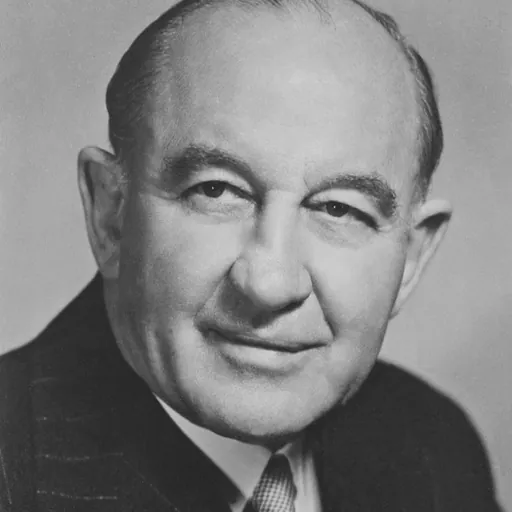
About Bill McKell
Lived 1891 – 1985 (aged 93). Bill McKell was an Australian politician, boilermaker, trade unionist and barrister.
Sir William John McKell (26 September 1891 – 11 January 1985) was an Australian politician who served as the 12th governor-general of Australia, in office from 1947 to 1953. He had previously been the 27th premier of New South Wales from 1941 to 1947, as leader of the Labor Party.
McKell was born in the small town of Pambula, New South Wales, but grew up in Sydney. He left school at thirteen, training as a boilermaker at Mort's Dock. McKell soon became involved with the union movement, and after a brief period on the railways began working full-time as a union secretary. He sided with the anti-conscriptionists during the Labor Party split of 1916, and at the 1917 state election defeated James McGowen, a former Labor premier who had been expelled from the party. In 1920, aged 29, McKell was Minister of Justice under John Storey. He also served as a minister under John Dooley and Jack Lang.
During the Labor Party's internal tensions in the 1930s, McKell came to be seen as a compromise candidate for the leadership of the party. He replaced Jack Lang as leader of the opposition in 1939, and became premier following Labor's victory at the 1941 state election. As premier, McKell oversaw both the war effort and the initial stages of post-war reconstruction, carrying out an ambitious programme of public works as well as various social reforms. He was re-elected with an increased majority at the 1944 election, making him the first Labor premier to win successive elections in New South Wales.
McKell had planned to retire from public life in 1946, but was instead convinced by Ben Chifley to become governor-general. His appointment was initially controversial due to its openly political nature; Sir Robert Menzies called it "shocking and humiliating". However, when Menzies returned as prime minister in 1949, they formed an amicable working relationship. Some of McKell's actions as governor-general were unpopular amongst his old Labor Party colleagues, notably his acceptance of a knighthood and his decision to grant Menzies a double dissolution in 1951. In later life, he served as a trustee of the Sydney Cricket Ground, and as a member of the Reid Commission, which drafted the Constitution of Malaysia.
Early life Bill McKell was born in Pambula, New South Wales, the eldest of four children. His father, Robert Pollock McKell, was a butcher who moved the family to Surry Hills in Sydney in 1898. Three years later he abandoned them. For the rest of his life, McKell concealed the matter by saying his father had died young. The family moved to Redfern, with McKell's mother working to support the family. He was educated at Bourke Street Public School in Surry Hills. McKell supplemented the family income by working part-time. As well as being a good student, McKell was a talented sportsman.
In 1919, McKell bought a house in Redfern that was to be his long-term home. The following year, he married Mary 'Minnie' Pye (later Lady McKell). The first of three children soon followed. In 1933, McKell bought a property near Goulburn. As an MP, McKell studied for the Bar and was admitted in 1925.
McKell became Minister of Justice after Labor won the 1920 election and retained the position until the Government was defeated in 1922.
Premier of New South Wales In the May 1941 election campaign, McKell outlined a programme of reforms for both city and country NSW. McKell contrasted this with United Australia Party Premier Alexander Mair's attitude that all social and other reform had to be postponed because of the war. The result was a victory for McKell, with Labor winning 54 of the 90 seats.
McKell set up a War Effort Co-ordination Committee chaired by himself. The Government built ships, roads, air strips and other defence works. NSW produced munitions and grew food. A vigorous civil defence and air raid precaution programme was instituted.
At the 1944 election, the Government won 56 seats, two more than in 1941. McKell was the first NSW Labor Premier to win a second consecutive term. On 26 March 1945, he broke Lang's record as the longest serving ALP Premier. The McKell Government achieved an impressive record in the social, industrial, planning, and environmental areas, including Kosciusko National Park and the Snowy Mountains Scheme.
On 13 February 1946, McKell announced that he was retiring from politics before the next election. Prime Minister Chifley appointed McKell governor-general. The official announcement was made on 31 January 1947. McKell resigned from Parliament and the Premiership on 6 February.
Governor-general In 1947 Chifley gained formal agreement from George VI for McKell's appointment as governor-general. This occurred only after very considerable opposition from the King and a detailed correspondence between them, also involving the incumbent governor-general (George's brother, the Duke of Gloucester) and the British Foreign Office, the details of which did not come to light for over 50 years. The objection was not personal (George VI had never met McKell) but centred on his being closely associated with a particular political party, and with a particular state. There was no precedent for a serving Australian politician, let alone a party leader and head of government, to be named governor-general, although there was a South African one and several former governors-general had strong ties with British political parties. In the end, the King had no option but accept Chifley's assurances of McKell's personal integrity and that the Crown would not be exposed to any political controversy.
Chifley was determined that the Duke of Gloucester's successor should be a native-born Australian, and he seems to have deliberately chosen a Labor man with a working-class background to make a political point. There was an outcry from the Liberal opposition and the conservative press: Robert Menzies called the appointment "shocking and humiliating". In a debate on a censure motion on 20 February, Menzies said the fact that McKell was actively engaged in politics when the appointment was announced (even though he had since vacated the political stage) was "a grave disqualification" which "strikes at the very foundation of the office of the governor-generalship, because that office in Australia should be as far removed from party politics as is the Crown itself in Great Britain". Chifley, in response, accepted full responsibility for the appointment, said that he offered no apologies, and "I am completely confident that as time goes on I shall have no reason to regret my action".
McKell kept a dignified silence on the matter of his appointment, rather than conducting a public defence of it. Nevertheless, Chifley publicly argued that any suitable Australian should be capable of being chosen as governor-general. Once McKell took office on 11 March, however, the continuing respect for the Crown and its representative meant that there was no further criticism. McKell carried out the usual round of his formal duties with dignity, behaved with unfailing respect towards the King himself, and succeeded in winning over all but the most inflexible. When Menzies succeeded Chifley as prime minister in December 1949, his relations with McKell were initially civil rather than friendly, but later on, the two men formed a cordial working relationship. Menzies even extended McKell's term by 14 months from its initial five years.
On 13 November 1951, McKell accepted a knighthood (Knight Grand Cross of the Order of St Michael and St George) from George VI, who personally invested him at Buckingham Palace while McKell was on an official visit to the United Kingdom. This caused considerable controversy in the Labor Party, as it was Labor policy to have nothing to do with knighthoods (a policy confirmed by the case of Queensland union leader Sir Jack Egerton a generation afterwards); but there was nothing Labor could do about it, since McKell had severed all connections with the party on assuming office. Also it was unprecedented and was still considered somewhat inappropriate, for a governor-general not to be at least a knight (many had been peers). McKell was the only Australian governor-general to be knighted during his term, until Quentin Bryce was appointed a Dame of the Order of Australia in March 2014.
McKell's official secretary for the first few weeks was Sir Leighton Bracegirdle, whose retirement was overdue after serving McKell's three predecessors over 16 years. He was succeeded by Sir Murray Tyrrell.
Later life McKell retired in May 1953. From June 1956 to 1957, he served as a member of the Reid Commission, which was responsible for drafting the Constitution of the Federation of Malaya (now Malaysia).
A longtime trustee and former chairman, McKell was a regular at the Sydney Cricket Ground. From the 1970s onwards there was a revival of academic and Labor Party interest in McKell and his legacy. Neville Wran (ALP Premier from 1976 to 1986) named a new state office building after McKell (the McKell Building, in Haymarket), and the party called one of its research bodies the McKell Institute.
McKell died in the Sydney suburb of Waverley in January 1985 aged 93. A memorial service was held at St Andrew's Cathedral. His widow, Lady (Mary) McKell, survived him by only six months. Both Sir William's and Lady McKell's ashes are interred at Northern Suburbs Crematorium, North Ryde.
Biographies
Don’t just read it —
keep it.
Full-length biographies made to live with: read them, listen on the way to work, watch them tonight.
- E-book
- Audio
- Video
Instant download · yours to keep · every purchase keeps this site free
Important facts
People in Bill McKell's life
Named in this biography and alive at the same time





Related people
Same field, nearest in time





Contemporaries
People whose lives overlapped Bill McKell's


Frequently asked questions
Who was Bill McKell?
former Governor-General of Australia (1891-1985)
When was Bill McKell born?
Bill McKell was born on 26 September 1891 in Pambula.
When did Bill McKell die?
Bill McKell died on 11 January 1985 in Waverley.
What was Bill McKell's occupation?
Bill McKell was a politician, boilermaker, trade unionist and barrister.
What nationality was Bill McKell?
Bill McKell was Australian.
Sources & further reading
Cite this page
APA: Biography.guide. (2026). Bill McKell. https://biography.guide/bill-mckell/
MLA: "Bill McKell." Biography.guide, https://biography.guide/bill-mckell/.
Chicago: "Bill McKell." Biography.guide. https://biography.guide/bill-mckell/.
Data last updated: 2026-09-23 · Spot an error? Report a correction.
Portrait: Wikimedia Commons · author & licence
Page generated 2026-09-27 05:05 UTC