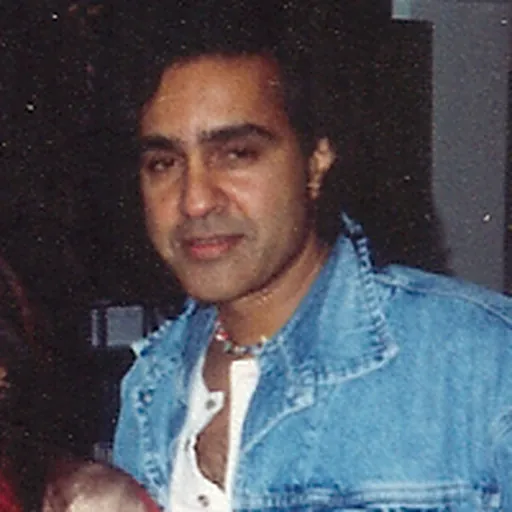
About Biddu
Born 1944. Biddu is an Indian record producer and songwriter.
Biddu Appaiah (born 8 February 1945), Considered one of the pioneers of disco, Euro disco, and Indian pop, he has sold millions of records worldwide,
Biddu was born in Bangalore, Kingdom of Mysore (Now Karnataka, India). He began his music career in the 1960s, by singing as part of a music band in India before moving to England where he would start his career as a producer. and producing several early disco songs that would find a niche audience in British northern soul clubs during the early 1970s. and Jimmy James; as well as several hit songs for Japanese pop idol Akina Nakamori
Early years and career Biddu's family originally hailed from Kodagu in the Karnataka state of India, but he was born and grew up in the city of Bangalore, where he attended the Bishop Cotton Boys' School. and found success playing cover versions of The Beatles, He saved a few pounds before he decided to rent studio time and record several singles, none of which received any airplay from UK radio stations. which was released as a single backed with "Bring Yourself Back to Me", written by Don Gould and Lynsey De Paul. The single earned positive reviews, with Billboard awarding it Special Merit Spotlight status and it reached number 107 on the Billboard Bubbling Under Chart. In 1972, Biddu scored music for the UK spy thriller Embassy. Around this time, he also started working with UK-based Jamaican-born musician Carl Douglas on a 45 (rpm record) single "I Want to Give You My Everything". While this song was intended for the A side, they cut a song for the B side, "Kung Fu Fighting", in only 10 minutes. Later, at the insistence of A&R at Pye Records, "Kung Fu Fighting" was put on the A-side. Soon after release in 1974, "Kung Fu Fighting" became a worldwide hit, ultimately selling eleven million copies worldwide. Shortly after, Biddu also produced Carl Douglas' debut album Kung Fu Fighting and Other Great Love Songs, which produced another major hit, "Dance The Kung Fu". He soon established himself as one of the key figures in Britain's soul and disco scenes during the 1970s, working with a variety of British soul and disco artists, including Tina Charles, The Outriders, and Jimmy James.
In 1975, Biddu recorded and released the instrumental LP, Blue Eyed Soul, and the album's first single, "Summer of '42", climbed to No. 14 on the UK Singles Chart, spending two months there and then had similar success in the US, topping the Dance Music/Club Play Singles chart and reached No. 57 on the Billboard Hot 100. Another single, "Jump for Joy", also topped the Dance Music/Club Play Singles chart in the US while reaching No. 72 on the Billboard Hot 100 in 1976. Also in 1975, he produced the album Can You Hear Me Ok? and single "I Got My Lady" for John Howard. Around the same time, a friend introduced Biddu to Tina Charles, a singer who had had some success singing lead vocals for the group 5000 Volts. The first single they worked together, "You Set My Heart on Fire", clinched a recording deal with CBS. In 1976, the second single "I Love to Love (But My Baby Loves to Dance)" was a major hit worldwide. "I Love to Love" and the subsequent hit "Dance Little Lady Dance" sold millions of copies around the world, giving Tina Charles a worldwide audience and fame, launching her solo career and firmly establishing Biddu.
In 1976, Biddu produced his own Rain Forest LP, followed by Eastern Man in 1977, both credited to Biddu & His Orchestra. His album Rain Forest earned him four Ivor Novello Awards, Around this same time, he began experimenting with electronic music in some of his disco songs, making use of electronic musical instruments such as keyboards and synthesizers. Some of his early examples of electronic disco include the early boogie 1976 single "Bionic Boogie"; the 1977 "Soul Coaxing" single; the Eastern Man and Futuristic Journey albums, which were recorded from 1976 to 1977; and the 1979 "Phantasm" single. He also began experimenting with high-tempo Hi-NRG disco music, with early examples including some of the songs in his 1976 Tina Charles albums I Love to Love and Dance Little Lady, as well as his disco singles such as "Voodoo Man" (1979) which had a tempo of 130 beats per minute. His backing tracks also had a strong influence on the British new wave band The Buggles, founded by two of Biddu's former session musicians, Trevor Horn and Geoff Downes, who are most famous for writing the hit song "Video Killed the Radio Star" in 1979.
In 1977, he worked on the Life album for the veteran Jamaican-born soul singer Jimmy James, which put out two chart hits "I'll Go Where Your Music Takes Me" and "Disco Fever". In early 1978, Biddu's own "Journey to the Moon" was a hit, peaking at No. 41 in the UK. That same year, he scored the music for the English film The Stud, starring Joan Collins; the film's soundtrack was successful on the UK Albums Chart, where it reached No. 2. He also produced the soundtrack for its sequel, The Bitch, in 1979.
Success in Asia (1980s) In the late 1970s, Western disco was getting popular in Asia and particularly in India, where there were not yet any home-bred disco stars. It was this reason that led established Indian filmmaker and actor Feroz Khan to England and to Biddu, in 1979. Khan wanted to introduce a catchy song in his upcoming Hindi film, Qurbani, in which the main score of the film was by the Indian music duo, Kalyanji Anandji. Biddu initially was not interested in composing a Hindi film song, but later took it up as he would say years later, "I thought it would keep my mum happy (back home in India)". About the same time Khan happened to come across 15-year-old Nazia Hassan at a party in London. Khan later requested Hassan have an audition with Biddu. Biddu later signed her up for the song he was composing for Qurbani.
Beyond Southern Asia, he also had some success in another part of Asia, the Far East. After having previously had a chart-topping hit in Japan with The Tigers in 1969, It was included in her 1985 album My Best Thanks, which topped the Japanese chart and sold around 300,000 copies. which became chart-topping hits in Japan. "BLONDE" in particular sold over 300,000 copies in Japan that year. He also worked in Hong Kong, where he produced and composed the song "傷心戲院" ("Sad Theater") for C-pop singer Samantha Lam in 1988. In the Philippines, the song "Chic-Chica-Chic-Chica-Chic" from his hit 1976 album Rainforest was used as the main theme of the popular 1980s sitcom Chicks to Chicks. In the late 1980s, he returned to the UK music scene with house music records such as "Humanity" (1989).
Indian pop scene (1990s) Having spent nearly a decade with the Nazia-Zoheb pair, Biddu next turned his attention to Hindi vocalist Shweta Shetty, both writing and producing the Johnny Joker album in 1993. Then in 1995, came another album, composed and produced by Biddu. Made in India – a dance album for the Hindi pop/film playback singer Alisha Chinai. The album became the best selling Hindi dance album and featured a handful of Western styled videos – a selling point for India's newly launched MTV channel. It topped the Indian chart, where it remained for over a year, and sold over five million copies in India.
In 1996, Biddu made a brother-sister duo popular again with Shaan (Shantanu Mukherjee) and Sagarika Mukherjee (Saag), producing the Naujawan album. Biddu spent the rest of the 1990s working with a variety of musicians, including the Indian girl-group Models, South Indian Singer K.S. Chithra, and Sonu Nigam, as well as continuing his collaboration with Alisha Chinai on her Dil Ki Rani album. Into the new millennium, he produced two hit songs with Sansara, Yeh Dil Sun Raha Hai and Habibi.
His own 1999 album, Eastern Journey, was an experiment which blended Indian pop with Western flair and strong, jazz elements.
Biddu also worked with Junaid Jamshed. Both of them worked in London and produced an album under the composition and lyrics of Shoib Mansoor Sahab.
In 2000 he launched the first ever British Asian Girl band ‘Sansara’. Their songs “Yeh Dil Sun raha hai” written by Sophie Choudry and “Habibi” went on to become big hits. The band split up but he continued to work with pop diva Sophie Choudry and produced her debut solo album “Le Le Mera Dil” in 2002. Til date, she credits him with her success saying he discovered her and encouraged her to move to India to pursue her career.
Experiments in fusion (2000s) In 2004, Biddu re-emerged with the album Diamond Sutra.
Biddu now lives in Spain with his English wife of 39 years, Sue, and two grown-up children. He started a publishing house called SueBiddu Music, which administers music for artists, wrote an autobiography called Made in India at the insistence of his wife, and has returned to live performances as a singer. and he was also awarded the "Lifetime Achievement Award" at the JD Rock Awards in India that same year. Biddu has also given music for Junaid Jamshed. Producer and writer
Albums Jack Wild – A Beautiful World (1972) Carl Douglas – Kung Fu Fighting and Other Great Love Songs (1974) Jimmy James – You Don't Stand a Chance if You Can't Dance (1975) John Howard – Can You Hear Me OK? (1975, unreleased; 2005) Lee Vanderbilt -– Get into What You're In (1977) Tina Charles – I Love to Love (1976) Jimmy James – Life (1977) Tina Charles – Rendezvous (1977) Tina Charles – Greatest Hits (1978) Kelly Marie – Feels Like I'm in Love (1981) Nazia Hassan – Disco Deewane (1981) Nazia Hassan & Zoheb Hassan – Star/Boom Boom (1982) Nazia Hassan & Zoheb Hassan – Young Tarang (1984) Nazia Hassan & Zoheb Hassan – Hotline (1987) Alisha Chinai – Made in India (1995) Junaid Jamshed -Naam (1995) The Pearls – A String of Pearls (2005) Debojit Saha - Debojit (2006) Sophie Choudry – Le Mera Dil (2008)
Singles The Tigers – "Smile for Me" (1969) The Showstoppers – "Action Speaks Louder Than Words" (1971) Jack Wild – "(Holy Moses!) Everything's Coming Up Roses" (1971) Carl Douglas – "Ain't No Use" (1972) Jimmy James – "A Man Like Me" (1972) The Flirtations – "Love A Little Longer" (1972) Mac and Katie Kissoon – "Beautiful World Out There" (1973) The Black Knights – "Billy Gunn" (1973) The Playthings – "Stop What You're Doing" (1973) Carl Douglas – "Kung Fu Fighting" (1974) The Pearls – "Doctor Love" (1974) The Playthings – "Surrounded by a Ray of Sunshine" (1974) Tina Charles – "One Broken Heart For Sale" (1974) Carl Douglas – "Blue Eyed Soul" (1975) Jimmy James – "You Don't Stand a Chance (If You Can't Dance)" (1975) John Howard – "I Got My Lady" (1975) Tina Charles – "You Set My Heart on Fire" (1975) Biddu – "Groovy Kind of Love" (1976) Jimmy James – "Now Is the Time" (1976) Tina Charles – "Dance Little Lady Dance" (1976) Tina Charles – "I Love to Love (But My Baby Loves to Dance)" (1976) Tina Charles – "Love Me Like A Lover" (1976) Claude François – "Laisse Une Chance A Notre Amour" (1977) The Real Thing – "Let's Go Disco" (1978) Captain Zorro – "Phantasm" (1979) Amy – "Small Talk" (1980) Akina Nakamori – "Don't Tell Me This is Love" (1985) Agnes Chiang (蔣麗萍) – "No. 55" (1985) Akina Nakamori – "The Look That Kills" (1987) Akina Nakamori – "Blonde" (1987) Samantha Lam – "傷心戲院" ("Sad Theater") (1988) Caron – "You'll Always Have A Friend" (1992) Nazia Hassan – "Boom Boom: The Biddu Experience '95" (1995) Bus Stop – "Kung Fu Fighting" (1998) Brighouse and Rastrick Brass Band – "I'll Go Where Your Music Takes Me" (1999)Biddu Orchestra Albums Blue Eyed Soul (1975) Rain Forest (1976) Funky Tropical (1977) Journey to the Moon (1977) Soul Coaxing / Nirvana (1977) Journey to the Moon / Journey in the Rain (1977) Eastern Man (1977) The Best of Biddu (1978) Disco Gold (1978) Futuristic Journey (1978) Dance of Shiva (1985) Diamond Sutra (2004)
Singles "Theme from Summer of '42" (1975) Released on the Epic label (EPC3318) Composer: M. Legrand Produced by Biddu for Subiddu Music and Productions Ltd. "B" side: "Northern Dancer" Composer: Biddu-Gerry Shury-McDonald-Rae "Jump for Joy" (1975) "Rain Forest" (1976) Released on the Epic label (EPC4084) Composer: Biddu Produced by Biddu for Subiddu Music Ltd. "B" side: "Exodus" Composer: E. Gold "Bionic Boogie" (1976) "Soul Coaxing" (1977) "Voodoo Man" (1979)Movie soundtracks Embassy (1972) The 14 (1973) The Stud (1978) The Bitch (1979) Flat Bust (1979) Qurbani (soundtrack released 1979, film released 1980) Star (1982) Goonj (1989) Maut Ki Sazaa (1991) Shootout at Lokhandwala (2007) Rise of the Zombie (2013)
Don’t just read it —
keep it.
Full-length biographies made to live with: read them, listen on the way to work, watch them tonight.
- E-book
- Audio
- Video
Instant download · yours to keep · every purchase keeps this site free
Important facts
People in Biddu's life
Named in this biography and alive at the same time







Related people
Same field, nearest in time



Contemporaries
People whose lives overlapped Biddu's



Frequently asked questions
Who is Biddu?
Indian singer
When was Biddu born?
Biddu was born on 8 February 1944 in Bengaluru.
What is Biddu's occupation?
Biddu is a record producer and songwriter.
What nationality is Biddu?
Biddu is Indian.
Sources & further reading
Cite this page
APA: Biography.guide. (2026). Biddu. https://biography.guide/biddu/
MLA: "Biddu." Biography.guide, https://biography.guide/biddu/.
Chicago: "Biddu." Biography.guide. https://biography.guide/biddu/.
Data last updated: 2026-09-21 · Spot an error? Report a correction.
Portrait: Wikimedia Commons · author & licence
Page generated 2026-09-27 05:00 UTC