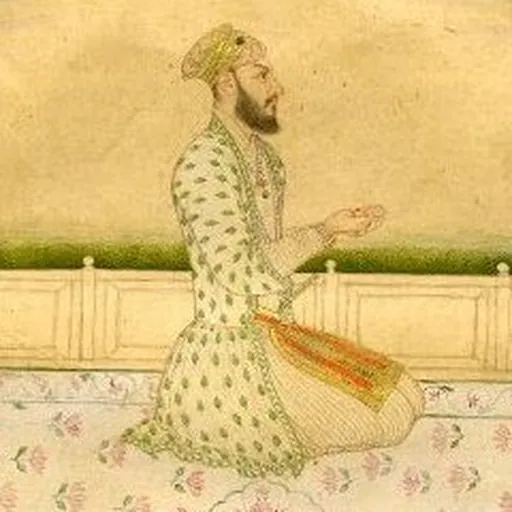
Bidar Bakht
Eldest son of Muhammad Azam Shah and Jahanzeb Begum
About Bidar Bakht
Lived 1670 – 1707 (aged 36).
Muhammad Bidar Bakht (; 4 August 1670 – 20 June 1707) was a Mughal prince. His father, Muhammad Azam Shah, briefly reigned as Mughal emperor in 1707. Bidar was noted for being a gallant, skillful and successful general and was regarded as the most able Mughal prince of his time. He was the favourite grandson of Emperor Aurangzeb. Bidar's mother was a Mughal princess and the daughter of Crown Prince Dara Shikoh, the deceased eldest son and heir-apparent of the previous emperor, Shah Jahan. Aurangzeb showed marks of exceptional love to Azam and Jahanzeb and to Prince Bidar Bakht, lavishing gifts on all three. Bidar Bakht was his grandfather's favourite grandson.
Marriage At the age of sixteen, Bidar Bakht married Shams-un-Nissa Begum (surnamed Puti Begum), the daughter of Qamr-ud-din (titled Mukhtar Khan) on 3December 1686. She belonged to the Ben-i-Mukhtar family which enjoyed great respect among Muslims. Bidar had always showed affection and favour to Shams-un-Nisa, who seems to have been proud and imperious. Shams-un-Nisa gave birth to Bidar's son, Shahzada Firuz Bakht on 23August 1695.
Military commander
In 1688, the Emperor sent the 17-year-old Prince Bidar Bakht to assume supreme command in the Jat War. Bishan Singh Kachhawa, the new Raja of Amber (Jaipur), was appointed as commandant of Muttra with a special charge to root out the Jats. Bidar Bakht infused vigour into the Mughal operations. Bidar Bakht managed to conquer many forts including Tarkand, Navalkhand, Khelna, as well as Sinsani. The Prince laid siege to Fort Sinsani where his troops underwent hardships from the scarcity of provisions and water. They fired a mine, stormed the breach and captured the fort after three hours of obstinate fighting, losing 900 men to 1,500 Jat casualties. The Jat leaders Churaman and Fateh Singh were able to escape. Although Imperial forces were able to win 52 Jat Forts including the strongholds like Khair, Jawar, Sonkh, Sogar, etc. and kill thousands of them they found themselves "at sea with the Jats". The imperial army was called in 1696 from Agra Province. The Jat War remained proved to be a failure.
Bidar Bakht received a royal order, that he should reduce Sorseeny, and return again to the presence. He invested the place for three or four months, and Zorawar Singh, finding his treasure exhausted, delivered himself up. The prince carried him with him to the Deccan, where Aurangzeb caused him to be blown from the mouth of a cannon.
Defeat of Rajaram In 1699 the Emperor sent urgent orders to Bidar Bakht to pursue and defeat the hostile force of Chhatrapati Rajaram at Surat, in the imperial territory. Bidar Bakht was west of Miraj, on his way to Panhala; he immediately turned aside and leaving his family and baggage in Miraj, rapidly advanced on the enemy. Bidar Bakht came upon the Marathas beyond the fort of Parenda. Rajaram stopped in safety further east, while he sent back his generals under Dhanaji Jadhav to check the Prince's advance. After a bloody fight the Marathas were broken and driven towards Ahmednagar on 13 or 14 November. Two days later, the Prince was joined by Chin Qalich Khan at Barsi, east of Parenda, and resuming the pursuit of Ausa on 22 or 23 November.
Viceroyalty
Malwa: 1704–1706
Bidar was appointed Viceroy of Malwa on 3August 1704 by Aurangzeb. The Prince had proved himself a brave and skilful general. He was already the viceroy of Aurangabad and kept that position with his new appointment. He had to shift from Malwa to Khandesh or vice versa as the situation demanded, regarding the tribute which reached Agra from the northern provinces and had to put down the local uprisings of the Bhils and Kolis. These risings were caused by the Maratha invasion of the previous year. The Bhils also caused disturbances on the north-western frontier, building the fort Gagron. After the danger of another invasion by Nima had disappeared, the Prince went to Malwa to escort the tribute. There he fell ill during December 1703 and January 1705 . He appointed Jai Singh II of Amber, his trusted assistant, to escort the tribute and to act as his deputy in Malwa. The Emperor objected to this appointment, ordering the Prince to recall Jai Singh. He appointed Khan Alam instead and ordered that no Rajput was to be appointed as a provincial governor or garrison commander. Bidar Bakht was ordered to go to Sansani, a fort near Bharatpur, which had recently been taken by the Jats and to recapture it. The Prince intend to comply but due to his illness and other engagements in Malwa, did not. During the 1705 rainy season, the Prince stayed in Malwa. During the closing months of 1705, his responsibilities were lightened. The provinces of Aurangabad and Khandesh were taken from his charge and entrusted to his father, Prince Azam, who was now on his way back from Gujarat.
Death of Aurangzeb : 1707 On the 3rd of March 1707 emperor Aurangzeb Alamgir died at his military camp in Ahmadnagar. Prince Bidar Bakht was informed about the death of the emperor by his father Azam Shah who was proclaimed as the new Mughal emperor. On hearing the news of his grandfather's demise Bidar Bakht was overwhelmed with grief. It was reported that the death of the late emperor dwelt long upon the mind of the prince who would frequently weep recollecting the late emperor whom he dearly loved.
Death Bidar Bakht was killed on 20June 1707, during the Battle of Jajau, part of the succession struggle on the death of Emperor Aurangzeb. His father, who had become emperor on the death of Aurangzeb on 17March, was also killed during the battle.
Ancestry
Don’t just read it —
keep it.
Full-length biographies made to live with: read them, listen on the way to work, watch them tonight.
- E-book
- Audio
- Video
Instant download · yours to keep · every purchase keeps this site free
Important facts
Family & relationships
People in Bidar Bakht's life
Named in this biography and alive at the same time



Contemporaries
People whose lives overlapped Bidar Bakht's





Frequently asked questions
Who was Bidar Bakht?
Eldest son of Muhammad Azam Shah and Jahanzeb Begum
When was Bidar Bakht born?
Bidar Bakht was born on 4 August 1670 in Agra.
When did Bidar Bakht die?
Bidar Bakht died on 8 June 1707 in Agra.
Sources & further reading
Cite this page
APA: Biography.guide. (2026). Bidar Bakht. https://biography.guide/bidar-bakht/
MLA: "Bidar Bakht." Biography.guide, https://biography.guide/bidar-bakht/.
Chicago: "Bidar Bakht." Biography.guide. https://biography.guide/bidar-bakht/.
Data last updated: 2026-09-23 · Spot an error? Report a correction.
Portrait: Wikimedia Commons · author & licence
Page generated 2026-09-27 05:05 UTC