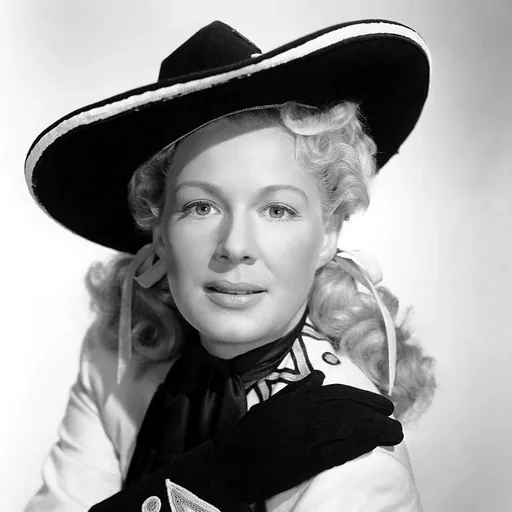
About Betty Hutton
Lived 1921 – 2007 (aged 86). Betty Hutton was an American film actor, singer, stage actor, television actor, actor and dancer.
1941–1949: Paramount contract and breakthrough
When DeSylva became a producer at Paramount Pictures, he offered Hutton a contract with the studio, and she relocated to Los Angeles.
Hutton was one of the many Paramount contract artists who appeared in Star Spangled Rhythm (1942). The same year, she was signed to Capitol Records and recorded several singles over the following years, marking one of the label's earliest recording artists. Meanwhile, Paramount did not immediately promote her to major stardom, but gave the second lead in a Mary Martin film musical, Happy Go Lucky (1943). The response was positive, and Hutton was given co-star billing with Bob Hope in Let's Face It (1943). During that year, she made $1250 per week.
In 1942, writer-director Preston Sturges cast Hutton in The Miracle of Morgan's Creek as a small-town girl who gives local troops a happy send-off and wakes up married and pregnant, but with no memory of who her husband is. The film was delayed by Hays Office objections and Sturges' prolific output, and was finally released early in 1944. The film made Hutton a major star; Sturges was nominated for a Best Writing Oscar, the film was named to the National Film Board's Top Ten films for the year, and the National Board of Review nominated the film for Best Picture of 1944, and awarded Betty Hutton the award for Best Acting for her performance. The New York Times named it as one of the 10 Best Films of 1942–1944.
Critic James Agee noted that "the Hays office must have been raped in its sleep" to allow the film to be released. And although the Hays Office received many letters protesting the film's subject matter, it was Paramount's highest-grossing film of 1944, playing to standing room-only audiences in some theatres.
Hutton was next cast in Paramount's And the Angels Sing (1944) with Fred MacMurray and Dorothy Lamour, and Here Come the Waves (1944) with Bing Crosby. Both were huge hits. DeSylva, one of Capitol's founders, also co-produced her next hit, the musical Incendiary Blonde (1945), where she played Texas Guinan. It was directed by veteran comedy director George Marshall, and Hutton had replaced Lamour as Paramount's top female box-office attraction. Hutton was one of many Paramount stars in Duffy's Tavern (1945), and was top billed in The Stork Club (1945) with Barry Fitzgerald, produced by DeSylva. Hutton went into Cross My Heart (1946) with Sonny Tufts, which she disliked. She did however enjoy the popular The Perils of Pauline (1947), directed by Marshall, where she sang a Frank Loesser song that was nominated for an Oscar: "I Wish I Didn't Love You So". The recording sold over a million copies worldwide, and reached number six in the U.S. charts.
Hutton's relationship with Paramount began to disintegrate when DeSylva left the studio due to illness (he died in 1950). "After he left I started doing scripts that I knew weren't good for me."
Hutton starred in Dream Girl (1948) with MacDonald Carey. Directed by Mitchell Leisen, it is based on the popular Broadway play of the same name by Elmer Rice. A drama, it was her second non-musical film. Her performance was largely well received by critics but the film itself received mixed reviews. Hutton later said Dream Girl, "almost ruined me." After Garland's firing, production on the film came to a halt in May of 1949, as a replacement actress was required. Hutton, Paramount's top female musical attraction, lobbied for the role with both MGM and Paramount, her home studio. An agreement between the studios was reached through a five-month loan-out deal. Paramount loaned Hutton, while MGM loaned Fred Astaire. In her next film, the 1950 musical Let's Dance, she starred with Fred Astaire and was billed above him. But the film was overshadowed by Annie Get Your Gun, which was the third highest grossing film of 1950.
She was one of several stars in The Greatest Show on Earth (1952), an epic drama directed by Cecil B. DeMille about performers in a circus which won two Academy Awards: Best Picture and Best Story. She made an unbilled cameo in Sailor Beware (1952) with Dean Martin and Jerry Lewis, a remake of The Fleet's In, in which she portrayed Dean's girlfriend, Hetty Button.
She starred in Somebody Loves Me (1952), a biography of singers and vaudevillans Blossom Seeley & Benny Fields with Ralph Meeker. During filming, Hutton had vocal surgery to have a wart removed in her throat. She extensively trained her voice to fit Seeley's lower pitch.
Hutton then clashed with Paramount. The New York Times reported that the dispute resulted from her insistence that her husband at the time, choreographer Charles O'Curran, direct her in a film.
In April 1952, Hutton returned to Broadway, performing in Betty Hutton and Her All-Star International Show. In July 1952, she announced that she and her husband would form a production company. She left Paramount in August.
In January 1953, Variety named her the second highest-grossing female star of 1952, behind Elizabeth Taylor, and fifth highest-grossing overall with a total gross of $14,200,000.
Hutton then transitioned to radio work and appeared in Las Vegas, where she had success performing in live theater productions. She had the rights to a screenplay about Sophie Tucker, but was unable to raise funds. Hutton's last completed film was a small one, Spring Reunion (1957). It was a financial disappointment. She also became disillusioned with Capitol's management and moved to RCA Victor. In 1957, she appeared on a Dinah Shore show on NBC that also featured Boris Karloff; the program has been preserved on a kinescope.
1959–1964: Television work Lucille Ball and Desi Arnaz took a chance on Hutton in 1959, with their company Desilu Productions giving her a CBS sitcom, The Betty Hutton Show. Hutton hired the still-blacklisted and future film composer Jerry Fielding to direct her series. They had met over the years in Las Vegas when he was blacklisted from TV and radio and could get no other work, and her Hollywood career was also fading. It was Fielding's first network job since losing his post as musical director of Groucho Marx's You Bet Your Life in 1953 after hostile questioning by the House UnAmerican Activities Committee. The Betty Hutton Show ended after 30 episodes.
Hutton continued headlining in Las Vegas and touring across the country. She returned to Broadway briefly in 1964 when she temporarily replaced a hospitalized Carol Burnett in the show Fade Out – Fade In. She guest-starred on shows such as The Greatest Show on Earth, Burke's Law, and Gunsmoke.
1965–1979: Personal and financial struggles By the early 1960s, Hutton's career had declined significantly, attributed to her chronic depression and addiction to alcohol and prescription drugs. Turner Classic Movies described her career downswing as "one of the grimmest declines in Hollywood history." and the collapse of her last marriage, Hutton's depression and substance abuse escalated. She divorced her fourth husband, jazz trumpeter Pete Candoli, when she discovered he had fallen in love with Edie Adams (who would become Candoli's second wife), and attempted suicide, causing her to lose custody of her youngest daughter, Carolyn, then sixteen years old.
In 1967, she was signed to make a comeback starring in two low-budget Westerns for Paramount, but was fired shortly after the projects began. After losing her singing voice in 1970, Hutton had a nervous breakdown and again attempted suicide. She regained control of her life through rehabilitation and the mentorship of a Catholic priest, Father Peter Maguire. Hutton converted to Catholicism and took a job as a cook and housekeeper
After an aborted comeback in 1974, she was hospitalized with emotional exhaustion.
Hutton appeared in an interview with Mike Douglas and made a brief guest appearance in 1975 on Baretta. In September 1978, Hutton was featured on The Phil Donahue Show, where she discussed her life and career. She was then happily employed as hostess at a Newport, Rhode Island, jai alai arena.
Hutton's rehearsal of the song "Little Girls" was featured on Good Morning America. Her Broadway comeback was also included in a profile on CBS News Sunday Morning about her life, her struggle with pills, and her recovery.
A ninth-grade dropout, Hutton went back to school and earned a master's degree in psychology from Salve Regina University in 1986. During her time at the university, Hutton became friends with fellow student and singer-songwriter Kristin Hersh, and attended several early concerts of Hersh's band, Throwing Muses. Hersh later wrote the song "Elizabeth June" as a tribute to Hutton, and wrote about their relationship in further detail in her memoir, Rat Girl (2010).
After completing her master's degree, Hutton worked as a drama instructor at Emerson College in Boston, Massachusetts.
Hutton's last known performance, in any medium, was on Jukebox Saturday Night, which aired on PBS in 1983. She became estranged again from her daughters.
Personal life Marriages and children Hutton was once engaged to the head of the Warner Bros. makeup department, makeup artist Perc Westmore, in 1942, but broke off the engagement, saying it was because he bored her.
Her first marriage was to camera manufacturer Ted Briskin in September 1945.
Hutton's second marriage in 1952 was to choreographer Charles O'Curran.
Hutton lived in Palm Springs until her death on March 12, 2007, at the age of 86 from complications of colon cancer. She is buried at Desert Memorial Park in Cathedral City, California.
Legacy For her contribution to the motion picture industry, Betty Hutton was awarded a star on the Hollywood Walk of Fame on 2 August 1960, which is located at 6259 Hollywood Boulevard. Hutton was posthumously awarded a star on the Palm Springs Walk of Stars on what would have been her 92nd birthday on 26 February 2013, which is located at 121 S. Palm Canyon Dr. Hutton was one of 500 Hollywood stars nominated by the American Film Institute for the AFI's 100 Years...100 Stars as one of the greatest female stars. Debbie Reynolds started her musical career lip syncing to Hutton's recording of the song "A Square in The Social Circle" written by Ray Evans.
In popular culture Hutton's music has been used in popular media; her recording of "Hit The Road To Dreamland" written by Johnny Mercer & Harold Arlend features in the 1997 film L.A. Confidential. Her music has also featured in the post-apocalyptic franchise Fallout, where her songs "It's a Man" and "He's a Demon, He's a Devil, He's a Doll" appeared in Fallout 4's in-game soundtrack. "It's a Man" also appeared in the 2024 Fallout episode "Target" along with "He's a Demon, He's a Devil, He's a Doll" which appears in the 2025 Fallout second season episode of "The Demon In The Snow".
Hit songs
Filmography + Television Year Title Role Notes 1954 Satins and Spurs Cindy Smathers TV musical 1958 That's My Mom 1 episode (unaired pilot) 1959–1960 The Betty Hutton Show Goldie Appleby 30 episodes 1964 The Greatest Show on Earth Julia Dana 1 episode 1964–1965 Burke's Law Carlene GloryRena Zito 2 episodes 1965 Gunsmoke Molly McConnell 1 episode 1977 Baretta Velma 1 episode (final appearance)
Box-office ranking For several years, film exhibitors voted Hutton among the leading stars in the country: 1944 – 23rd (US) 1945 - 12th (US) 1950 – 15th (US) 1951 – 9th (UK) 1952 – 14th (US), 3rd (UK)
Stage work Two for the Show (1940) Panama Hattie (1940) Betty Hutton and Her All-Star International Show (1952) Gypsy (1962) South Pacific (1962) Annie Get Your Gun (1963) Gentlemen Prefer Blondes (1964) Fade Out – Fade In (1964) (replacement for Carol Burnett) Mary, Mary (1965) Here Today (1966) Here Today (1972) Anything Goes (1973) Annie (1980) (replacement for Alice Ghostley)
Radio appearances Year Program Episode/source April 12, 1942 Command Performance with Gene Tierney - first show from Hollywood June 2, 1942 Command Performance with Mickey Rooney February 6, 1943 Command Performance with Rita Hayworth October 2, 1943 Command Performance with Don Ameche November 13, 1943 Command Performance with Bob Hope May 29, 1948 Command Performance with Bob Hope - sixth-anniversary special February 6, 1950 Lux Radio Theatre "Red, Hot And Blue" 1952 Stars in the Air "Suddenly, It's Spring" April 27, 1953 Lux Radio Theatre "Somebody Loves Me"
Awards and nominations YearAwardCategoryFilmResult 1944 Golden Apple Awards Most Cooperative Actress National Board of Review Awards Best Acting The Miracle of Morgan's Creek 1950 Golden Globe Awards Best Actress in a Motion Picture – Musical or Comedy Annie Get Your Gun Photoplay Awards Most Popular Female Star
Don’t just read it —
keep it.
Full-length biographies made to live with: read them, listen on the way to work, watch them tonight.
- E-book
- Audio
- Video
Instant download · yours to keep · every purchase keeps this site free
Important facts
Family & relationships
People in Betty Hutton's life
Named in this biography and alive at the same time





Related people
Same field, nearest in time



Contemporaries
People whose lives overlapped Betty Hutton's





Frequently asked questions
Who was Betty Hutton?
American actress (1921–2007)
When was Betty Hutton born?
Betty Hutton was born on 26 February 1921 in Battle Creek.
When did Betty Hutton die?
Betty Hutton died on 11 March 2007 in Palm Springs.
What was Betty Hutton's occupation?
Betty Hutton was a film actor, singer, stage actor, television actor, actor and dancer.
What nationality was Betty Hutton?
Betty Hutton was American.
Sources & further reading
Cite this page
APA: Biography.guide. (2026). Betty Hutton. https://biography.guide/betty-hutton/
MLA: "Betty Hutton." Biography.guide, https://biography.guide/betty-hutton/.
Chicago: "Betty Hutton." Biography.guide. https://biography.guide/betty-hutton/.
Data last updated: 2026-09-23 · Spot an error? Report a correction.
Portrait: Wikimedia Commons · author & licence
Page generated 2026-09-27 05:06 UTC