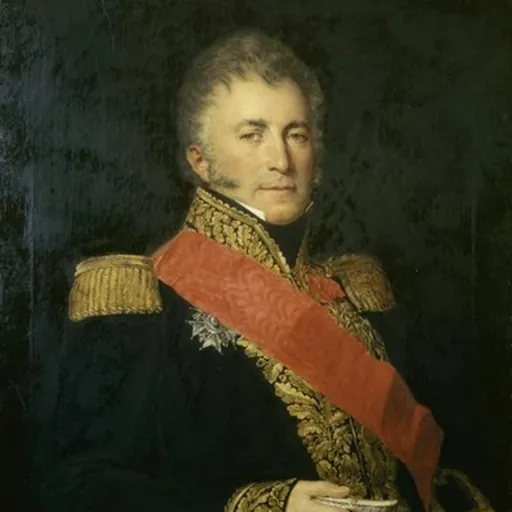
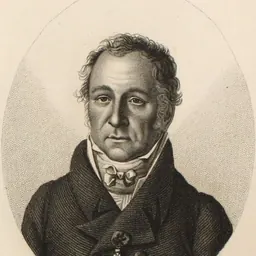
About Bertrand Pierre Castex
Lived 1771 – 1842 (aged 70). Bertrand Pierre Castex was a French politician and military officer.
Bertrand Pierre Castex (; 29 June 1771 – 19 April 1842) was a French cavalry general whose career spanned the Revolutionary and Napoleonic Wars, rising from a volunteer trooper to general of division through sustained battlefield distinction.
The son of a Gascon innkeeper and originally intended for a legal career, Castex joined the revolutionary forces in 1792 and gained early experience in the Pyrenees and Italy before emerging as a talented light cavalry commander. His charge at Jena in 1806 earned Napoleon's personal praise and rapid promotion, followed by hard fighting at Eylau, Friedland, and in the 1809 campaign against Austria, where his exploits at Amstetten and Wagram led to his elevation to general.
Castex commanded a cavalry brigade on the northern flank during the invasion of Russia, fighting at Klyastitsy, Polotsk, and the Berezina, and despite repeated wounds continued to serve in the German and Belgian campaigns of 1813–1814, finishing his career in the Empire as a senior officer in the Imperial Guard. Under the Bourbon Restoration he was retained in high command, accumulated major honours, served briefly as a deputy, and remained a respected military figure until his death in 1842, with his name commemorated on the Arc de Triomphe.
Origins and early life Bertrand Castex was born on 29 June 1771 in the village of Pavie in Gascony. His parents were Blaise Castex (1737–1808), a baker and innkeeper, and his wife Marianne Semont (1745–1777). A younger sister, Jeanne, was born in 1774 before his mother's death three years later. Blaise remarried in 1781, but had no further children.
The Castex family had operated the inn in Pavie for generations, but Blaise Castex had higher ambitions for his son, intending to make him a lawyer. Young Bertrand was sent to the college in Auch at the age of ten, and from there went on to the University of Toulouse. However, with the coming of the French Revolution, a military career beckoned. Sent to fight in the Western Pyrenees, these troops took part in the battle of Sans Culottes Camp before returning to Auch and being incorporated into the regular army as the 24th Chasseurs à Cheval. He took park in the taking of Verona, after which he was promoted to captain on 7 January 1797. On 29 October 1803, he transferred to the 20th Chasseurs à Cheval with the rank of Major. It was at the head of this regiment that he led a dramatic charge at the battle of Jena under the eyes of Napoleon himself. Afterwards, the Emperor told him: "I have long known that the Chasseurs were superior to the Saxons and Prussians; the 7th has just given proof of this. You are a brave man; I appoint you colonel." As the colonel of Castex's own regiment had been killed in action during the battle, Castex was promoted to command the 20th Chasseurs in his place. After the victories in Bavaria in April, Castex was able to write: Three battles, three combats, and as many victories and I am doing well. Bavaria is entirely evacuated and we are marching on Vienna where we will without a doubt arrive in less than a month. The newspapers will give you the other details, until then I am mounting up to be the advance guard of the army. Near Amstetten, Castex at the head of his regiment defeated a force composed of a regiment of Uhlans, one of Hussars, and an infantry battalion. This feat was reported in the 6th bulletin of the Grande Armée, dated Sankt Pölten, 9 May. At the battle of Wagram he captured an infantry square, and was rewarded with promotion to general de brigade. With war with Russia looming, he took command of a cavalry brigade in Münster in November 1811 that would go on to form part of Oudinot's II Corps. Castex fought at the battle of Klyastitsy, where he charged at the head of one of his regiments and took 400 prisoners, and the first and second battles of Polotsk.
During the retreat, Oudinot had introduced Castex to Napoleon saying "Sire, I present to you General Castex; he has as many successes as battles."
On the restoration of the Bourbons, Castex was placed on reserve when the Imperial Guard was disbanded, but he was made a Knight of Saint Louis by the new regime on 13 August 1814. He rejoined the colours during the Hundred Days and commanded the cavalry of Claude Lecourbe's Army of the Jura. After Napoleon's defeat he retired again to his estate in Val-de-Villé. He was made Grand Cross of the Order of Saint Louis on 3 November 1827, but not re-elected to the Chamber. He lost his command after the July Revolution and returned to Alsace, becoming a member of the Bas-Rhin General Council. The couple had ten children, seven of whom lived to adulthood: Charles Pierre Victor (1814–1848), Captain in the infantry, killed in Algeria. Adélaïde-Zoé (1815–1903), married , engineer and officer of the Legion of Honour. Sophie Stéphanie (1822–1856), married Francois Furcy Deval. Ernestine (1825–1911), married Jean-Alexandre de Fleurans, director of the Strasbourg arsenal and officer of the Legion of Honour. Jules Marie (1826–1853), 2nd Lieutenant in the 13th Chasseurs à Cheval Théodore (1828–1898), Chamberlain to Napoleon III Félicité (1830–1849)
Death and legacy Bertrand Castex died in Strasbourg on and buried in the cemetery at Thanvillé. A street in Paris was named after him,
Don’t just read it —
keep it.
Full-length biographies made to live with: read them, listen on the way to work, watch them tonight.
- E-book
- Audio
- Video
Instant download · yours to keep · every purchase keeps this site free
Important facts
People in Bertrand Pierre Castex's life
Named in this biography and alive at the same time
Related people
Same field, nearest in time



Contemporaries
People whose lives overlapped Bertrand Pierre Castex's




Frequently asked questions
Who was Bertrand Pierre Castex?
French politician and officer (1771–1842)
When was Bertrand Pierre Castex born?
Bertrand Pierre Castex was born on 29 June 1771 in Pavie.
When did Bertrand Pierre Castex die?
Bertrand Pierre Castex died on 19 April 1842 in Strasbourg.
What was Bertrand Pierre Castex's occupation?
Bertrand Pierre Castex was a politician and military officer.
What nationality was Bertrand Pierre Castex?
Bertrand Pierre Castex was French.
Sources & further reading
· Wikipedia: Bertrand Pierre Castex
· DBpedia: Bertrand Pierre Castex
Cite this page
APA: Biography.guide. (2026). Bertrand Pierre Castex. https://biography.guide/bertrand-pierre-castex/
MLA: "Bertrand Pierre Castex." Biography.guide, https://biography.guide/bertrand-pierre-castex/.
Chicago: "Bertrand Pierre Castex." Biography.guide. https://biography.guide/bertrand-pierre-castex/.
Data last updated: 2026-09-20 · Spot an error? Report a correction.
Portrait: Wikimedia Commons · author & licence
Page generated 2026-09-27 04:58 UTC