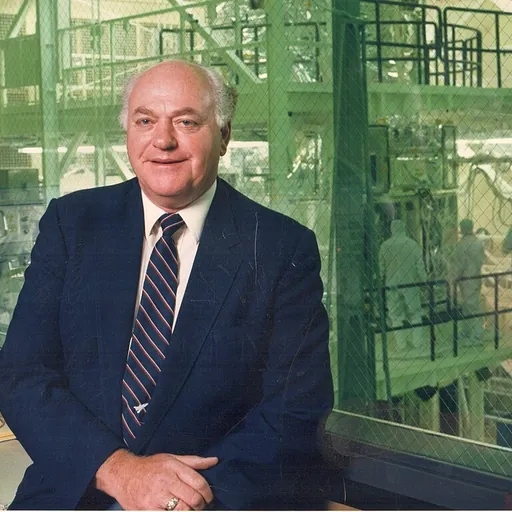
About Bert R. Bulkin
Lived 1929 – 2012 (aged 82). Bert R. Bulkin was an American engineer.
Bertram Raoul Bulkin (July 20, 1929 – March 10, 2012) was an American aeronautical engineer who participated in the first United States photo-reconnaissance satellite programs and is best known for his role in building the Hubble Space Telescope.
Biography
Early life and education Bulkin was born in Brooklyn, New York, the son of David Bulkin and Anne Clara Strauss, both immigrants. He was named after Berel Reven Bulkin, a paternal uncle from the Kiev area of Ukraine. After residing briefly in Springfield, Massachusetts, he and his family returned to Brooklyn, where he attended P.S. 197, an elementary school. Bulkin was graduated from John Marshall High School (Los Angeles, California) in 1946 at age 16. By 1957, he was working as a design engineer. In support of that program, he and William Williamson from the U.S. Army Corps of Engineers designed a SECOR (Sequential Correlation of Range) spacecraft based on the OSCAR (Orbiting Satellite Carrying Amateur Radio) model. Bulkin's colleagues also credited him with proposing the use of ping-pong balls to cool the interior of one satellite module. Corona lore includes the story of another colleague stopped by the California Highway Patrol while driving from the Bay Area to a launch at Vandenberg Air Force Base, unable to explain the cases of ping-pong balls he was transporting in the back of his Ford Thunderbird.
After completing a management course with the Lockheed Management Institute at Santa Clara University in 1965, he became the payload integration manager for the Hexagon, another early satellite reconnaissance program; he served as division manager for experiment design and integration for the Satellite Control Section, a satellite launch vehicle development program in support of the Hexagon, until at least July 1970. From then until 1972, he was the director of advanced project development for the electro-optical division of International Telephone and Telegraph in Fort Wayne, Indiana.
On his return to Lockheed's Sunnyvale location, he was assigned to the company's proposal to build the Support Systems Module or basic spacecraft for the Space Telescope or Large Space Telescope (ST or LST; later renamed the Hubble Space Telescope or HST). Early on, observers noted the design continuity between the systems modules for the Hexagon and the LST. After Lockheed won that contract in October 1977, Bulkin initially managed the equipment section. Lockheed became responsible for the physical integration of all systems aboard the HST.
In 1982, Bulkin was named Program Manager for the LST and was recognized for his leadership role on the program. In that role, he accompanied senior Lockheed officials to hearings before the House of Representatives' Subcommittee on Space Science and Applications on June 16, 1983, and took several questions from the panel on cost, schedule, and performance concerns related to the telescope project.
In January 1985, Robert W. Smith of NASA's Space Telescope History Project interviewed Bulkin, who reviewed several of the design and management issues that had arisen to that time. The disaster that engulfed the Space Shuttle Challenger led to a review of the entire space-shuttle program, delaying the launch of the Hubble from 1986 to 1990.
Bulkin described the April 24, 1990 launch of the Hubble Space Telescope as "like watching your mother-in-law go over a cliff in your brand-new Cadillac." Asked at the time of the launch what scientists hoped to see with the new instrument, he said simply, "God."
On July 10, 1990, Bulkin appeared along with representatives of other companies contributing to the Hubble before the Subcommittee on Science, Technology, and Space of the Committee on Commerce, Science, and Transportation. He appeared as Lockheed's Director of Scientific Space Programs to respond to Congressional concerns about flaws discovered in the Optical Telescope Assembly prepared for the HST by Hughes-Danbury (Perkin Elmer).
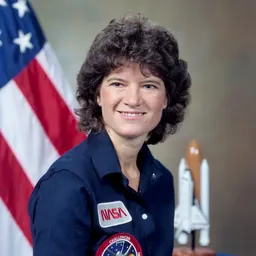
Bulkin also oversaw Lockheed's contributions to the Spitzer Space Telescope or Space Infrared Telescope Facility (launched 2003), the Gravity Probe B or Einstein Experiment (launched 2004), the Solar Probe (projected for 2018), and the ongoing Mission to Planet Earth, a NASA program proposed by physicist and astronaut Sally Ride in the 1987 Ride Report to improve the prediction of Earth's climate, weather, and natural hazards. He retired as Lockheed's Director of Scientific Space Programs in 1992
• Independent Review Team for the Lyman-Spitzer Infrared Telescope
• Assessment of Options for Extending the Life of the Hubble Space Telescope (2004)
Death Bulkin died of complications from a heart attack at Lodi Memorial Hospital on March 10, 2012,
Awards
Pioneer of Space Technology (for work on the Corona project) (CIA; 1985) Distinguished Public Service Award (NASA; March 21, 1991) Lodi Hall of Fame (Lodi, California; 2008)
Don’t just read it —
keep it.
Full-length biographies made to live with: read them, listen on the way to work, watch them tonight.
- E-book
- Audio
- Video
Instant download · yours to keep · every purchase keeps this site free
Important facts
People in Bert R. Bulkin's life
Named in this biography and alive at the same time



Related people
Same field, nearest in time





Contemporaries
People whose lives overlapped Bert R. Bulkin's

Frequently asked questions
Who was Bert R. Bulkin?
American aeronautical engineer
When was Bert R. Bulkin born?
Bert R. Bulkin was born on 20 July 1929 in Brooklyn.
When did Bert R. Bulkin die?
Bert R. Bulkin died on 10 March 2012 in Lodi.
What was Bert R. Bulkin's occupation?
Bert R. Bulkin was an engineer.
What nationality was Bert R. Bulkin?
Bert R. Bulkin was American.
Sources & further reading
Cite this page
APA: Biography.guide. (2026). Bert R. Bulkin. https://biography.guide/bert-r-bulkin/
MLA: "Bert R. Bulkin." Biography.guide, https://biography.guide/bert-r-bulkin/.
Chicago: "Bert R. Bulkin." Biography.guide. https://biography.guide/bert-r-bulkin/.
Data last updated: 2026-09-24 · Spot an error? Report a correction.
Portrait: Wikimedia Commons · author & licence
Page generated 2026-09-27 05:08 UTC