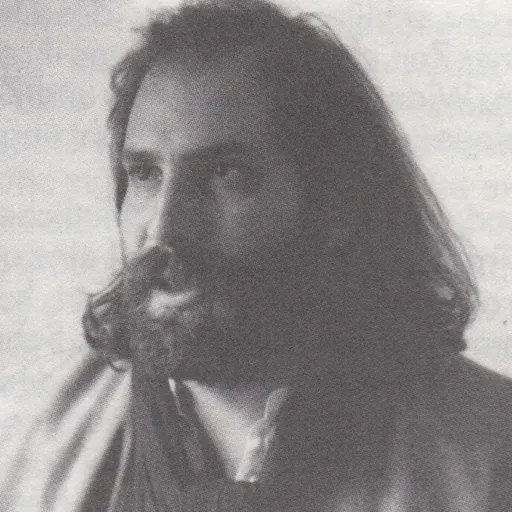
About Bernardo Kuczer
Lived 1955 – 2023 (aged 68). Bernardo Kuczer was an Argentine composer, architect, painter and music theorist.
Bernardo Mario Kuczer (30 April 1955 – 22 June 2023 ) was an Argentinian composer, music theoretician and architect.
Biography
Argentina Bernardo Mario Kuczer was born in Buenos Aires, Argentina, on 30 April 1955. Until his early twenties, he was involved in rock music as composer and guitarist, also writing music for the theatre. Simultaneously, he studied architecture and graduated in 1978.
Through the study of the classical guitar with Hector Rocha and then with Jorge Panitsch he came into classical music. He studied harmony and musical analysis with Nestor Zadoff and then with Sergio Hualpa and later Renaissance counterpoint with Nestor Zadoff. He became a member of an interdisciplinary music investigation group, collaborating with psychologists, biologists, doctors and musicologists.
In 1979 he presented a thesis under the supervision of Sergio Hualpa with own ideas about "the Basic Components of Music, their multiple interrelations and a special kind of "energy" generated by their uni- and multidimensional dynamic interactions, an energy which determines and enables the micro and macro Articulation of the Music-stream". The thesis was first named: "La forma natural de la música" ("The natural ways of music"), then "The New Connections" and later "Música sin el Factor Humano" ("Music without the Human Factor").
Europe In 1980, Kuczer went to London to study the viola da gamba, abandoning it shortly after for starting composition.
His first ensemble piece ("Even ... the loudest sky") (1981) for saxophone quartet, was selected by the British SPNM (Society for the Promotion of New Music) for the "composers' week-end", London 1981.
Kuczer arrived in Freiburg in 1983 to study composition with Brian Ferneyhough. He felt however very soon the need to continue his way in music alone.
In 1984 he was invited to participate of the "International Summer Courses for New Music" at Darmstadt, where several pieces of his tape-cycle Civilización o Barbarie received a first performance and where he was awarded, as first Latin American composer, the "Kranichsteiner Musikpreis" (Kranichstein Music Prize).
In 1986, for the next edition of the Darmstadt Courses, he was invited to perform a second concert with works of his tape-cycle.
Civilización o Barbarie was later selected, as personal choice of the jury, by Klaus Huber (one of the three jurors), for the "World Music Days" of the ISCM (International Society for Contemporary Music) held in 1987 in Cologne.
During 1990 he was a stipendiary of the "Heinrich-Strobel-Stiftung" (Heinrich Strobel Foundation) of the broadcasting service Südwestrundfunk.
After 1999 he remained apart and distant to the active music and concert scene.
Since 2000, he has been working extensively with computers, designing, writing and developing his own computer programs. These programs, which are based on and are used to further research his personal hypotheses, models and theoretical ideas about harmony, rhythm, sound, musical form and "Music-Stream", have also been used to generate his latest digital, computer and algorithmic generated works.
At times and complementary to his main musical activities, Kuczer has been active in other fields of art. He has produced more than 1000 paintings, drawings, sculptures, as well as designed his own furniture. As a writer he has written some 250 poems and two (still unpublished) books, the title of the first one being: "Salvas de Guerra" (contra La Música)" ["War Salvos" (against Music)]. He also produced and musicalised an own documentary film: "Vida?"(por un Espacio Poético o una Poesía del Espacio-Tiempo), una documentación" ["Life?" for a Poetic Space or a Space-Time Poetry, a documentation].
Work and performances Kuczer's musical oeuvre comprises more than 81 (principal) works (with some 110 individual "named" pieces) covering different areas of music (e.g. instrumental music, tape music, electroacoustic music, computer music, algorithmic compositions and digital music).
More than 60 of his works have remained unperformed (and mostly unrevealed). Several of his instrumental pieces were and/or are still considered unplayable. His Saxophone Quartet (1981) was first regarded as unplayable until 1994, when it was given its first performance. Some of his works have been played and broadcast in various European cities and elsewhere.
Examples: London: „Composers' Weekend“, 1981 Darmstadt: Darmstädter Ferienkurse, 1984 and 1986 Como: „18° festival internazionale, autunno musicale“, 1984 Milan: „Musica del nostro tempo“, 1987 Freiburg: „Horizonte Reihe“, 1984 Paris: „Perspectives du XXe siècle“ (Carte blanche à Harry Halbreich), 1985 Stockholm: „International Festival of Electronic Music“, 1985 Freiburg: „Aventure Freiburg“, 1987 Mönchengladbach: „Ensemblia Festival“, 1987 Cologne: Weltmusiktage der IGNM, 1987 Frankfurt: Hessischer Rundfunk, 1989 Los Angeles: Arnold Schoenberg Institute, 1990 Witten: Wittener Tage für neue Musik, 1994 Basel: IGNM Basel, 1995 Piteå: Piteå University, 1995 Bremen: Festival „Transit“ Orte/NichtOrte, 1999 Montreal: World Saxophone Congress, 2000
Press reviews ... the real revelation of this disc is Argentinian Bernardo Maria Kuczer, whose "even ... The loudest sky!!" is one of the wildest things I've heard for some time. Brilliantly written (fiendishly difficult) and played with utter conviction, it makes you wonder what Kuczer's been up to since he wrote this back in 1981. Anything new by either Kuczer or [the saxophone ensemble] Xasax is welcome here.
On the 2 May 1996, Fara C. wrote in the music magazine World: ..., and " Even … The loudest sky!!! ", composed by the Argentine Bernardo Kuczer in 1981.
This work reaches a summit of complexity such as it had never been played before the world creation of Xasax in 1994 ! Six months of hard work were necessary to the group to triumph over these supernatural seven minutes. A musical intensity which the quartet will make us share with crazy pleasure.
The Belgian musicologist Harry Halbreich wrote a review about the Darmstadt International Summer Courses of New Music 1984, published in the monthly magazine Le Monde de la musique:
However, the end of the evening had to be spent... in the company of the Argentinian Bernardo Kuczer living in Germany and some of his apocalyptic electroacoustic pieces grouped into an immense cycle under the title Civilización o Barbarie. I admit that I fled. But two days later I was able to hear again, at a somewhat more bearable volume level, these extraordinary pieces of music of a visionary madman, skinned alive, bleeding shreds of flesh of a prodigious expressive power, produced, paradoxically, with a simple cassette tape recorder!
Work list Articulaciones II (1980), for two alto recorders (or two equal wind instruments), tuned at a quarter tone difference Seis estudios sobre la disonancia simple y la mixtura de lenguas (1980), for choir Huella (1981), for flute Dualidades (1981), for piano Drei'h (1981), for clarinet Even ... the loudest sky (1981), for saxophone quartet A-gent's Arguum (1982), for viola La Distancia IV (un fragmento) 1982–83, for flute, bass clarinet, violoncello and piano towards a New Brutality (1983), nine studies Study Nº 1: (Historias Naturales), for percussion and (digital) Sound-Space (*) Study Nº 2: (Soul-Lage), for voice in a Sound-Space (*) Study Nº 3: (La vuelta al día Ia), for percussion (two roto-toms) (*) Study Nº 4: (memorias de un pasado por suceder...) (1983), for two percussionists, voice, tape and electronices Study Nº 5: (La vuelta al día II: de Spatium Natura), for Space-Percussion (*) Study Nº 6 & 7: (Twin dances) Nº 6 dance A, for percussion and (digital) Sound-Space (*) Nº 7 dance B, for percussion and (digital) Sound-Space (*) Study Nº 8: (El espejo y la lámpara I), for percussion (*) Study Nº 9: (El espejo y la lámpara II), for voice and percussion (*) (*) revised in 2012, now existing only as digital version Civilización o Barbarie (1984), a cycle comprising the following 18 individual tape pieces: Peripéteia II (1984), tape music Peripéteia III (1984), tape music Peripéteia IV (1984), tape music Peripéteia V (1984), tape music Peripéteia VI (1984), tape music Peripéteia VII: Iña'K (1984), tape music Peripéteia VIII: Periplo (1984), tape music Une mémoire la vie (1984), tape music Cri de la mémoire fermée (1984), tape music Finale, ou la mémoire pulsante (1984), tape music Contre-rime (1984), tape music Him'l (1984), tape music Dream-line (1984), tape music One other desert (1984), tape music Escenas-Miró (1984), tape music Ejercicio de aire (1984), tape music Hole the black (1984), tape music ... und Stille daneben (1984), tape music K'tedral (1984–85) for viola formas y fluidos II–VII (1985) for piano Form-Memory (1986), tape music Memory-Form (1986), tape music Equations of change (1987), computer music In search of the Engram (1986–88, 89–90), for wind quintet Zeitschlag -Brücken (zer-)schlagen- (1991–2001), a cycle comprising the following 8 pieces (with possible amplification and/or electronic processing): FORM I (1991–98), for viola, cello and 1 or 2 pianos or for cello and piano FORM II (1991–98), for viola, cello and (1 or) 2 pianos FORM III (1991–98), for viola and piano FORM IV (1991–98), for viola, cello and 1 or 2 pianos ZickZackZeit (1991–97), for violin Zeit-Raum-Zerre II (1991–99), for cello Zeit-Raum-Zerre III (1991–99), for viola and cello Ziele umzingelnd (2000–01), for violin, viola and cello (String trio) Cosmografía -Panopticum Armonicum- (2002–04), for piano Sinfines (2002–04), for piano, piano four hands or two to five pianos La vuelta al día Ic (1983, 2000, 2006) (computer generated versions and scores), for 1, 2, 3, 4, 6 or 8 percussionists Resistencia de la materia (2011–12), a cycle comprising the following 5 independent digital works: Tungsteno (2011–12), digital music Casi Ayer (2011–12), digital music Siglo XX: Un Respiro (2011–12), digital music A-Sintaxis III (2011–12), digital music Siglo XX, Pequeño Epitafio Nº2: Esmeril (2011–12), digital music Trenzados americanos (2011–12), digital music Drama de amar (2011–12), for digital percussion, digital music Malambo (2011–12), digital music Cuicantos (2011–12), for digital percussion ensemble, digital music (*) Sureña Ic (2012), for piano (*) (*) these pieces belong to the so-called Apócrifos americanos, a series of composer aided, computer generated studies Sendas negras (2012), for percussion ensemble Schwarmverhalten I (1986–2012), digital music Schwarmverhalten II (1986–2012), digital music Schwarmverhalten III (1986–2012), digital music Auf Wachstum und Gedeih (2012), digital music Máximos y Mínimos (en un Nanocosmos) (2012–13), a collection of 27 digital works Música de cámara Nº1 (algo oscura) (2013), digital music Música de cámara Nº2 (donde hubo fuego) (2013), digital music Juego de engranajes (2013), digital music Gris ardiente (2013), digital music Los Pasos Perdidos (2013), digital music Lo heterogéneo (2013–14), a cycle comprising nine independent digital works, belonging to four different groups: Tres Hibridaciones (2013), a group of three independent digital works Canticum Sacrum Non (2013), digital music Formas nobles y melancólicas (2013), digital music Tourdion (et basse) (2013), digital music Una Decantación (2014), comprising a single independent digital work Un sol menor (2014), digital music Tres Aleaciones (2014), a group of three independent digital works Stehe hier nicht still... (2014), digital music Marcha plana (2014), digital music Tres ceremonias (an der Schmelzgrenze) (2014), digital music Dos Imbricaciones (2014), a group of two independent digital works Imbricación I (Süredrath) (2012, 2014), digital music Imbricación II (Silétsere) (2014), digital music La rueca de Mahatma (natura subascolta II) (2014), digital music W(e)aving (Ein Heldentod (sic)), Digitale Tondichtung (2013–14), digital music Kalte Töne (2013–14), digital music Todo y Molécula (2013–14), a cycle comprising 6 independent digital works 1) Materia prima I, set 1c (Custos Horologii) (2014), digital music 2) Materia prima II (Magma) (2014), digital music 3) Materia prima III (Música Seca I) (2014–16), digital music 4) Materia prima IV (Schwere Schwebstoffe) (2014–16), digital music 5) Materia prima VI (Enigma XXI) (2014), digital music 6) Materia prima VII (Traits and Trails) (2014), digital music Heridas (2016), digital music Exploración Diagonal Nº2 (2014–17), digital music Anima XM'ch'na I (Principal Pieces) (2017-2021), algorithmic compositions, digital music Nº5 (XM'nc'ng) (2018) Nº10 (XM'm'ri's) (2018) Nº12 (XM'sh) (2018) Nº13 (XM'rr'r) (2018) Nº14 (XM'sur's) (2018) Nº16 (XM'n'l'g) (2019) Nº18 (XM'n'l'th) (2019) Nº19 (XM'd'nt) (2019) Nº21 (XM'sa'k) (2019) Nº23 (XM'nt'cs) (2019) Nº24 (XM'ns'ons) (2019) Nº29 (XM'b) (2019) Nº30 (XM'sts) (2019) Anima XM'ch'na I, Addendum (Secondary Pieces) (2017-2021), algorithmic compositions, digital music Nº1 (XM'ng'lia) (2017) (**) Nº2 (XM'r'ñao) (2017) (**) Nº3 (XM'g'n'tio) (2018) (*) Nº7 (XM'n'us) (2018) (***) Nº11 (XM'nf'st) (2018) (*) Nº15 (XM'dn'ght) (2019) (*) Nº20 (X(M)p'nto) (2019) (*) Nº22 (XM'ths) (2019) (*) Nº25 (XM'ss1) (2019) (*) Nº26 (XM'ss3) (2019) (*) Nº27 (XM'ss4) (2019) (*) Nº28 (XM'ss5) (2019) (*)
Note: the pieces, result of automatic generation and creation processes, were then (loosely) classified into the following categories: (*) Genéricos Instrumentales (Gramática de la (N.) Música (standard)), (**) Genéricos Globales (World Music), (***) Genéricos Americanos.
Nº 11 (XM'nf'st II) (2018) (digital piano sound), algorithmic composition, digital music Aftermat(h) (2020) (digital piano sound), algorithmic composition, digital music
Don’t just read it —
keep it.
Full-length biographies made to live with: read them, listen on the way to work, watch them tonight.
- E-book
- Audio
- Video
Instant download · yours to keep · every purchase keeps this site free
Important facts
People in Bernardo Kuczer's life
Named in this biography and alive at the same time



Related people
Same field, nearest in time



Contemporaries
People whose lives overlapped Bernardo Kuczer's

Frequently asked questions
Who was Bernardo Kuczer?
Argentinian composer, music theoretician and architect
When was Bernardo Kuczer born?
Bernardo Kuczer was born on 30 April 1955 in Buenos Aires.
When did Bernardo Kuczer die?
Bernardo Kuczer died on 22 June 2023.
What was Bernardo Kuczer's occupation?
Bernardo Kuczer was a composer, architect, painter and music theorist.
What nationality was Bernardo Kuczer?
Bernardo Kuczer was Argentine.
Sources & further reading
Cite this page
APA: Biography.guide. (2026). Bernardo Kuczer. https://biography.guide/bernardo-kuczer/
MLA: "Bernardo Kuczer." Biography.guide, https://biography.guide/bernardo-kuczer/.
Chicago: "Bernardo Kuczer." Biography.guide. https://biography.guide/bernardo-kuczer/.
Data last updated: 2026-09-23 · Spot an error? Report a correction.
Portrait: Wikimedia Commons · author & licence
Page generated 2026-09-27 05:07 UTC