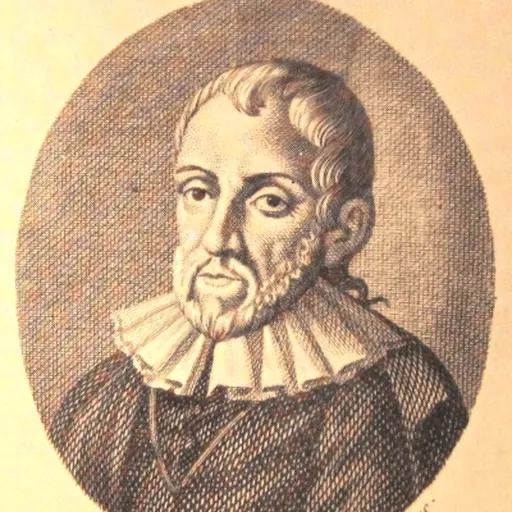
About Bernardino Telesio
Lived 1509 – 1588 (aged 78). Bernardino Telesio was a philosopher and naturalist.
Bernardino Telesio (; 7 November 1509 – 2 October 1588) was an Italian philosopher and natural scientist. While his natural theories were later disproven, his emphasis on observation made him the "first of the moderns" who eventually developed the scientific method.
Biography Telesio was born of noble parentage in Cosenza, a city in Calabria, Southern Italy (Kingdom of Naples). He was educated in Milan by his uncle, Antonio, himself a scholar and a poet of eminence, and afterwards in Rome and Padua. His studies included a wide range of subjects, classics, science and philosophy, which constituted the curriculum of the Renaissance savants. Thus equipped, he began his attack upon the medieval Aristotelianism which then flourished in Padua and Bologna and he wrote some short poems, brought back to light by Luca Irwin Fragale in 2010. In 1553 he married and settled in Cosenza, becoming the founder of the Cosentian Academy. From 1544 to 1550 and after 1565 he lived in the household of Alfonso III Carafa, Duke of Nocera.
In 1552 Telesio married Diana Sersale, a widow with two children, with whom he had four children, the eldest of whom, Prospero, was mysteriously killed in 1576. After the death of his wife, Pope Pius IV offered him the Archbishopric of Cosenza, but Telesio refused in favour of his brother Tommaso. Bernardino spent the last years of his life in Cosenza where he took over the philosophical-scientific "Telesian" Academy that had been started by Aulo Giano Parrasio.
He died in Cosenza in 1588, famous among scholars and his students, but opposed by the Church for the heterodox views which he maintained against the established Aristotelianism. Pope Clement VIII placed his books on the Index of Prohibited Books in 1596.
Works
His work De Rerum Natura Iuxta Propria Principia (On the Nature of Things according to their Own Principles) appeared in 1565 and the complete edition of nine books was published in 1586. These were followed by a large number of scientific and philosophical works of subsidiary importance, added to bolster his major work.
Besides De Rerum Natura, his other works include: De Somno De his quae in aere fiunt De Mari De Cometis et Circulo Lactea De usu respirationis. he does acknowledge him as being "the first of the moderns" (De Telesio autem bene sentimus, atque eum ut amantem veritatis, & Scientiis utilem, & nonnullorum Placitorum emendatorem & novorum hominum primum agnoscimus., from Bacon's De principiis atque originibus) for putting observation above all other methods for acquiring knowledge about the natural world. This frequently quoted phrase from Bacon, though, is misleading, for it oversimplifies and misrepresents Bacon's opinion of Telesio. Most of Bacon's essay is an attack on Telesio and this phrase, invariably taken out of context, has facilitated a general misconception of Telesian natural philosophy by giving it a Baconian stamp of approval, which was far from Bacon's original intentions. Bacon sees in Telesio an ally in the fight against ancient authority, but he has little positive to say about Telesio's specific theories.
What is perhaps most striking about De rerum natura is Telesio's attempt to mechanize as much as possible. Telesio clearly strives to explain everything in terms of the matter informed by hot and cold and to keep his arguments as simple as possible. When his discussions turn to human beings he introduces an instinct of self-preservation to account for their motivations. And when he discusses the human mind and its ability to reason in the abstract about immaterial and divine topics, he adds a soul. For without a soul, all thought, by his reasoning, would be limited to material things. This would make God unthinkable and clearly, this was not the case, for observation proves that people think about God.
Don’t just read it —
keep it.
Full-length biographies made to live with: read them, listen on the way to work, watch them tonight.
- E-book
- Audio
- Video
Instant download · yours to keep · every purchase keeps this site free
Important facts
Related people
Same field, nearest in time



Contemporaries
People whose lives overlapped Bernardino Telesio's



Frequently asked questions
Who was Bernardino Telesio?
Italian philosopher
When was Bernardino Telesio born?
Bernardino Telesio was born on 7 November 1509 in Cosenza.
When did Bernardino Telesio die?
Bernardino Telesio died on 2 October 1588 in Cosenza.
What was Bernardino Telesio's occupation?
Bernardino Telesio was a philosopher and naturalist.
Sources & further reading
· Wikipedia: Bernardino Telesio
Cite this page
APA: Biography.guide. (2026). Bernardino Telesio. https://biography.guide/bernardino-telesio/
MLA: "Bernardino Telesio." Biography.guide, https://biography.guide/bernardino-telesio/.
Chicago: "Bernardino Telesio." Biography.guide. https://biography.guide/bernardino-telesio/.
Data last updated: 2026-09-23 · Spot an error? Report a correction.
Portrait: Wikimedia Commons · author & licence
Page generated 2026-09-27 05:07 UTC