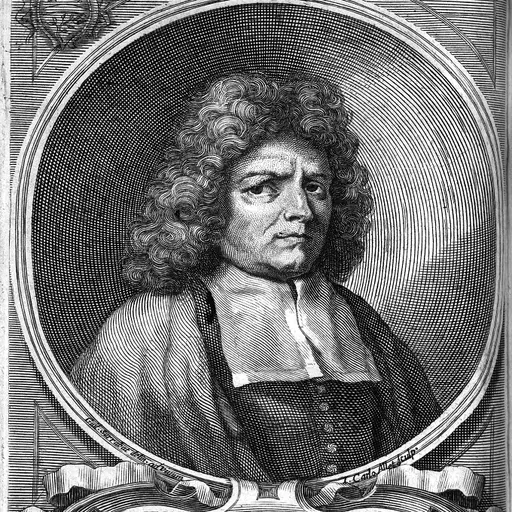
About Bernardino Genga
Lived 1620 – 1690 (aged 69–70). Bernardino Genga was a physician and anatomist.
Bernardino Genga (1620–1690) was a scholar of Classical medical texts, editing several works of Hippocrates. He also had a great interest in the preparation of anatomical specimens as well as the anatomy of ancient Greek and Roman sculpture. These interests led to his work at the French Academy in Rome, where he taught anatomy to artists.
Biography Bernardino Genga's Anatomia per Uso et Intelligenza del Disegno (Rome: Domenico de' Rossi, 1691). Bernardino Genga was born in Mondolfo in the Duchy of Urbino and died in Rome, where he practiced surgery in the Hospital of Santo Spirito in Sassia and San Giacomo degli Incurabili. An authoritative anatomist and surgeon in Rome, Genga stressed the importance of solid anatomical knowledge for the surgeon.
In 1672, he published his noted Anatomia Chirurgica, a textbook for surgeons which went through a number of editions. This work has been called the “first book devoted entirely to surgical anatomy” (Garrison-Morton 384) and remained a widely used manual for at least fifty years. In the tract appended to this work, Genga showed himself to be one of the first Italians to accept Harvey's theory on the circulation of the blood. But Genga also maintained that the discovery was made by Colombo and Cesalpino before Harvey.
A year after his death was published the beautiful Anatomia per Uso et Intelligenza del Disegno, which consisted of renderings of his anatomical preparations by the artist Charles Errard (1606–1689), director of the Accademia, and most likely engraved by François Andriot (died 1704). Giovanni Maria Lancisi (1654–1720), the Papal physician, edited the work and provided much of the commentary.
Anatomia per Uso et Intelligenza del Disegno consists of 59 copperplate engravings of text and illustrations printed on one side only. After the engraved title is a plate with allegorical emblems of death. Of the illustrated plates, the first 23 deal with osteology and myology drawn from Genga's anatomical preparations. The remainder consists of representations of antique statues viewed from different angles, including the Farnese Hercules, the Laocoön (without his sons), the Borghese Gladiator, the Borghese Faun, the Venus de Medici, the Boy with Thorn, and the Amazon of the House of Cesi. A variant of this work lacks the final three images and contains the words "libro primo" on the engraved title, though there was never a libro "secundo" published.
An English translation of the work appeared in London in 1723 under the title, Anatomy Improv'd. The plates were re-engraved by Michael Vandergucht and others after the original edition published at Rome in 1691.
Works Anatomia chirurgica cioe Istoria anatomica dell'ossa, e muscoli del corpo humano, con la descrittione de vasi piu riguardeuoli che scorrono per le parti esterne, & un breue trattato del moto, che chiamano circolatione del sangue di Bernardino Genga da Mondolfo, Roma, per Nicolò Angelo Tinassi, 1672. Anatomia per uso et intelligenza del disegno ricercata non solo su gl'ossi, e muscoli del corpo humano, ma dimostrata ancora su le statue antiche più insigni di Roma: delineata in più tavole con tutte le figure in varie , e vedute, Roma, per Domenico de Rossi, 1691. In Hippocratis Aphorismos ad chirurgiam spectantes, commentaria. Eminentissimo, ac reuerendissimo principi Francisco Mariae cardinali Medices dicata a Bernardino Genga, Roma, Stamperia Camerale, 1694.
Gallery of Prints
Don’t just read it —
keep it.
Full-length biographies made to live with: read them, listen on the way to work, watch them tonight.
- E-book
- Audio
- Video
Instant download · yours to keep · every purchase keeps this site free
Important facts
People in Bernardino Genga's life
Named in this biography and alive at the same time




Related people
Same field, nearest in time


Contemporaries
People whose lives overlapped Bernardino Genga's



Frequently asked questions
Who was Bernardino Genga?
Italian medical scholar
When was Bernardino Genga born?
Bernardino Genga was born in 1620 in Mondolfo.
When did Bernardino Genga die?
Bernardino Genga died in 1690 in Rome.
What was Bernardino Genga's occupation?
Bernardino Genga was a physician and anatomist.
Sources & further reading
Cite this page
APA: Biography.guide. (2026). Bernardino Genga. https://biography.guide/bernardino-genga/
MLA: "Bernardino Genga." Biography.guide, https://biography.guide/bernardino-genga/.
Chicago: "Bernardino Genga." Biography.guide. https://biography.guide/bernardino-genga/.
Data last updated: 2026-09-20 · Spot an error? Report a correction.
Portrait: Wikimedia Commons · author & licence
Page generated 2026-09-27 04:58 UTC