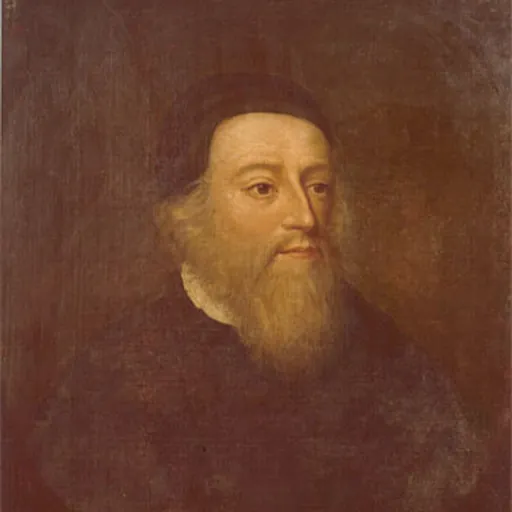
About Bernard Gilpin
Lived 1517 – 1583 (aged 65–66). Bernard Gilpin was an English theologian.
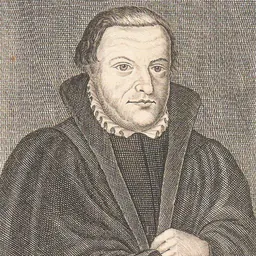
Bernard Gilpin (1517 – 4 March 1583), was an Oxford theologian and then an influential clergyman in the emerging Church of England spanning the reigns of Henry VIII, Edward VI, Jane, Mary and Elizabeth I. He was known as the 'Apostle of the North' for his work in the wilds of northern England.
His theological position was not in accord with any of the religious parties of his age. He initially backed transubstantiation at Oxford under Henry, but was not satisfied with the Elizabethan settlement, had great respect for the Church Fathers, and was with difficulty induced to subscribe in 1571.
The views of Edwin Sandys, Archbishop of York on the Eucharist horrified him; but on the other hand the Puritans had some hope of his support and he maintained friendly relations with the Protestant Thomas Lever and James Pilkington (Bishop of Durham from 1561) and Thomas Lever. His parents were Edwin and Margaret (née Layton), the latter being niece of Cuthbert Tunstall, Bishop of London and then of Durham, and executor of Henry VIII's estate. George Gilpin was Bernard's elder brother.
Life Early life Memorial of 1901 by the Keswick School of Industrial Art in St. Cuthbert's Church, Kentmere Kentmere Hall, birthplace and childhood home of Bernard Gilpin. He was born at Kentmere Hall, and grew up in the Kentmere valley; the parish church of St Cuthbert is today little changed from mid seventeenth century drawings, and its churchyard contains a yew tree known to Gilpin, being certified over 1,000 years old. He is recorded to have entered Lancaster Royal Grammar School in the 1530s
Oxford He entered Queen's College Oxford in 1533. He graduated Bachelor of Arts (B.A.) in 1540, Master of Arts (M.A.) in 1542 and Bachelor of Divinity (B.D.) in 1549. He was elected fellow of Queen's and ordained in 1542, though he later declined an offer of that college's provostship in 1561.
Subsequently he was elected Student of Christ Church. He was a diligent student of the writings of Erasmus but whilst still at Oxford initially adhered to the conservative side. He defended the doctrines of the church against those who would later become victims of the Marian Persecutions, and in particular John Hooper, one of the first four Marian Martyrs.
Pietro Martire Vermigli, a leading Italian Reformer, was appointed to the chair of Divinity of Oxford and in the course of his Lectures on 1st Corinthians attacked the "Romish doctrine" of transubstantiation. In the subsequent debate one of his opponents was Gilpin, along with Doctors Tresham, Chedsey and Morgan.
Edward and Mary In November 1552 he was presented to the vicarage of Norton, in the diocese of Durham. Persons appointed to livings in Royal patronage at that time were required to preach before the King, that there might be an opportunity of ascertaining their orthodoxy. Accordingly, on the first Sunday after Epiphany 1553 Gilpin went to Greenwich to preach in the Royal presence. His sermon on sacrilege is extant and displays the high ideal he had formed of the clerical office. His contemporary John Knox, later a Presbyterian, was another. He was also a clergyman in the Diocese of Durham, at Berwick-upon-Tweed and Newcastle, between 1549 and 1554. On Mary's accession in 1553 he went abroad to pursue his theological investigations at Leuven, Antwerp and Paris; and from a letter dated 1554, we get a glimpse of the quiet student rejoicing in an "excellent library belonging to a monastery of Minorites."
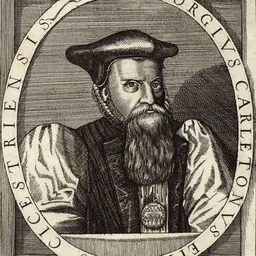
Rector of Houghton-le-Spring Attacks Returning to England towards the close of Queen Mary's reign, he was invested in 1556 by his mother's uncle, Cuthbert Tunstall, bishop of Durham, with the archdeaconry of Durham, to which the rectory of Easington was annexed. He gained enemies from his wide-ranging attacks on the vices of his time, especially those of the clergy, and he was formally brought before the bishop on a charge consisting of thirteen articles. Tunstall, however, not only dismissed the case in 1557, but also presented Gilpin with the rich living of Houghton-le-Spring; and when the accusation was again brought forward, he again protected him. ) was George Carleton, Bishop of Chichester (1619–1628).
Grieved at the ignorance and superstition which the remissness of the clergy permitted to flourish in the neighbouring parishes, he used every year to visit the most neglected parts of Northumberland, Yorkshire, Cheshire, Westmorland and Cumberland and therefore continually had to pay for an assistant to tend to his own flock back in Houghton.
Glove
The boldness which he could display at need is well illustrated by his action in regard to duelling. Finding one day a challenge-glove stuck up on the door of a church where he was to preach, he took it down with his own hand, and proceeded to the pulpit to inveigh against the unchristian custom. His tomb is in Houghton-le-Spring Church.
Reception
Carleton published his Vita Bernardi Gilpini in 1628. This was published in English in 1638 as The Life of Bernard Gilpin along with the text of the Sermon preached before Edward VI in 1552. The Reverend C. S. Collingwood's Memoirs of Bernard Gilpin was published in 1884, whilst Gilpin also appears in stained glass in the Anglican cathedrals in Durham and Liverpool.
In 1888 Arthur Wollaston Hutton asked William Ewart Gladstone "in what sense he understood the existence of a spiritual continuity between the ancient Catholic Church and the existing Church of England" and received a letter in reply stating that before the Reformation and "before Anglicanism had a recognised existence as a form of thought" he should look for it mainly in men like John Colet and after that in men like Gilpin. Hutton mentioned this in his introduction to S. R. Maitland's 1899 Essays on the Reformation, adding: Although this hardly involves continuity in the sense in which the question was asked, the conjunction of these two names strikes me as particularly happy : for, while both of them were Catholic priests by ordination, neither of them could he described as Roman in their sympathies; indeed, it would be truer to say of both that their tone of mind, as ecclesiastics and as educationists, was more what would now he reckoned as Anglican.
And the name of Bernard Gilpin suggests the lines on which a true, popular history of the Reformation might be written. Born in 1517 and dying in 1583, ordained in the reign of Henry VIII, selected to preach before Edward VI, presented to an important benefice in the north of England in the reign of Mary, and holding it until his death, he might seem an obvious butt for satire on the laxity of conscience in those who conformed throughout the Reformation period. But a study of his life would tell a very different tale, and show a man of deep Christian convictions and unimpeachable honesty, deservedly held in honour, not only by the conforming priests of whom he was one, and who formed of course the great majority of the clergy of the Church of England during the early years of Elizabeth's reign, but also by the new men, ordained under the new regime.
An historical romance, based on the life of Bernard Gilpin, concerning whom a good deal is known, and illustrated, by a competent historical scholar, with accurately stated incidents, in which the religious life of the Reformation period should be depicted, as graphically as Newman in Callista, or Pater in Marius the Epicurean, deincted the growth of Christian ideas in the early centuries of our era – such a book would certainly go far to fill the vacant place to which at the outset I referred; and might, in the guise of fiction, obtain a wide circulation and popular acceptance, doing thus a great service to the cause of historical truth.
Don’t just read it —
keep it.
Full-length biographies made to live with: read them, listen on the way to work, watch them tonight.
- E-book
- Audio
- Video
Instant download · yours to keep · every purchase keeps this site free
Important facts
People in Bernard Gilpin's life
Named in this biography and alive at the same time



Related people
Same field, nearest in time



Contemporaries
People whose lives overlapped Bernard Gilpin's





Frequently asked questions
Who was Bernard Gilpin?
English theologian
When was Bernard Gilpin born?
Bernard Gilpin was born in 1517 in Kentmere.
When did Bernard Gilpin die?
Bernard Gilpin died on 4 March 1583.
What was Bernard Gilpin's occupation?
Bernard Gilpin was a theologian.
What nationality was Bernard Gilpin?
Bernard Gilpin was English.
Sources & further reading
Cite this page
APA: Biography.guide. (2026). Bernard Gilpin. https://biography.guide/bernard-gilpin/
MLA: "Bernard Gilpin." Biography.guide, https://biography.guide/bernard-gilpin/.
Chicago: "Bernard Gilpin." Biography.guide. https://biography.guide/bernard-gilpin/.
Data last updated: 2026-09-20 · Spot an error? Report a correction.
Portrait: Wikimedia Commons · author & licence
Page generated 2026-09-27 04:58 UTC