
About Bernard Bosanquet
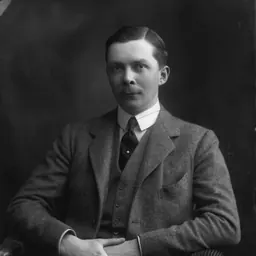
Lived 1877 – 1936 (aged 58). Bernard Bosanquet was a British cricketer.
Bernard James Tindal Bosanquet (13 October 1877 – 12 October 1936) was an English cricketer best known for inventing the googly, a delivery designed to deceive the batsman. When bowled, it appears to be a leg break, but after pitching the ball turns in the opposite direction to that which is expected, behaving as an off break instead. Bosanquet, who played first-class cricket for Middlesex between 1898 and 1919, appeared in seven Test matches for England as an all-rounder. He was chosen as a Wisden Cricketer of the Year in 1905.
Bosanquet played cricket for Eton College from 1891 to 1896, before gaining his Blue at Oriel College, Oxford. He was a moderately successful batsman who bowled at fast-medium pace for Oxford University between 1898 and 1900. As a student, he made several appearances for Middlesex and achieved a regular place in the county side as an amateur. While playing a tabletop game, Bosanquet devised a new technique for delivering a ball, later named the "googly", which he practised during his time at Oxford. He first used it in cricket matches around 1900, abandoning his faster style of bowling, but it was not until 1903, when he had a successful season with the ball, that his new delivery began to attract attention. Having gone on several minor overseas tours, Bosanquet was selected in 1903–04 for the fully representative Marylebone Cricket Club (MCC) tour of Australia. During that tour, he made his Test debut for England and although he largely failed as a batsman, he performed well as a bowler and troubled all the opposing batsmen with his googly.
More success followed; in the 1904 season, he took more than 100 wickets and his bowling career peaked when he took eight wickets for 107 runs in the first Test against Australia in 1905 to bowl England to victory. However, he never mastered control of good length bowling and remained an erratic performer. After 1905, Bosanquet's bowling went into decline; he practically gave it up and made fewer first-class appearances owing to his business interests. After taking part in the First World War in the Royal Flying Corps, he married and had a son, Reginald Bosanquet, who later became a television newsreader. He died in 1936, aged 58.
Early life Bosanquet was born in Bulls Cross, Enfield, Middlesex, on 13 October 1877. He was one of five children of Bernard Tindal Bosanquet and his wife Eva Maude Cotton, daughter of Sir William James Richmond Cotton; Bosanquet had a younger brother and three sisters. His younger brother Nicolas Edmund Tindal Bosanquet also played cricket for Eton. Many of his relations were well known in their fields, including his uncle and namesake Bernard Bosanquet the philosopher. His grandfather, James Whatman Bosanquet, was a banker and achieved distinction as a biblical historian. His father worked for the banking firm Bosanquet & Co., and became a partner in a firm of hide, leather, and fur brokers in London; he was also High Sheriff of Middlesex from 1897 to 1898 and captained Enfield cricket club. His great-grandfather, Sir Nicolas Conyngham Tindal, was Chief Justice of the Common Pleas between 1829 and 1846.
After going to Sunnymede School in Slough, Bosanquet attended Eton College between 1891 and 1896. Against Winchester College, he took three wickets and scored 29 not out in the second innings, while at Lord's Cricket Ground against Harrow School, Bosanquet scored 120 runs in 140 minutes. At this time, he bowled fast-medium pace, while as a batsman he had developed, in the words of his obituary in The Times, "a rather curious, wristless style; stiff and yet powerful". In all first-class matches in 1898, Bosanquet scored 168 runs at a batting average of 14.00 and took 30 wickets at a bowling average of 18.70. At the end of the season, he joined a team led by Plum Warner which toured America, where he had further success as a bowler. He scored three further fifties for Middlesex and once took five wickets in an innings, but bowled comparatively rarely, only once bowling more than 13 overs in an innings. In other sports, he received half-Blues for hammer-throwing and billiards, and also played ice hockey.
Developing the googly
Genesis
Bosanquet is remembered as the inventor of the googly, a delivery designed to deceive the batsman. When bowled, it appears to be a leg break, but after pitching the ball turns in the opposite direction to that expected, behaving as an off break instead. Consequently, Bosanquet decided to change his style. According to his own account, his inspiration came in the mid-1890s, from a table-top game he often played called Twisti-Twosti; the object was to bounce a tennis ball on a table so that it could not be caught by an opposing player. Bosanquet began to experiment with ways of throwing the ball so that, after pitching, it turned and spun in an unexpected direction, without his opponent detecting any difference in the delivery. A slightly different version of events was provided by the son of Louise Bosanquet, Bernard's cousin, who claimed in 1965 that Bosanquet conceived the idea in 1890 and practised bowling to Louise with a tennis ball from 1893 onwards. There were later suggestions that other cricketers invented the googly before Bosanquet. In 1935, Jack Hobbs wrote that Kingsmill Key, a former captain of Surrey, told him that the googly was invented by an Oxford student, Herbert Page, in the 1880s. Key claimed that Page bowled the delivery regularly, but never used it in a first-class match.
Practising throughout 1899 and 1900, Bosanquet began to use the googly in minor matches before using it in important cricket. His first use of the new delivery in first-class cricket came in the match against Leicestershire in 1900 in which he scored two centuries. In the second innings, Samuel Coe had scored 98 when Bosanquet, still known as a fast-bowler, bowled his off break; the ball bounced four times and the batsman was stumped (although, writing in 1925, Bosanquet recalled Coe had been bowled). Bosanquet later wrote that the wicket "was rightly treated as a joke, and was the subject of ribald comment". But Bosanquet persisted with the delivery and soon began to be noticed by influential cricketers who recognised the potential of the googly. Previously, some bowlers occasionally bowled unintended googlies, but were unable to control them.
It was around 1903 that Bosanquet's delivery first became known as a "googly". Some have suggested a Maori origin for the word, although other explanations include a derivation from "guile" meaning cunning, or from the word "googler", meaning a high, flighted delivery at the time.
Regular use in County Cricket Apart from some early season games for MCC and A. J. Webbe's XI, all of Bosanquet's cricket in 1901 was for Middlesex. However, the tour was more notable for an incident in the match against Canterbury. Bosanquet had taken an early wicket in the first innings, but bowled poorly afterwards. He was the fourth bowler used in the second innings and with his third ball, it looked as if he had bowled Walter Pearce behind his legs as he attempted a big hit. However, both umpires were unsighted and the non-striker Arthur Sims, who also had his view obscured, urged Pearce not to leave the middle. The tourists' wicket-keeper, Arthur Whatman, Bosanquet and other English players surrounded the umpire, who decided Pearce was not out. Bosanquet then turned to Sims and said: "You're a nice cheat. I bowled him round his legs. Anybody could see that." As a bowler, he took eight wickets at 42.75. Many critics were impressed by the wicket-taking potential of googly bowling on hard pitches and Warner later described Bosanquet's bowling as causing a sensation. he took six wickets in consecutive innings against Surrey and Kent, going on to take 10 wickets in the latter match. He also took 12 wickets in a match for Warner's team against a touring side, the Gentlemen of Philadelphia. Although no Test matches were played that season, Warner believed that Bosanquet's form would have gained him a place in a representative side. Before the tour began, Sussex and England batsman C. B. Fry wrote an open letter to Warner in the Daily Express, stating Warner "must persuade that Bosanquet of yours to practise, practise, practise those funny 'googlies' of his till he is automatically certain of his length. That leg-break of his which breaks from the off might win a test match!"
MCC tour of Australia
Bosanquet was one of the few bowlers in the MCC team not to have some success in the opening two matches of the tour, although he impressed Warner. In addition, he scored 79 runs with the bat in the second game. The third match of the tour was against New South Wales; Bosanquet took four for 60, and his googly caused many problems, particularly for Australia's opening batsman Reggie Duff. He continuously defeated the batsmen, maintaining his length effectively through the innings. By this stage of the tour, Warner believed that Bosanquet was potentially the best bowler in a strong attack if he could bowl a good length, particularly on hard, fast pitches which normally would favour the batsmen. However, Bosanquet's bowling form remained erratic; in a minor match against a weak side, the opposing captain made a joke about his team's bowling being no worse than Bosanquet's.
Bosanquet played in the first Test against Australia, making his Test debut for England. Australia batted first and recovered from a poor start to score 285 runs; Bosanquet took the wickets of Warwick Armstrong and Syd Gregory with googlies to finish with two for 52 in 13 overs. He scored a single run when he batted, out of an English total of 577. In the second innings he bowled 23 overs and took one for 100. The English bowlers came under heavy punishment from the Australian batsmen; Victor Trumper scored an unbeaten 185 and the team reached 485. England needed to score 194 to win and Bosanquet came to the wicket with 13 needed to win; he scored one run before the winning hit was made. A hand injury forced Bosanquet to miss the second Test. However, with England 2–0 up in the series, he returned for the third Test. On a very good pitch for batting, Bosanquet took three for 95 in an Australian innings of 388, and none of the batsmen were comfortable batting against his googly. When England replied, Bosanquet was out for 10 runs, hitting a poor shot as his team were bowled out for 245. In Australia's second innings, Bosanquet bowled badly at first, delivering full tosses and long hops at the end of the third day's play. Next morning, his bowling improved as he established a good length, delivering a spell of seven overs in which he took four wickets for 23 runs, again causing confusion with his googly. |group=note However, his bowling was poor; Warner wrote that Bosanquet "bowled abominably". Against New South Wales, a team the tourists regarded as the biggest challenge outside of the Test matches, Bosnanquet was very successful. In the first innings, he scored 54 runs in 65 minutes, then took two for 51 with the ball. When the MCC batted again, he played an innings which Warner called the best of his career. Unbeaten on 17 at the start of the third day, Bosanquet scored 97 runs in 65 minutes before being dismissed for 114. Bosanquet followed this with figures of six for 45, including two wickets bowled by the googly.
The fourth Test proved to be the crucial game of the series. England scored 249, of which Bosanquet made 12 before falling to the final ball of the first day, and Australia replied with 131. Bosanquet was required to bowl only two overs. He failed again in the second innings, scoring seven but England reached 210. Australia required 329 to win, which was considered possible on a good pitch; Warner recorded that Australia's batsmen believed their team to be favourites. Bosanquet came on to bowl shortly before the tea interval and immediately took the wickets of Clem Hill and Syd Gregory. He went on to take another four wickets, at one point having taken five wickets for 12 runs, to complete figures of six for 51. England won by 157 runs to ensure they could not lose the series, being 3–1 up with one game remaining. Australia recorded a consolation victory in favourable conditions for the bowlers in the final Test, and Bosanquet scored 20 runs in the match and bowled four overs without taking a wicket. In the final match of the tour, Bosanquet scored 22 and took three for 70 in the first innings, one wicket coming when the batsman gave a catch to the wicketkeeper from a wide ball which bounced three times.
In all first-class matches on the tour, Bosanquet scored 587 runs at an average of 36.68 and took 37 wickets at an average of 27.27. Following the team's return home, Bosanquet wrote an article giving his impressions of the tour for Wisden. The main Wisden report stated: "Bosanquet's value with the ball cannot be judged from the averages, as on his bad days he is, as everyone knows, one of the most expensive of living bowlers. When he was in form the Australians thought him far more difficult on hard wickets than any of the other bowlers, Clement Hill saying, without any qualification, that his presence in the eleven won the rubber."
The reaction of crowds in Australia was slightly different. According to Justin Parkinson, in his book on the history of English leg spin, they took to "calling Bosanquet 'Elsie', a tribute to the elaborate, supposedly effeminate jumpers he wore." They also named the googly delivery a "Bosie". However, this may have been more than a simple shortening of his name. According to Parkinson, it may have referred to the nickname ("Bosey") of Lord Alfred Douglas who was widely known to have had a homosexual affair, a criminal act at the time, with Oscar Wilde. This remained a topical subject, and the source of humour, in Australia. Parkinson suggests that the anonymous originator of the name "Bosie" for the googly must have been aware of the association. He also notes that the other common term in Australia for the googly was "wrong 'un", which was slang for both "criminal" and "homosexual". Parkinson suggests that these two terms for the googly, the nickname "Elsie", were attempts to "label the whole English ruling class as effete".
1904 season The 1904 season was Bosanquet's best with bat and ball. Although he made a slow start batting, failing to reach double figures in six of his first nine innings, he was immediately successful with the ball. He took nine for 107 for MCC against the touring South African team and seven for 83 for I Zingari against Gentlemen of England, going on to take 11 wickets in the latter match. Then for Middlesex, he scored 110 in 85 minutes with 16 fours, in a tied match against the South Africans, and 126 in two hours against Surrey including a five and 16 fours. (In England at the time, the ball had to be hit out of the ground to be worth six and there was no equivalent to the Australian rule for hitting the ball over the boundary for five.) Five runs could only be scored from one shot by running. This preceded his selection for two Gentlemen v Players matches in six days. In the first at Lord's, he scored nine and 22 and took four wickets in the match. At the Oval, he hit 145 in 210 minutes with two fives and 15 fours. After taking two for 97 in the Players' first innings, he took six for 60 in the second to give the Gentlemen their second victory in a week. In a loss to Lancashire, the eventual 1904 County Championship winners, Bosanquet took six for 99 for Middlesex and in a drawn game against Yorkshire, who finished second in the table, he scored 141 and took 10 for 248. He also took eight for 53 in the second innings to bowl Middlesex to victory and give him 11 wickets in the game. Bosanquet was selected for the opening Test match, his first such appearance in England. In England's first innings, he assisted in a recovery, making his highest Test score of 27. Australia took a first innings lead, but despite a failure by Bosanquet, England scored 426 for five declared in their second innings. Australia were set 402 to win, which was considered unlikely in the time available so the tourists had to bat until the end of the game to achieve a draw. The pitch remained good for batting and Australia reached 62 without losing a wicket. Subsequently, Bosanquet took five quick wickets, including a good catch from his own bowling to dismiss Hill, to reduce Australia to 100 for five. Although the tourists managed a partial recovery, Bosanquet continued to take wickets. With very little time remaining owing to poor light—if play had stopped, Australia would have achieved a draw—he took the last wicket to fall, giving England a 213-run victory. Bosanquet had taken his best Test figures of eight for 107. Wisden reported: "The Englishmen owed everything to Bosanquet ... He gained nothing from the condition of the ground, the pitch remaining firm and true to the end."
After two county matches in which he did little with bat or ball, Bosanquet played in the second Test. However, in his two innings, he scored only six and four not out, and did not bowl in the only innings. The almanack also commented in the report on the first Test: "In the first flush of his triumph his place in the England team seemed secure for the whole season, but he never reproduced his form, and dropped out of the eleven after the match at Leeds."
In the remainder of the season, Bosanquet never took more than three wickets in an innings, although he scored a century against Essex and three other fifties. He played for the Gentlemen against the Players scoring 38 and 19 but did not take a wicket in the 17 overs he bowled. In 1912, he played for Middlesex against the Australians but did not bat or bowl, before appearing in three festival games in August and September.
Style and technique
After he became a leg break bowler, Bosanquet bowled the ball very slowly and did not look dangerous. However, while still appearing to bowl a leg break, he could deliver an off break which confused the best batsmen in the world and this googly was recognised as a completely new style of delivery. The unfamiliarity of this type of bowling increased his effectiveness on the occasions when he could bowl a good length. But he was never a reliable bowler; on other occasions, he bowled long hops and full tosses giving away easy runs. Warner noted that Bosanquet had been "described as the 'worst best bowler' in the world".
Bosanquet did not bat in a style typical of a cricketer from Eton, where batsmen were taught to play with style and grace. In Australia, Bosanquet was troubled by fast pitches and struggled against bowlers such as Monty Noble and Bert Hopkins who could make the ball move towards him through the air. He could hit the ball hard, particularly when driving.
As the googly caused a sensation following its invention, many other cricketers tried to emulate Bosanquet. Reggie Schwarz, the South African cricketer who played for Middlesex, learned how to bowl the googly through observation of Bosanquet; Schwarz in turn passed it on to the South African bowlers Aubrey Faulkner, Bert Vogler and Gordon White. These four raised the bowling of the googly to a high standard and raised fears of the detrimental effect it would have on batting. Following the development of googly bowling by South Africans, it was further refined by English and Australian cricketers until it became firmly established. In later years, the googly was blamed for a deterioration in the quality and attractiveness of batting. Bosanquet refused to accept any blame and published a defence in The Morning Post during 1924, later reprinted in Wisden, which humorously downplayed the impact of the googly. He wrote: "It is not for me to defend it. Other and more capable hands have taken it up and exploited it, and, if blame is to be allotted, let it be on their shoulders. For me is the task of the historian, and if I appear too much in the role of the proud parent, I ask forgiveness." On one occasion, Nottinghamshire batsman William Gunn was stumped after running down the pitch in an attempt to stop a ball bowled by Bosanquet. Gunn's teammate Arthur Shrewsbury then protested that Bosanquet's bowling was unfair. For many years, the googly remained known as a "Bosie" in Australia. His Times obituary stated, "No man probably has in his time had so important and lasting an influence on the game of cricket".
Don’t just read it —
keep it.
Full-length biographies made to live with: read them, listen on the way to work, watch them tonight.
- E-book
- Audio
- Video
Instant download · yours to keep · every purchase keeps this site free
Important facts
People in Bernard Bosanquet's life
Named in this biography and alive at the same time




Related people
Same field, nearest in time


Contemporaries
People whose lives overlapped Bernard Bosanquet's



Frequently asked questions
Who was Bernard Bosanquet?
English cricketer (1877-1936)
When was Bernard Bosanquet born?
Bernard Bosanquet was born on 13 October 1877 in Bulls Cross.
When did Bernard Bosanquet die?
Bernard Bosanquet died on 12 October 1936 in Ewhurst, Surrey.
What was Bernard Bosanquet's occupation?
Bernard Bosanquet was a cricketer.
What nationality was Bernard Bosanquet?
Bernard Bosanquet was British.
Sources & further reading
· Wikipedia: Bernard Bosanquet
· DBpedia: Bernard Bosanquet (cricketer)
Cite this page
APA: Biography.guide. (2026). Bernard Bosanquet. https://biography.guide/bernard-bosanquet/
MLA: "Bernard Bosanquet." Biography.guide, https://biography.guide/bernard-bosanquet/.
Chicago: "Bernard Bosanquet." Biography.guide. https://biography.guide/bernard-bosanquet/.
Data last updated: 2026-09-26 · Spot an error? Report a correction.
Page generated 2026-09-27 05:14 UTC