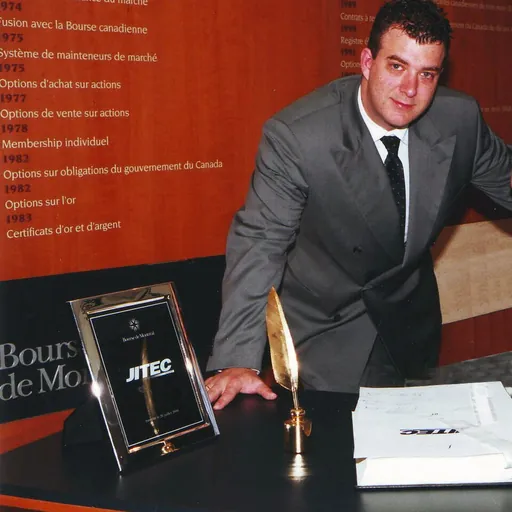
About Benoît Laliberté
Born 1972. Benoît Laliberté is a Canadian businessperson.
Benoît Laliberté (born July 18, 1972) is a Canadian entrepreneur, inventor and is currently the CEO of Investel Capital Corporation and United American Corp. He is the founder of JITEC, Vectoria Inc., TeliPhone Corp., the New York Telecom Exchange Inc and Teliphone Navigata-Westel. Laliberté’s personal net worth was estimated at more than C$345 million. In 2016, Laliberté’s iFramed patent portfolio was appraised at approximately US$1 billion by TechInsights, a Silicon Valley patent analysis firm.
Earlier in his career, Laliberté gained some notoriety in Canada and in Quebec with JITEC. In July 2000, JITEC was listed on the Montreal Exchange following an initial public offering during the height of the technology market expansion a public company which at its peak in 2000 had an estimated value of $CDN575 million. In a 2000 interview, Benoit Laliberte stated that JITEC was “provoking a revolution in the way people do computing,” At a time when the term “cloud computing” had not yet entered mainstream use, JITEC’s approach anticipated what would later become widely known as cloud-based infrastructure and managed services. The company’s early emphasis on remote management, shared resources, and subscription-style access positioned it as a precursor to the cloud computing model that would emerge in the following decade. In 2016, Investel filed patent litigation against Snapchat in United States district court of Los Angeles and in Federal Court of Canada relating to Geofence geofiltering technology. More recently, he invented several technologies in telecommunications, social media, and information technology (IT).
Early years and beginnings (1986–1993) Benoît Laliberté was born in Mont-Saint-Hilaire, Québec, Canada. The company claimed the system could detect and prevent computer virus activity in real time. However, technical specialists expressed skepticism regarding the breadth of such claims. Vectoria computer announced that it would stop using Intel’s Pentium processor and instead adopt the California-made NexGen Nx586 RISC microprocessor (Reduced Instruction Set Computer), which it described as faster and more efficient.
In 1994, Laliberté created Vectoria Inc., a portfolio of companies involved in software, information technology, and telecommunications. In conjunction with Vectoria, JITEC created the first electronic virus immune computer using its Electronic Virus Activity Control (EVAC) technology. EVAC was built into computer servers to immediately detect and prevent viruses. By 1996, JITEC had CDN$7 million in annual sales and 45 employees.
In 1997, Laliberté created Windows Based Intelligent Terminals (WINBIT) and POWERVEC servers. He worked with Microsoft to develop the first generation of cloud computing services. In July 2000, JITEC was listed on the Montreal Stock Exchange after a successful IPO. At this point, Laliberté's personal net worth was in excess of $345 million.
JITEC IPO
In early 2000, JITEC announced plans to go public on the Montreal Exchange. By 1996, he was described as the sole owner of JITEC, operating company-owned stores and franchises, selling Vectoria computers, and supplying computer, software, networking, and maintenance services to small businesses. The company’s public-market story also emphasized its thin-client/network-computing model for small and medium-sized businesses, which was presented as a lower-cost alternative to conventional Personal computer ownership. JITEC’s stock experienced sharp volatility in the weeks following its market debut, drawing attention from regulators and investors. On October 13, 2000, the QSC was investigating trading in JITEC shares amid concerns about irregular transactions. During this period, attention turned to a dispute between Benoit Laliberté and Montreal businessman Herbert Black, chief executive of American Iron & Metal.
On October 14, 2000, a clash between Laliberté and Black was described as scrutiny increased around JITEC’s public disclosures and market activity.
Trading ban and leadership crisis
On November 11, 2000, the QSC issued a personal trading ban preventing Laliberté from trading JITEC shares. The same day, Laliberté was accused by regulators of supporting trading activity in his own stock. The president of JITEC had been prohibited from securities transactions during the investigation. On November 13, 2000, Laliberté stepped aside temporarily as chief executive officer while the probe continued. The following day, the head of the company had stepped down amid mounting controversy. On November 23, 2000, Laliberté resigned as the scandal deepened. The company sought a replacement for Laliberté as regulators and shareholders intensified scrutiny. That same day, Laliberté resigned as president of JITEC.
Shareholder litigation and public fallout
In November 2000, investors were considering legal action related to losses incurred during the stock’s decline. A class action petition was filed naming Laliberté and financial intermediaries including CIBC Capital Markets and Canaccord Genuity. Laliberté was named in a lawsuit related to the drop in share price. Herbert Black had initiated legal proceedings while also being a prominent figure in the unfolding dispute.
Company restructuring and transition
Following Laliberté’s resignation, JITEC appointed new leadership and adjusted its board structure. In December 2000, JITEC named a new chief executive officer and continued efforts to stabilize operations.
Herbert Black and QSC controversy (2000–2005)
Herbert Black became a recurring figure in coverage of the JITEC troubles after he complained to the QSC about suspected irregular trading in the company’s shares. Black, the chief executive of American Iron & Metal, was described as having provided information to regulators after meeting Laliberté at a Montreal restaurant in September 2000. Trudeau said the money was a gift and that he had not provided a service to Black in exchange for it, while Laliberté’s litigation alleged that Trudeau had leaked confidential material. In January 2001, securities authorities lifted certain restrictions, allowing Laliberté to trade JITEC shares again under specified conditions. In June 2001, shareholders were asked to vote on the company’s future direction as trading resumed after a prolonged halt. By 2001, the company adopted the name Advantage Link Inc., a rebranding widely interpreted as an attempt to distance itself from the JITEC controversy. During this period, Paul Massicotte, president of Groupe Alexis Nihon and later a Canadian senator at the Senate of Canada, served as chairman of the board during the crisis years. The company also recruited Alex Delisle, a former senior executive at Hewlett-Packard, as chief executive officer in an effort to stabilize operations.
Financial distress and investor concerns
Throughout 2001, concerns continued about Advantage Link’s financial position, including questions about receivables and cash reserves. In March 2001, JITEC’s cash position was under pressure and certain amounts were considered potentially uncollectable. Laliberté also faced allegations of defaulting on debts connected to the company’s finances. In May 2001, securities investigations cleared Laliberté of certain wrongdoing allegations in relation to early trading activity. However, the company’s shares continued to face volatility as the broader technology boom collapsed. The entire affair has been widely reported in Canadian media. On September 23, 2013, the Montreal newspaper La Presse published an article on Laliberté, which chronicled his business life since 2000.
Class actions and civil proceedings (2002)
By 2002, shareholder litigation expanded, with courts authorizing proceedings related to alleged stock losses. In September 2002, a Quebec judge approved a lawsuit over stock losses involving JITEC and related defendants.
In October 2014 the case was settled for 9.85 million. A court-appointed claims administrator is currently in the process of dealing with all claims in the matter.
Lawsuits against brokers and securities regulator (2003)
In October 2003, Laliberté filed a civil lawsuit against brokerage firm Canaccord Genuity seeking damages related to transactions during the JITEC period. In November 2003, Laliberté launched a major lawsuit against the QSC, alleging abusive and reckless conduct during the investigation. The action was described as a $117-million claim against the regulator, one of the largest suits of its kind filed in Quebec securities history. Laliberté sought damages exceeding $100 million in relation to the collapse of JITEC’s market value.
Transition to AMF enforcement (2004)
In 2004, the Autorité des marchés financiers (Quebec) (AMF) replaced the QSC as Quebec’s securities regulator and continued enforcement actions arising from the JITEC matter. In October 2004, the AMF pursued statute proceedings against Laliberté, seeking substantial financial penalties. Laliberté could face sanctions of up to $1 million under Quebec securities law. Prosecutors alleged Laliberté had promoted contracts and commercial arrangements that regulators argued did not materialize as publicly presented. Testimony related to corporate announcements issued during the rapid rise of JITEC’s stock price in 2000. In November 2007, courtroom exchanges included Laliberté denying wrongdoing and attributing the collapse of the company’s share price in part to external market pressures and actions by critics. On February 22, 2008, Laliberté was found guilty on multiple securities-related counts. The court concluded that certain public statements made during the 2000 period constituted violations of Quebec securities law. The AMF had initially sought penalties totaling approximately C$1.2 million. In May 2009, Laliberté was found guilty on three additional counts connected to the JITEC matter. The proceedings extended over several years and involved numerous counts relating to securities infractions. He was found guilty of stock market manipulation in 2008. In September 2010, a court ordered Laliberté to pay increased financial penalties as part of enforcement actions arising from the convictions. The refusal to grant leave to appeal marked the conclusion of the principal criminal proceedings arising from the JITEC investigation. TeliPhone was described as an Voice over Internet Protocol telecommunications provider offering hosted business telephony and IP-based services. In December 2012, TeliPhone acquired Vancouver-based Navigata Communications 2009 Inc., forming what was later referred to as TeliPhone Navigata-Westel. In November 2016, 8640025 Canada Inc., doing business as Teliphone Navigata-Westel Communications, filed for court protection under the Companies' Creditors Arrangement Act in the Supreme Court of British Columbia, and Ernst & Young was appointed as monitor and directed to manage the business. On September 28, 2017, the monitor closed an agreement under which Distributel acquired the assets of TNW and took over associated operations. BCE later reported that the proposed acquisition of Distributel was valued at up to C$335 million, based on the achievement of certain performance objectives.
New York Telecom Exchange (NYTEX)
Laliberté was associated with the New York Telecom Exchange (NYTEX), a company described as a telecommunications commodity exchange. In 2012, Teliphone acquired New York Telecom Exchange from United America Corp.
TNW Wireless
In 2017, TNW Wireless Inc., a company controlled by Investel Capital Corporation and previously known as RuralCom Corporation, applied to the Canadian Radio-television and Telecommunications Commission (CRTC) for mandated wholesale mobile wireless roaming agreements from Bell Mobility Inc. and TELUS Communications Inc. pursuant to the Commission’s wholesale wireless framework. The company structures properties through trusts that are divided into 1,000 digital units offered to the public, along with a separate occupancy token granting usage rights. Dome-shaped structures housing cryptocurrency mining equipment were installed on agricultural land in Sainte-Marie-Madeleine, Quebec. The installations were described as data-processing facilities designed to support high-capacity digital asset mining operations. The same report also stated that related expansion plans contemplated the reuse of waste heat from the mining and data-processing operations to support adjacent greenhouse facilities. Quebec Commission for the Protection of Farmland (CPTAQ)
In July 2018, Commission de protection du territoire agricole du Québec (CPTAQ) ruled that cryptocurrency mining did not constitute an agricultural activity under provincial land-use legislation and ordered cessation of operations. The CPTAQ decision concluded that the installation of data center infrastructure on protected farmland was inconsistent with permitted agricultural uses. More than C$56 million was alleged to be owed to provincial and federal tax authorities over an extended period.
Early Tax Litigation and Claims (2000s)
The dispute became publicly visible in the late 2000s, when QSC sought to recover substantial sums from Laliberté in relation to unpaid corporate taxes and alleged undeclared revenues.
Provincial Statute Proceedings
In November 2022, prosecutors from Quebec Revenue Agency brought notices of infraction against Laliberté, alleging failures to remit corporate fiscal obligations linked to companies in the Téléphone-Navigata-Westel group. His disputes began in the early 2000s with regulatory and commercial proceedings in Quebec, followed by enforcement actions and tax litigation involving Revenu Québec. Laliberté was named as inventor on multiple filings related to telephony-over-data systems, mobile authentication platforms, and streaming content delivery technologies between 2013 and 2016. Other filings addressed user-generated content platforms and advertising integration systems marketed under the name iFramed. In 2016, Canadian and U.S. patent records show that certain patents in the iFramed family were granted. The litigation attracted international attention due to Snapchat’s prominence in the social media sector.
Bitcoin (BCH) litigation
In 2018, a Florida-based corporation linked to Laliberté filed a federal lawsuit relating to the Bitcoin Cash blockchain dispute. Based on the length of time this overlay is used, advertisers provide incentives such as reduction of their telecommunications bill, discounts, and cash by check or prepaid credit card. Geolocation filters and demographics determine the overlay options and incentives provided.
Investel filed for a patent for Paid-to-View in Canada under application number 2,917,948, in the US under serial number 14/993,661, and internationally under the Patent Cooperation Treaty, application number PCT.CA2014/050628. The filings describe a method by which advertising content may be embedded within streamed programming and selectively displayed to users in exchange for incentives. A related Canadian patent (CA 2,887,596) was granted in June 2016.
In August 2016, Investel filed a lawsuit in the Federal Court of Canada against Snapchat for patent infringement related to the patent.
Internet Personal Communication Service (iPCS)
In 2014, Laliberté developed the Internet Personal Communication System (iPCS), a Smartphone Over IP (SoIP) technology which uses data only to provide all voice and text services from a cloud-based platform.
iPCS was developed with the support of the Canadian Scientific Research and Experimental Development Program (SRED). It was launched in beta in October 2014.
Don’t just read it —
keep it.
Full-length biographies made to live with: read them, listen on the way to work, watch them tonight.
- E-book
- Audio
- Video
Instant download · yours to keep · every purchase keeps this site free
Important facts
People in Benoît Laliberté's life
Named in this biography and alive at the same time




Related people
Same field, nearest in time




Contemporaries
People whose lives overlapped Benoît Laliberté's





Frequently asked questions
Who is Benoît Laliberté?
Canadian businessman
When was Benoît Laliberté born?
Benoît Laliberté was born on 18 July 1972 in Mont-Saint-Hilaire.
What is Benoît Laliberté's occupation?
Benoît Laliberté is a businessperson.
What nationality is Benoît Laliberté?
Benoît Laliberté is Canadian.
Sources & further reading
Cite this page
APA: Biography.guide. (2026). Benoît Laliberté. https://biography.guide/benoit-laliberte/
MLA: "Benoît Laliberté." Biography.guide, https://biography.guide/benoit-laliberte/.
Chicago: "Benoît Laliberté." Biography.guide. https://biography.guide/benoit-laliberte/.
Data last updated: 2026-09-22 · Spot an error? Report a correction.
Portrait: Wikimedia Commons · author & licence
Page generated 2026-09-27 05:04 UTC