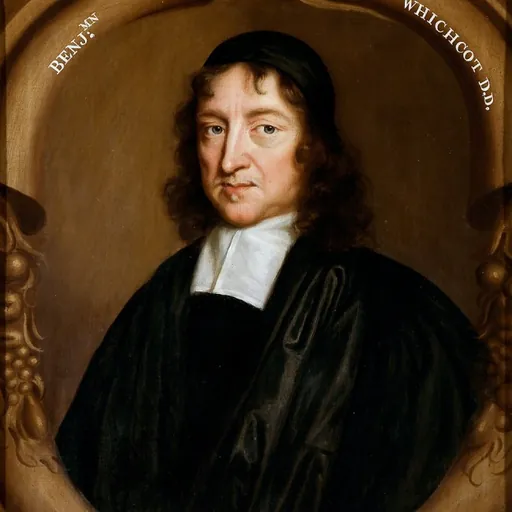
About Benjamin Whichcote
Lived 1609 – 1683 (aged 73–74). Benjamin Whichcote was an English philosopher, theologian and writer.
Benjamin Whichcote (March 1609 – May 1683) was an English Establishment and Puritan priest, Provost of King's College, Cambridge and leader of the Cambridge Platonists. He held that man is the "child of reason" and so not completely depraved by nature, as Puritans held. He also argued for religious toleration.
Life and career Whichcote was born at Whichcote Hall in Stoke upon Tern, Shropshire. He entered Emmanuel College, Cambridge in 1628, and became a fellow in 1633. In 1637, he was ordained a deacon and priest at the same time. In 1643, he married and took up priestly duties in a Cambridge-dispensed parish in North Cadbury, Somerset. In 1644, he became 19th Provost of King's College due to Parliamentary control of the universities. However, he was the only new head of house who did not subscribe to the National Covenant. In 1650, during the Interregnum, he was vice-chancellor of the University of Cambridge, and advised Oliver Cromwell on the subject of toleration of the Jews. After the Restoration he was removed from his position at King's College, but reinstated when he accepted the Act of Uniformity in 1662.
From that time he was the Curate of St. Anne's Church, Blackfriars, until it burnt down in 1666. In 1668, he was appointed Vicar of St Lawrence Jewry.
Whichcote was one of the leaders of the Cambridge Platonists, and had liberal views. In 1650, he was involved in a controversy with his former teacher and friend Anthony Tuckney. He was opposed to the doctrine of total depravity and adopted a semi-Pelagian position, holding that man is the "child of reason", and therefore not, as the Puritans held, of a completely depraved nature. He argued that there are some questions beyond the ability of reasonable and religious people to solve, and he therefore called for religious toleration. He was accused at various times by various persons of being an Arminian, Socinian, and Latitudinarian.
He died in Cambridge in May 1683 aged 74 and was buried in London at the church of St Lawrence Jewry.
Works Nearly all of his works were published posthumously. They include Select Notions of B. Whichcote (1685), Select Sermons (1689), Discourses (1701), and Moral and Religious Aphorisms (1703).
Don’t just read it —
keep it.
Full-length biographies made to live with: read them, listen on the way to work, watch them tonight.
- E-book
- Audio
- Video
Instant download · yours to keep · every purchase keeps this site free
Important facts
People in Benjamin Whichcote's life
Named in this biography and alive at the same time


Related people
Same field, nearest in time


Contemporaries
People whose lives overlapped Benjamin Whichcote's






Frequently asked questions
Who was Benjamin Whichcote?
English theologian
When was Benjamin Whichcote born?
Benjamin Whichcote was born in 1609 in Stoke-on-Trent.
When did Benjamin Whichcote die?
Benjamin Whichcote died in 1683 in Cambridge.
What was Benjamin Whichcote's occupation?
Benjamin Whichcote was a philosopher, theologian and writer.
What nationality was Benjamin Whichcote?
Benjamin Whichcote was English.
Sources & further reading
· Wikipedia: Benjamin Whichcote
Cite this page
APA: Biography.guide. (2026). Benjamin Whichcote. https://biography.guide/benjamin-whichcote/
MLA: "Benjamin Whichcote." Biography.guide, https://biography.guide/benjamin-whichcote/.
Chicago: "Benjamin Whichcote." Biography.guide. https://biography.guide/benjamin-whichcote/.
Data last updated: 2026-09-22 · Spot an error? Report a correction.
Portrait: Wikimedia Commons · author & licence
Page generated 2026-09-27 05:02 UTC