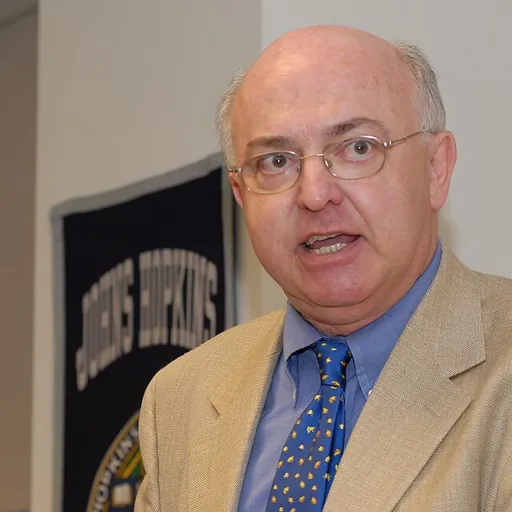
Benjamin Ginsberg
American political scientist
About Benjamin Ginsberg
Born 1947. Benjamin Ginsberg is an American political scientist, historian and johns Hopkins University.
Benjamin Ginsberg (born 1947) is an American political scientist who is David Bernstein Professor, and Chair of Center for Advanced Governmental Studies, at Johns Hopkins University. Much of his earlier career was spent at Cornell University. Ginsberg is known for his criticism of American politics, in which he says that citizens have become "marginalized as political actors"
At Cornell University, Ginsberg was an instructor (1972), assistant professor (1973), associate professor (1978), and professor (1983). He became director of the Cornell Institute for Public Affairs. He also acted as faculty advisor to the Cornell chapter of the College Republicans student organization.
He returned to University of Chicago in 1992 as the Exxon Foundation Lecturer for the Committee on Social Thought, also becoming a professor at Johns Hopkins University later that year. The Washington Post discussed how Ginsberg and Crenson charted the declining importance of citizens to political and public life in the United States. A review in the Independent Review, a quarterly academic journal, found the writing style to be "well documented" and "analytical," which exposed the "thoroughly corrosive impact of beltway politics on democratic processes and citizen power." The authors suggest that citizens, who used to be the "backbone of the western state," are no longer relevant.
Citizenship, political parties, and polling Ginsberg has criticized the Washington political climate as "toxic", characterized by a "cycle of attack and counterattack" in which minor indiscretions are used as political weapons. While Ginsberg sees voting as a passive and meaningless act which gives the illusion of public control over government, he sometimes criticizes both political parties as having a "resistance" to sincerely working towards increased voter participation. Ginsberg argued that citizenship has been undermined by a move to a voluntary military. He believes citizen participation in the military is good since it strengthens patriotism, which means "sacrifice and a willingness to die for one's country." Ginsberg criticized American leaders for trying to wage war on terrorism without any sacrifice from citizens: "U.S. leaders have pleaded for what can best be described as defiant normalcy – living, spending and consuming to show that terrorists won't change the American way of life," according to a reporter commenting on Ginsberg's views.
Ginsberg has commented on campaign strategies; for example, he suggested that a photo of young Bill Clinton shaking the hand of President John F. Kennedy, taken by photographer Arnold Sachs, was used by campaign operatives to reinforce the idea of Clinton as "heir apparent" to the Kennedy legacy. He also commented on the tight presidential primary race between Hillary Clinton and Barack Obama in 2008, and compared the two candidates to "Walmart and Kmart – they're occupying the same space." Ginsberg has a cynical outlook, seeing the Republican Party as courting Jews not for their votes but for their financial contributions. He was quoted as saying: "When the numbers are added up, we will probably find that Jewish money was especially important to the Republicans this year." In another instance, Ginsberg criticized the administration of FDR for the tactic of having federal investigators sift through tax and financial records of opposition politicians. He's known for speaking bluntly about religious politics: for example, he said "Jews have always been the brains, the wallet and the legs of the Democratic Party," in an interview in 2002. Ginsberg participated in panel discussions about polling and democracy.
The effect of administrative bloat on universities Ginsberg has been an outspoken critic of the expansion in the number and pay of non-teaching university administrators on campuses throughout the world. As these administrators now outnumber faculty in every university in the U.S., he points out that this is the fundamental reason for rapid tuition increases despite the fact that the faculty to student ratio has remained nearly unchanged and faculty salaries generally track inflation. There is general consensus that Ginsberg's observations are correct with some studies showing that administrators not qualified to be assistant professors in their own discipline are hired to oversee faculty at all levels. These conditions have incited rage in some faculty, yet little has changed at university campuses since the publication of Ginsberg's book. Ginsberg places the blame not only on administrators but also on faculty for ceding their universities to inept administrators. Even critics have said, "Ginsberg rightly points out that numbers of administrators and professional staffers have grown far more quickly than numbers of faculty, pushing up the costs that students and their families pay without enhancing the academic side of their experience."
Books
Moses of South Carolina: A Jewish Scalawag During Radical Reconstruction (Baltimore; Johns Hopkins University Press; 2010) The American Lie: Government by the People and other Political Fables Presidential Power: Unchecked and Unbalanced (co-authored) Embattled Democracy: Politics and Policy in the Clinton Era (co-authored with Theodore J. Lowi), W.W. Norton, 1995 What Washington Gets Wrong: The Unelected Officials Who Actually Run the Government and Their Misconceptions about the American People, 2016. How the Jews Defeated Hitler: Exploding the Myth of Jewish Passivity in the Face of Nazism The Worth of War The Value of Violence Congress: The First Branch Essentials of American Politics The New American Anti-Semitism: The Left, the Right, and the Jews Presidential Government Speaking Truth to Power: Expertise, Politics and Governance The Imperial Presidency and American Politics: Governance by Edicts and Coups Do the Jews Have a Future in America? Trumping Democracy A Guide to the United States Constitution Electoral deadlock: Politics and policy in the Clinton era The Sibling Rivalry Monster American Government: Power and Purpose American Government: A Brief Introduction Dissenting Electorate: Those Who Refuse to Vote and the Legitimacy of Their Opposition Anti-Semitism on the Campus: Past and Present American Government Jews in American Politics: Essays From Antisemitism to Anti-Zionism: The Past & Present of a Lethal Ideology Analytics, Policy, and Governance Analyzing American Government Big Brother and the Grim Reaper: Political Life After Death Let's Talk Soft Drinks: The Story of a Great Industry The Dark Side of Politics America's State Governments Democracy: How Direct?: Views from the Founding Era and the Polling Era
Don’t just read it —
keep it.
Full-length biographies made to live with: read them, listen on the way to work, watch them tonight.
- E-book
- Audio
- Video
Instant download · yours to keep · every purchase keeps this site free
Important facts
People in Benjamin Ginsberg's life
Named in this biography and alive at the same time



Related people
Same field, nearest in time




Contemporaries
People whose lives overlapped Benjamin Ginsberg's




Frequently asked questions
Who is Benjamin Ginsberg?
American political scientist
When was Benjamin Ginsberg born?
Benjamin Ginsberg was born in 1947.
What is Benjamin Ginsberg's occupation?
Benjamin Ginsberg is a political scientist, historian and johns Hopkins University.
What nationality is Benjamin Ginsberg?
Benjamin Ginsberg is American.
Sources & further reading
· Wikipedia: Benjamin Ginsberg
· DBpedia: Benjamin Ginsberg (political scientist)
Cite this page
APA: Biography.guide. (2026). Benjamin Ginsberg. https://biography.guide/benjamin-ginsberg/
MLA: "Benjamin Ginsberg." Biography.guide, https://biography.guide/benjamin-ginsberg/.
Chicago: "Benjamin Ginsberg." Biography.guide. https://biography.guide/benjamin-ginsberg/.
Data last updated: 2026-09-23 · Spot an error? Report a correction.
Portrait: Wikimedia Commons · author & licence
Page generated 2026-09-27 05:06 UTC