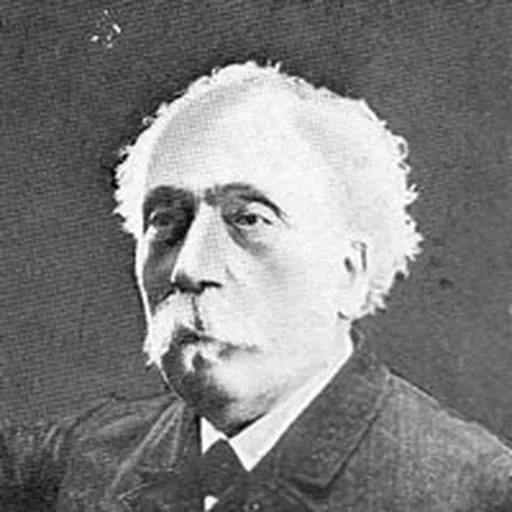
About Benjamin Baillaud
Lived 1848 – 1934 (aged 86). Benjamin Baillaud was a French astronomer, meteorologist and university teacher.
Édouard Benjamin Baillaud (; 14 February 1848 – 8 July 1934) was a French astronomer.
Biography Born in Chalon-sur-Saône, Baillaud studied at the École Normale Supérieure (1866-1869) and the University of Paris. He worked as an assistant at the Paris Observatory beginning in 1872. Later he was director of the Toulouse Observatory from 1878 to 1907, during much of this time serving as Dean of the University of Toulouse Faculty of Science.
He greatly expanded the observatory and enthusiastically supported the Carte du Ciel project. He specialized in celestial mechanics, in particular the motions of the satellites of Saturn.
In 1903, the observatory took over a facility on the Pic du Midi in the Pyrenees that had been founded by amateurs in the 1850s with the goal of putting a telescope there. However, the height of 2865 metres (9400 feet) posed formidable logistical challenges and the ambition had remained unrealised though a meteorological observatory had operated from 1873 to 1880. Baillaud organised a team of soldiers to erect a 0.5 metre (20 inch) reflecting telescope, and 0.25 metre refracting telescope on the summit.
In 1907, he became director of the Paris Observatory where he immediately set to work to relaunch the stalled Carte du Ciel project with a conference held at the observatory, entertained by singers from the Paris Opera and refreshed by wine provided by the director of the Bordeaux Observatory. Though the French government agreed to fund the project, it was becoming increasingly clear that its objectives were hopelessly unrealistic.
Baillaud was the President of the Société astronomique de France (SAF), the French astronomical society, from 1909 to 1911.
Baillaud was active in time standardisation, becoming the founding president of the International Time Bureau and initiating the transmission of a time signal from the Eiffel Tower. Baillaud maintained the observatory and the time signal throughout World War I, even though the German howitzer Big Bertha was targeted on the nominal co-ordinates of Paris, the location of the observatory! Baillaud's concern for the astronomical time standard led him to be an outspoken opponent of daylight saving time.
Baillaud became founding president of the International Astronomical Union in 1919 and served in this position until 1922. He retired as director of the Paris Observatory in 1926.
He was a regular academician in the astronomy section of the Académie des Sciences. He won the Bruce Medal in 1923.
The crater Baillaud on the Moon is named after him, as is the asteroid 11764 Benbaillaud. 1280 Baillauda is named after his son.
Don’t just read it —
keep it.
Full-length biographies made to live with: read them, listen on the way to work, watch them tonight.
- E-book
- Audio
- Video
Instant download · yours to keep · every purchase keeps this site free
Important facts
Related people
Same field, nearest in time


Contemporaries
People whose lives overlapped Benjamin Baillaud's




Frequently asked questions
Who was Benjamin Baillaud?
French astronomer (1848-1934)
When was Benjamin Baillaud born?
Benjamin Baillaud was born on 14 February 1848 in Chalon-sur-Saône.
When did Benjamin Baillaud die?
Benjamin Baillaud died on 8 July 1934 in Paris, Toulouse.
What was Benjamin Baillaud's occupation?
Benjamin Baillaud was an astronomer, meteorologist and university teacher.
What nationality was Benjamin Baillaud?
Benjamin Baillaud was French.
Sources & further reading
· Wikipedia: Benjamin Baillaud
Cite this page
APA: Biography.guide. (2026). Benjamin Baillaud. https://biography.guide/benjamin-baillaud/
MLA: "Benjamin Baillaud." Biography.guide, https://biography.guide/benjamin-baillaud/.
Chicago: "Benjamin Baillaud." Biography.guide. https://biography.guide/benjamin-baillaud/.
Data last updated: 2026-09-22 · Spot an error? Report a correction.
Portrait: Wikimedia Commons · author & licence
Page generated 2026-09-27 05:02 UTC