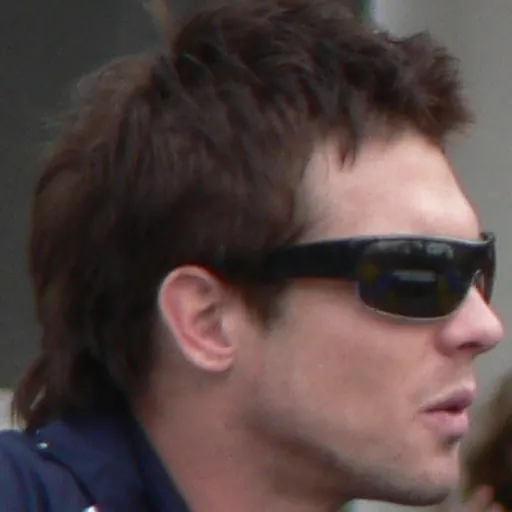
About Ben Cousins
Born 1978. Ben Cousins is an Australian australian rules football player.
Early life Cousins was born in Geelong, Victoria, on 30 June 1978, to Stephanie and Bryan, an Australian rules footballer who had moved from Western Australia to play for the Geelong Football Club in the Victorian Football League. When Cousins was 18 months old, his family moved back to Perth, Western Australia, where he was raised with younger siblings Matthew, Sophie and Melanie. He played junior football for the Bull Creek-Leeming Junior Football Club and for his private school, Wesley College. In his last year at Wesley in 1995, he was recruited to join the East Fremantle Football Club's senior side in the West Australian Football League (WAFL) and played for both his school and East Fremantle throughout the season.
Cousins' popularity continued to increase over the following seasons. In 1998, the Herald Sun ran a two-page article across its centre pages about 20-year-old Cousins, titled "West goes wild for the kid". The article portrayed Cousins as a sex symbol and "football's answer to Brad Pitt". When asked about the article, he said the popularity "comes with the territory... If you want to be a league footballer you have to accept that it is part of the game." Sports agent Ricky Nixon approached Cousins in 1998 about managing his endorsement deals, because "He's good-looking, he elected to stay in Perth and not play in Victoria, opposition coaches take notice of him and on top of that he's a future leader." In 1999, International Management Group, who managed sports stars such as Tiger Woods and Pete Sampras, said they would like to sign Ben, as "There is no doubt that he is now in the top bracket of players and has great marketing potential... Apart from being an outstanding footballer, he is a quality young man." Ross Nicholas, West Coast's marketing manager, said: He played in his first AFL finals game in 1997 against the Adelaide Crows in a qualifying final at Football Park, and the year included another selection in the All-Australian Team and representing Australia in the International Rules Series.
2000–2003: Best and Fairest at West Coast and appointed co-captain He played his 100th game amid speculation he would take over the captaincy from Guy McKenna, who was due to retire after the same game. Cousins said, "After you play two or three seasons, you think of the possibility of a leadership role down the track, but the talk of it has certainly come a lot earlier than I would have thought." He won his first club Best and Fairest at the end of the season, a feat which he repeated in 2002 and 2003, and he was again named in the All-Australian Team in 2001 and 2002. Kemp's retirement saw Cousins become the captain in 2002, a role he filled until 2006. In 2005, West Coast coach John Worsfold said of Cousins' fifth year as captain, "Ben is improving all the time and with the way this group is coming along, I think he is going to be a great leader".
2003–2004: Continued individual success and injuries In early 2003, Cousins injured his ankle in a game against Hawthorn but played on through five weeks of pain-killing injections. In Round 15, 2004, he injured his back and missed six games. Cousins said, "That injury is something that I got over and am probably no chance of getting a relapse... The other side to it is, because I have played 10 years of consistent AFL footy, I've probably got an older back than someone my age". as video clips of his ten years at West Coast were shown at the end of the game. Cousins was "possibly the highest-profile sportsman in Western Australia", Cousins was the favourite to win with bookmakers, after five previous top-10 finishes. West Coast's last training session in Perth before travelling to their first Grand Final game since 1994 Nesbitt added: He was runner-up to Barry Hall in the coaches' player of the year award, In May 2006, he signed a new three-year contract with West Coast, and in September 2006, West Coast won the Grand Final, defeating Sydney by one point. Cousins was suspended indefinitely by West Coast on 20 March 2007 after missing two training sessions. It was later confirmed that Cousins had a substance abuse problem. After returning from four weeks of rehabilitation in Malibu, California, for substance abuse, On 29 June 2007, Cousins was given clearance by the AFL to resume training with the West Coast Eagles, which he did the following Monday. However, he injured a hamstring in training, delaying his comeback until West Coast's home game against Sydney on 21 July at Subiaco Oval. He gained 38 disposals and six marks in the game, inspiring West Coast's win.
2007–2008: Drug possession arrest, West Coast Eagles delistment, and 12-month AFL ban On 16 October 2007, Cousins' car was stopped in Northbridge and searched. He was arrested for drug possession and refusing to submit to a blood test. The Eagles sacked him the next day, which meant that he was no longer a registered AFL player. and was formally delisted by West Coast on 30 November. Eagles officials said that he would never appear in an Eagles guernsey again, and AFL CEO Andrew Demetriou said it would be "extremely difficult" for him to ever return to the AFL. In November 2008, the AFL Commission cleared Cousins to play AFL football in 2009. The Commission ruled that Cousins must submit to regular drug tests, including urine testing up to three times per week and hair testing up to four times annually. Cousins attended drug testing in early November with no body hair long enough to sample.
Several teams showed an interest in drafting Cousins for 2009, including Collingwood Football Club, St Kilda Football Club and Brisbane Lions. Collingwood sent a private investigator to Perth to follow Cousins for several days. After meeting with Victorian Chief Commissioner of Police Christine Nixon in October 2008, Collingwood announced that they would not draft Cousins. In November, after reviewing Cousins and consulting stakeholders for five months, St Kilda said they would not draft him. The day before the national draft, Brisbane issued a media release that said they would not be drafting Cousins. On 29 November 2008, Cousins was not selected in the AFL National Draft.
Ahead of the AFL Pre-season Draft in December 2008, Richmond Football Club approached the AFL Commission for approval to move injured senior player Graham Polak to its rookie list in order to obtain a second draft pick in the pre-season draft, which it said it would use to select Cousins. The AFL Commission had given approval to Essendon two years earlier to do similar with Adam Ramanauskas during his battle with cancer. The commission, with the support of the AFLPA and most of the clubs, denied Richmond's request. However, Richmond selected Cousins with its only Pre-season Draft selection (#6 overall) on 16 December. Following this Richmond received an influx of new club members In Richmond's Round 1 game against Carlton on 26 March, Cousins strained his hamstring during the final quarter. He played a game with the Coburg Football Club in the Victorian Football League before returning to the AFL in Round 7 against Brisbane.
On 17 August 2010, after weeks of speculation by the media, Cousins announced his retirement in front of his family and huge crowd. During the speech, he thanked everyone who had assisted him during his career, acknowledged his encounters with drugs and the law, and apologised to his family for the situation he had put them in: I'll always regret what I've put my family through. There's a lot of shame and regret. People wonder why I haven't broken down or shed a tear (in public). My tears are something that I hold close to me; they're for me and my family.
Statistics
Led the league for the season only Led the league after finals only Led the league after season and finals
270 217 134 3447 2646 6093 935 489 0.8 0.5 12.8 9.8 22.6 3.5 1.8
Honours and achievements Brownlow Medal votes Season Votes 1996 3 1997 1 1998 18 1999 15 2000 8 2001 18 2002 16 2003 21 2004 4 2005 20 2006 13 2007 4 2009 5 2010 2 Total 148 Key: Green / Bold = Won
Team AFL Premiership (West Coast): 2006 McClelland Trophy (West Coast): 2006 Individual Brownlow Medal: 2005 Leigh Matthews Trophy (AFLPA MVP Award): 2005 All-Australian: 1998, 1999, 2001, 2002, 2005, 2006 Australian Football Media Association Player of the Year Award: 2005 John Worsfold Medal (West Coast Eagles Best & Fairest): 2001, 2002, 2003, 2005 Herald Sun Player of the Year Award: 2005 Lou Richards Medal: 2005 Australian Representative Honours in International rules football: 1999 West Coast Eagles – Team 20 Geoff Christian Medal: 2001 Western Australian Sports Star of the Year: 2005 Goal of the Year: 1999 AFL Rising Star Award: 1996 AFL Rising Star Nominee: 1996 (Round 12) West Coast Eagles Life Membership Inductee: 2003
Media career In June 2023, Cousins commenced presenting the sport on 7NEWS Morning Edition in Perth.
In early 2024, Seven Network announced that Cousins would appear as a contestant on the twenty-first season of Dancing with the Stars Australia. He was the fifth contestant to be eliminated. His casting drew criticism from commentators who questioned the appropriateness of a mainstream family entertainment role in light of his stalking convictions.
In February 2025, Cousins joined the Hit Network to co-host the Western Australian breakfast radio show Pete & Kymba with Pete Curulli and Kymba Cahill on Mix 94.5; the show was subsequently renamed Pete & Kymba with Ben Cousins. Cousins' appointment to the show and his wider media comeback were criticised by commentators and family-violence researchers. Writing in Pedestrian.TV, Rachel Choy argued that the Seven Network had rewarded a convicted stalker with a mainstream hosting role. Professor Silke Meyer, Adjunct Professor at Monash University's Gender and Family Violence Prevention Centre, told Mamamia that the coverage of Cousins' return to television "completely erases the experiences of his ex-partner and children", and that celebrating a "comeback" risked sidelining women's and children's experiences of violence.
Personal life Early professional career In 1997, Cousins took part in an education campaign for the WA Asthma Foundation. During his first year in the AFL, Cousins said his chest often felt tight and he had difficulty playing, "but if I monitored my asthma correctly and took the right medication, I was able to overcome those effects". In 1999, he had a mild asthma attack while warming up for a game against Melbourne, then fainted while at a restaurant after the game. West Coast's football manager, Rod Lester-Smith, said Cousins may have been affected by asthma, low blood pressure from playing the game earlier, and a corked leg that caused some internal bleeding. He was taken to Murdoch Hospital and recovered quickly.
West Coast coach Ken Judge was told by a Perth detective in 2001 that Cousins and two of his teammates may have been using illegal drugs. Judge passed this information on to the club's administration but no action was taken.
In September 2002, Cousins punched teammate Daniel Kerr at the club's best and fairest award celebrations, after an argument about Kerr's relationship with Cousins' sister Melanie.
In May 2005, Cousins and teammate Michael Gardiner were questioned about their acquaintance with John Kizon and Troy Mercanti, two Perth underworld figures who were allegedly involved in a stabbing and shooting at Perth's Metro City nightclub. Cousins was in Melbourne at the time of the shooting, but it was claimed that he and Gardiner had received phone calls from the figures both before and after the incident at the nightclub. Police questioned Cousins and Gardiner about the incident but they refused to co-operate. Newspaper columnists at The West Australian and talkback radio callers demanded Cousins resign his captaincy. On 20 February, Cousins resigned as captain of the West Coast Eagles. He was fined an additional $5,000 by West Coast.
On 3 December 2006, Cousins was arrested for public intoxication after passing out in front of Crown Casino in Melbourne and spent four hours in jail. The West Coast Eagles later announced that the club would not discipline Cousins, stating that the media scrutiny was sufficient punishment.
In early March 2007, Cousins and his girlfriend of 13 years, Samantha Druce, ended their relationship. On 20 March, Cousins was suspended indefinitely from West Coast after failing to attend two training sessions. and it was later confirmed that he had a substance abuse problem. On 22 March, his father Bryan released a statement in a video broadcast by Network Ten:
"I am making this statement today not on behalf of Ben, but as a father on behalf of his son... Ben's problem relates to substance abuse and he faces a great challenge... We acknowledge the public scrutiny that comes with the opportunities and privileges that Ben has had, but I ask now with the issues that Ben faces, that my son be given the privacy and the opportunity that he needs to deal with this problem... Ben, you are not alone with this challenge. Your family, your friends, your fans and your footy club want you to overcome this issue and win in the same manner in which you have done throughout your whole career."
Rehabilitation commences At the end of March 2007, He returned to Perth on 30 April 2007, with much attention from the media.
"As you are aware, I have been at an overseas rehabilitation centre for the past month undergoing treatment for a number of personal issues, including illness as the result of substance use... I apologise to the West Coast Eagles Football Club, sponsors, the AFL and the community for my actions... I know that in order to play football again I will have to be accepted back by the players and staff of the West Coast Eagles and the AFL, and I'm willing to fulfil any obligations imposed on me. At the present time I don't know when I'll play again. My priority is to regain my health, my life and my standing."
Chris Mainwaring, a former West Coast Eagles player and close friend of Cousins, died of a drug overdose on 1 October 2007. Cousins received renewed media attention, as he was the last person to see Mainwaring alive, having visited him twice on the night of his death to provide emotional support and deliver food. On 16 October, Cousins was arrested in the Perth suburb of Northbridge after police pulled over his vehicle because of "the manner of his driving". Cousins' vehicle was searched, and he was charged with failure to comply with a police-ordered drug assessment and possession of a prohibited drug, Cousins was sacked by West Coast for serious breaches of his agreement with the club the day after his arrest. The media reported that Cousins was missing and had failed to attend treatment in Malibu, and he was admitted to hospital several days later after an alleged cocaine binge. No charges were laid by US police. He returned to Australia and told a packed media conference that he was "overcoming a drug addiction". A week later he flew to the Gold Coast for a three-day alcohol and drug binge during Schoolies week.
A painting of Cousins titled Waiting for the Day reached the finals of the 2009 Archibald Prize. Painted by South Australian artist Megan Roodenrys, it shows Cousins in bed battling through a sleepless night during his drug scandal. The painting was bought at auction by a Melbourne businessman the following year for $18,000.
In March 2010, Cousins was twice admitted to Epworth Hospital after suffering from abdominal pain and cramping. The Richmond Football Club denied reports that it had warned Cousins to curb his drinking amid fears his AFL career could be shortened by excessive alcohol consumption. On 12 April, Cousins was among four Richmond players suspended by the club after a drunken escapade at the team hotel in Sydney earlier that week. Although Cousins was not intoxicated, the club deemed that he had not acted responsibly or in a manner expected of him by the club, and he was suspended for one week. On 5 July, Cousins was admitted to hospital after a "severe reaction to prescribed sleeping medication". His hospitalisation prompted debate over the use of legal stimulants such as caffeine and legal sedatives such as sleeping pills among sportspeople, with the Premier of Victoria, John Brumby, disapproving of their use.
A feature-length documentary on Cousins' personal problems, filmed over a two-year period, aired on the Seven Network in August 2010. Titled Such is Life, it is named after bushranger and outlaw Ned Kelly's alleged last words, which Cousins got tattooed across his torso in 2007. Cousins is featured taking illicit drugs, speaking candidly about his addiction and saying that he hopes his story will ultimately help to save lives. It was one of the year's most-watched programs in Australia, with over two million viewers nationwide. In November of that year, Cousins released an autobiography, Ben Cousins: My Life Story, published by Macmillan Australia.
Legal issues In May 2011, it was reported that since Cousins' departure from AFL football his life had lost direction: he had failed to commit to a mining job in Western Australia and was struggling to find focus. His father confirmed that his son's attempt to rebuild his life had taken a "couple of bad turns" in the previous three months and that he was battling "troubled times".
On 9 January 2012, Cousins was admitted to Sir Charles Gairdner Hospital after suffering a fall at a drug rehabilitation clinic. He slipped while getting out of a shower, striking his head on a basin and injuring his neck. It was reported that Cousins had been experiencing continuing problems with illicit drugs, despite seeking help at several drug rehabilitation clinics, and that he had "never been clean for more than three months." It was also reported that he had recently undertaken an extreme drug binge lasting for approximately eight days. Cousins was committed by doctors to a suburban mental health unit under police escort on 13 January 2012 after suffering a four-day episode of drug-induced psychosis while being treated at Sir Charles Gardiner Hospital.
On 27 March 2012, Cousins was arrested by police at Esperance Airport, in the south of Western Australia, on suspicion of possession of drugs. He was strip-searched and found to have methamphetamine secreted in his anus. The initial charge of intent to sell or supply the drug was later downgraded to simple possession, to which Cousins pled guilty and was fined $800. On 17 April 2012, Cousins was arrested and charged again in Western Australia for possession of cannabis and a smoking implement.
On 11 March 2015, Cousins was arrested in the Perth suburb of Bicton after leading police on a slow-speed car chase, stating he could not stop due to a family emergency. Four days later, it was reported that Cousins had been sent to a mental health facility after he was found inside the Special Air Service's Campbell Barracks in Swanbourne. Cousins was arrested for the third time in two weeks after trying to outrun police in Canning Vale following a "bizarre incident" outside a Sikh temple.
In June 2016, police intervened when Cousins attempted to direct traffic on Perth's Canning Highway. He was described by witnesses as being "really lost, confused and making no sense at all", and taken to Fiona Stanley Hospital.
In November 2016, Cousins failed to appear in court on charges of breaching a violence restraining order and possessing methamphetamine. A bench warrant was issued for his arrest. At around 1:30 am the following day, while driving high on methamphetamine in High Wycombe, he crashed his car head-on into a truck. He sustained minor injuries and was taken to Royal Perth Hospital under police guard.
2017 imprisonment for aggravated stalking Cousins was arrested in the Perth suburb of Melville in February 2017 and charged with a number of drug, violence and stalking offences, including seven counts of breaching a violence restraining order taken out by Maylea Tinecheff, the mother of his two children. Police alleged his conduct included approaches at Tinecheff's home, her church and the children's school, and large numbers of unwanted phone calls and text messages. He became eligible for parole in August 2017 but the parole board denied his application and ordered him to complete rehabilitation courses after he failed a drug test; He was granted bail in April 2019.
In September 2019, the charges of stalking and threatening to harm Tinecheff were dropped and Cousins pleaded guilty to 12 lesser offences; he was sentenced to eight months' imprisonment, backdated to his August 2018 arrest, and released shortly afterwards.
2020 imprisonment for aggravated stalking On 22 April 2020, Cousins was arrested in East Victoria Park and charged with 15 offences, including aggravated stalking of Tinecheff, 13 breaches of a family violence restraining order between 2 and 15 April 2020, and possession of approximately 2.5 grams of methamphetamine.
On 4 November 2020, Magistrate Brian Mahon of Armadale Magistrates Court convicted Cousins of one count of aggravated stalking, finding he had bombarded Tinecheff with text messages and phone calls — as many as 29 in a single day — and sentenced him to seven months' imprisonment, backdated to his arrest.
During the trial, Tinecheff told the court that Cousins had been abusive to their children when affected by drugs, and that she had been frightened to discover he had located the family after they had relocated.
Cousins was acquitted of 20 associated counts of breaching the family violence restraining order after Mahon found the prosecution had not proved that the order was in force at the relevant times. Reporting on the verdict, Australian Associated Press noted that Cousins had by that point accumulated 22 convictions for breaches of restraining orders, 20 of which had resulted in prison sentences. He was released shortly after the expiry of the seven-month backdated term. No further convictions have been publicly reported as of April 2026.
Don’t just read it —
keep it.
Full-length biographies made to live with: read them, listen on the way to work, watch them tonight.
- E-book
- Audio
- Video
Instant download · yours to keep · every purchase keeps this site free
Important facts
People in Ben Cousins's life
Named in this biography and alive at the same time






Related people
Same field, nearest in time


Contemporaries
People whose lives overlapped Ben Cousins's


Frequently asked questions
Who is Ben Cousins?
Australian rules footballer
When was Ben Cousins born?
Ben Cousins was born on 30 June 1978 in Geelong.
What is Ben Cousins's occupation?
Ben Cousins is an australian rules football player.
What nationality is Ben Cousins?
Ben Cousins is Australian.
Sources & further reading
Cite this page
APA: Biography.guide. (2026). Ben Cousins. https://biography.guide/ben-cousins/
MLA: "Ben Cousins." Biography.guide, https://biography.guide/ben-cousins/.
Chicago: "Ben Cousins." Biography.guide. https://biography.guide/ben-cousins/.
Data last updated: 2026-09-20 · Spot an error? Report a correction.
Portrait: Wikimedia Commons · author & licence
Page generated 2026-09-27 04:57 UTC