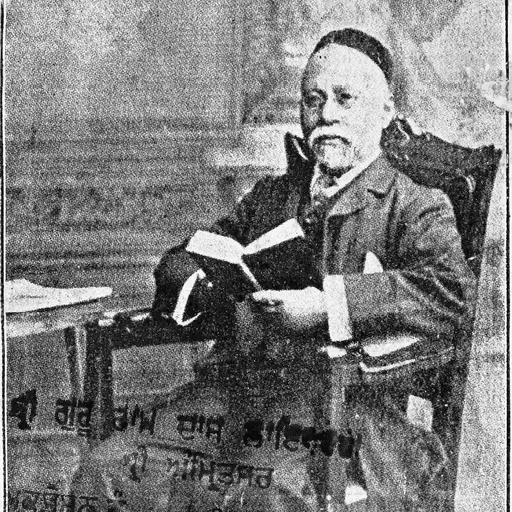
About Behramji Malabari
Lived 1853 – 1912 (aged 59). Behramji Malabari was a writer, poet, social reformer and journalist.
Behramji Merwanji Malabari (18 May 1853 – 12 July 1912) was an Indian poet, publicist, author, and social reformer best known for his ardent advocacy for the protection of the rights of women and for his activities against child marriage.
Early life Behramji Merwanji Malabari was born on 18 May 1853 at Baroda (present-day Vadodara, Gujarat). He was a son of Dhanjibhai Mehta, a Parsi clerk employed by the Baroda State, and Bhikhibai (Gaekwar government). His father, about whom nothing more is known "than that he was a mild, peace-loving man, with a somewhat feeble constitution and not overmuch force of character", died when the boy was six or seven. His mother then took him to Surat (on the coast, 140 km from Baroda), where Behramji was then educated at an Irish Presbyterian mission school.
Author and editor As early as 1875 Malabari published a volume of poems in Gujarati, followed in 1877 by The Indian Muse in English Garb, which attracted attention in England, notably from Alfred Tennyson, Max Müller, and Florence Nightingale.
Malabari's life work began in 1880 when he acquired the Indian Spectator, an English-language daily, which he edited for twenty years until it was merged into the Voice of India, which Malabari had already been editing together with Dadabhai Naoroji and William Wedderburn since 1883. In 1901 he became editor of the monthly East and West, a position he would hold until shortly before his death on 12 July 1912 at Simla. that is, his ardent advocacy for social reform with regards to child marriage and the remarriage of widows. In August 1884, Malabari published a set of Notes on Infant Marriage and Enforced Widowhood, that he sent to 4,000 leading Englishmen and Hindus. In it, Malabari deplored the "social evil" of "baby marriage" and demanded legislature to prevent it. Similarly on the issue of remarriage for widows, Malabari criticised the Hindu practice of prohibiting it, and he placed the blame squarely with that religion's "priestly class" and the "social monopolists" for their "vulgar prejudices." Although acknowledging that many educated Hindus deplored the practice, he repeatedly argued that it was due to inaccurate interpretation of scripture by "the greedy priests" and base Hindu "superstition" that caused "a girl after ten [to be treated as] a serpent in the parents' house." His "notes" were the prelude to an emotionally charged discussion that occupied the press for over seven years and made Malabari "one of, if not the most influential" Indian social reformer of his time.
In 1885, a girl named Rukhmabai was ordered by a Judge Pinhey to return to her husband or be jailed. Malabari's editorials of the Rukhmabai case gave the issue a popular focus, and it "was largely by his efforts" that brought about the Criminal Law Amendment Act of 1885, and the Age of Consent Act (which regulated the age of consent for females in Britain and India) in 1891. In this, Malabari "was instrumental not just in refining the gendered dimensions of contests for cultural legitimacy and power in the western presidency, but in refiguring such contests for consumption by the British reform public at home as well."
In his conviction that the Hindu priesthood were misinterpreting the Vedas and Upanishad, Malabari was also instrumental in the translation of Max Müller's Hibbert Lectures into Indian languages. On the insistence of Müller and assisted by one N. M. Mobedjina, Malabari himself undertook the translation into Gujarati. Malabari then attempted to have the lectures translated into other languages (including Marathi, Bengali, Hindi and Tamil), and to do so travelled extensively to find translators and the funding for them.
Although Malabari stayed away from the Indian National Congress as an organisation, Malabari attended the Indian National Congress in Bombay in 1885, and "he was a nationalist" and he had a close relationship with Dadabhai Naoroji," one of the founders and leaders of the Congress. It was however to his advantage not to allow his name to be aligned to any specific political party or movement, as that would have precluded support from British politicians in his campaign for social reform as well as from the Indian princes of Patiala, Gwalior and Bikaner upon whose financial generosity he depended.
He founded Seva Sadan in 1908 along with a friend, Diwan Dayaram Gidumal. Seva Sadan was specialized in taking care of those women who were exploited and then discarded by society. It provided the destitute women with education and medical and welfare services.
Don’t just read it —
keep it.
Full-length biographies made to live with: read them, listen on the way to work, watch them tonight.
- E-book
- Audio
- Video
Instant download · yours to keep · every purchase keeps this site free
Important facts
People in Behramji Malabari's life
Named in this biography and alive at the same time




Related people
Same field, nearest in time
Contemporaries
People whose lives overlapped Behramji Malabari's



Frequently asked questions
Who was Behramji Malabari?
Indian poet and social reformer (1853–1912)
When was Behramji Malabari born?
Behramji Malabari was born on 18 May 1853 in Vadodara.
When did Behramji Malabari die?
Behramji Malabari died on 12 July 1912 in Shimla.
What was Behramji Malabari's occupation?
Behramji Malabari was a writer, poet, social reformer and journalist.
Sources & further reading
· Wikipedia: Behramji Malabari
Cite this page
APA: Biography.guide. (2026). Behramji Malabari. https://biography.guide/behramji-malabari/
MLA: "Behramji Malabari." Biography.guide, https://biography.guide/behramji-malabari/.
Chicago: "Behramji Malabari." Biography.guide. https://biography.guide/behramji-malabari/.
Data last updated: 2026-09-20 · Spot an error? Report a correction.
Portrait: Wikimedia Commons · author & licence
Page generated 2026-09-27 05:19 UTC