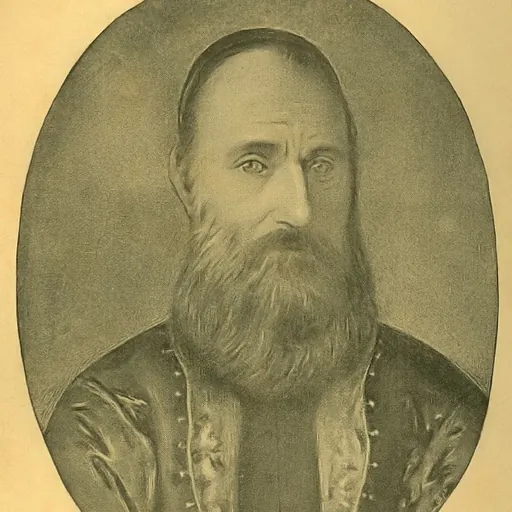
About Basil Moga
Lived 1774 – 1845 (aged 70). Basil Moga was an eastern Orthodox priest and bishop.
Vasile Moga (; 1774 – October 17, 1845) was an Imperial Austrian ethnic Romanian bishop of the Metropolitanate of Karlovci. A native of Sebeș, he was a parish priest for some years before being made bishop of Transylvania. The first Romanian to hold this office in over a century, he served for over three decades. Living in Sibiu during this period, he worked both to improve the spiritual and educational foundations of the diocese and to secure additional rights for the province's Romanians.
Biography
Origins and rise to bishop Born in to an old priestly family in Sebeș, in the Principality of Transylvania, Thus, although he placed second of three candidates, the Transylvanian authorities recommended Moga over the winner Hutovici, and the Emperor quickly approved the nomination in December. He resided at Sibiu and remained as bishop until his death.
Activities as bishop During his 34 years as at the helm of the diocese, Moga confronted difficulties placed in his path by both the imperial and the Transylvanian authorities, by the local Saxons and the Greek-Catholic clergy. Even the decree naming him bishop imposed nineteen restrictions. Reminded that he held office thanks to the Emperor's grace, he was obliged to be his faithful subject and follow all the country's laws. Every month, he had to submit minutes of his consistorial meetings to the government. He and his priests were not allowed to object to the spread of Greek Catholicism or to accept the presence of monks from the Danubian Principalities. The clergy were considered "tolerated" and not permitted to request improvements in their condition, and did not own land like priests from other faiths. The document specified that if Orthodox parishioners embraced Greek Catholicism, the church land would become the property of the latter denomination, while if an entire village took up Orthodoxy, the Greek-Catholic priest would retain control. The general sense of these restrictions was to consolidate the Greek-Catholic Church at the expense of the Orthodox one.
One of these was Gheorghe Lazăr, who spent about three years on the faculty before an ongoing conflict with Moga forced him to leave Sibiu in late 1815. The previous year, the bishop had recalled his nephew Moise Fulea from Vienna in order to train priests. In 1816 another nephew, Ioan Moga, also a Vienna returnee, replaced Lazăr. The pair would be the only seminary faculty members at Sibiu for some three decades. Despite misunderstandings with Lazăr, Moga continued to improve education for future priests after 1815. In 1832, he created a scholarship fund worth 10,000 florins and capable of supporting six Orthodox students; he added another 30,000 florins in 1835. He freely gave money to those in need. He published a number of religious books at private printing presses in Sibiu, while sponsoring the printing of textbooks and other materials in the Romanian language, and facilitated the circulation of Petru Maior's works. He also supported cultural events and the distribution of Romanian gazettes and magazines. The money he gave out came entirely from the synodal fund, the church's only source of revenue.
Political involvement and legacy Over the course of his episcopate, Moga pushed for the Romanians' recognition as the fourth nation in Transylvania (see Unio Trium Nationum) and for their political and social rights. The two sent the resulting document to Vienna in April 1834, taking up the grievances of the earlier Supplex Libellus Valachorum. Although without immediate effect, the episode demonstrated that clerics from the two churches could cooperate in seeking to advance the rights of Romanians.
Moga alone petitioned the Transylvanian Diet in 1837, seeking to obtain certain economic benefits and relief from taxes and tithes for his clergy and faithful on the Saxon-dominated Fundus regius, and again in 1842 to obtain enforcement of a 1791 law recognizing freedom of worship for the Orthodox. Later the same year, he again joined with Lemeni to seek sanctions against the Hungarian and Székely members of the Diet for allegedly discriminating against the Romanian inhabitants of the Fundus regius. The initiative, in which the bishops reminded the privileged nations of the significant inequalities faced by their community, took place against a backdrop of conflict between Hungarians and Saxons regarding the principality's official language. Although Hungarian and Székely deputies showed some interest in embarrassing the Saxons, the petitions were unsuccessful, either relegated to the archives or sent to be forgotten in a study committee. Upon his death in 1845, Moga was buried in the yard of the Annunciation Church. While his eventual successor Andrei Șaguna has been the subject of ample historiographic study, Moga's life has generally been treated in cursory fashion, with the last biography appearing in 1938. One noted study, published in 1915 by Ioan Lupaș, analyzed the dispute between Moga and Lazăr.
Don’t just read it —
keep it.
Full-length biographies made to live with: read them, listen on the way to work, watch them tonight.
- E-book
- Audio
- Video
Instant download · yours to keep · every purchase keeps this site free
Important facts
People in Basil Moga's life
Named in this biography and alive at the same time

Related people
Same field, nearest in time


Contemporaries
People whose lives overlapped Basil Moga's





Frequently asked questions
Who was Basil Moga?
Romanian orthodox bishop of Sibiu
When was Basil Moga born?
Basil Moga was born on 19 November 1774 in Sebeș.
When did Basil Moga die?
Basil Moga died on 29 October 1845 in Sibiu.
What was Basil Moga's occupation?
Basil Moga was an eastern Orthodox priest and bishop.
Sources & further reading
Cite this page
APA: Biography.guide. (2026). Basil Moga. https://biography.guide/basil-moga/
MLA: "Basil Moga." Biography.guide, https://biography.guide/basil-moga/.
Chicago: "Basil Moga." Biography.guide. https://biography.guide/basil-moga/.
Data last updated: 2026-09-20 · Spot an error? Report a correction.
Portrait: Wikimedia Commons · author & licence
Page generated 2026-09-27 04:57 UTC