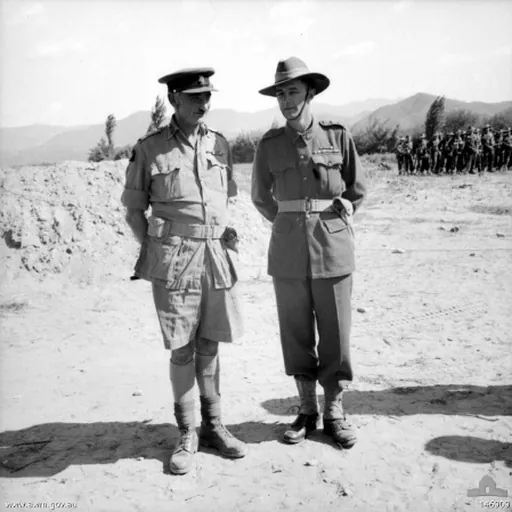
Basil Coad
British Army general
About Basil Coad
Lived 1906 – 1980 (aged 73). Basil Coad was a British military personnel, colonel (United Kingdom), deputy Lieutenant and duke of Edinburgh's Royal Regiment.
Major-General Basil Aubrey Coad, (27 September 1906 – 26 March 1980) was a senior British Army officer. He held battalion, brigade and divisional commands during the Second World War and immediately after, but is best known as the commander of the 27th British Commonwealth Brigade during the Korean War.
After his involvement in Korea, he held a further divisional command, and then a senior administrative position in the army before retiring. In retirement, he continued his connection with the army, serving as Colonel of his former regiment, and assisting in writing the British official history of the Korean War. He was also appointed a Deputy Lieutenant of Wiltshire.
Early life and military career Coad was born on 27 September 1906 at Portsmouth, Hampshire. He was educated at Felsted School and Royal Military College, Sandhurst. From Sandhurst he was commissioned into the British Army as a second lieutenant in the Wiltshire Regiment on 4 February 1926. He was soon bound for India to join the 1st Battalion. After a few years' service there he was posted to Shanghai, then one of the treaty ports, in January 1929, promoted to lieutenant on 4 February, and appointed as Deputy Assistant Provost Marshal from December that year.
Coad returned to the United Kingdom in 1934 and was appointed adjutant of the 2nd Battalion, Wiltshires. On 22 January 1937 he was seconded to the 4th Battalion, a Territorial Army (TA) unit, to serve as its adjutant, at the same time he was granted temporary rank as a captain in the TA. He was promoted to substantive captain on 18 March 1938.
Second World War With the outbreak of the Second World War, Coad was promoted to acting major for service as an instructor in the 43rd (Wessex) Infantry Division, he became a temporary major on 1 February 1940. In January 1941 he was appointed second-in-command of the 2nd Battalion, Wiltshires. By August 1942 he was an acting lieutenant colonel in command of the Battle School of the 43rd Division, now commanded by Major General Ivor Thomas, in Kent. He was then appointed commanding officer of the 5th Battalion, Dorset Regiment at the beginning of 1943.
The 5th Dorsets participated in Operation Overlord (the Normandy Campaign) as part of the 130th Infantry Brigade, 43rd Division. On 10 July 1944, during the opening of Operation Jupiter, the unit was ordered to capture Chateau de Fontaine, near Fontaine-Étoupefour. They successfully captured the chateau, and were then ordered to take a further objective. Coad personally reconnoitred the route across open country, despite heavy machine gun and mortar fire. The attack was launched and the objective taken, but it could not be held. Coad withdrew his two furthest forward companies and prepared the chateau as a defensive position. As a result of his leadership on this occasion Coad was awarded the Distinguished Service Order (DSO) on 19 October 1944. The citation concluded:
Lt Col COAD throughout the day retained complete control of the situation and by his personal example inspired his battalion to carry out all the tasks allotted them magnificently. A year later he was awarded a Bar to his DSO on 11 October 1945 for his leadership in the intervening period, which covered the Western Allied invasion of Germany. The citation remarked:
Prior to [7 October 1944] the had been "unlucky", several times knocked about, and its only clear cut success had been once before when Brig COAD as a Lt Col, was temporarily in . This officer by fearless and indefatigable leadership, has raised the standard of his Bde to a very high level, and has led it through a series of uniformly successful actions, particularly since 1 February 45. [... He] has shown himself to be a fine and determined leader, [...] whose presence in the forward area has so often been an inspiration to all ranks under his command. He relinquished the command, and reverted to temporary brigadier on 10 March 1946. He returned to 130th Brigade, and then reverted to lieutenant colonel and returned to his own regiment, commanding the 2nd Wiltshires. He was then again made a brigadier and commanded 30th Infantry Brigade, before returning to 2nd Wiltshires again.
Korean War After returning to the UK from Germany in August 1948, he was again made a temporary brigadier, and given command of 27th Infantry Brigade. In June 1949, the brigade arrived in Hong Kong as part of Far East Land Forces (FARELF), and was designated United Kingdom Strategic Reserve, theoretically able to deploy anywhere in the world at ten days notice. On 6 April 1950 he was made a substantive colonel. A year after the brigade's arrival in Hong Kong, North Korean forces crossed the de facto border with South Korea, the 38th parallel, triggering the outbreak of the Korean War. On 6 July the British Cabinet decided not to send land forces to Korea. British forces were already heavily committed in Malaya in the developing Malayan Emergency, aid had been promised to the French in Vietnam, and there were fears that the escalating tensions could lead to China threatening Hong Kong.
However, as July wore on the South Koreans and Americans suffered further reverses, and with the Foreign Office pointing out that the UK's standing as a world power, and its relationship with the US, was in danger of being jeopardised, on 25 July the Cabinet resolved to send land forces to Korea. The decision was announced in the House of Commons the following day by the Minister of Defence, Manny Shinwell who said:
It was initially envisaged that the British contribution would consist of 29th Infantry Brigade. This was based in the UK, and reservists had to be recalled to bring it up to strength. As the situation Korea continued to worsen, it was decided to send other British forces from closer at hand, and this decision was announced in the Commons on 20 August 1950. Coad's brigade, then consisting of the first battalions of the Middlesex Regiment, Argyll and Sutherland Highlanders and Leicestershire Regiment, plus some supporting services, was selected to form this force. The Leicesters were left in Hong Kong due to the ongoing concern over China's attitude. The brigade had no artillery, and little transport, Coad was told he would have to rely on US support and supplies, including rations. Compounding the difficulties of organising the move to Korea, most of the men had just been given leave after a hard exercise, and were on their way into Hong Kong City for a Friday night out, and would prove hard to retrieve over the weekend. Both battalions were somewhat under strength, and this problem was exacerbated by a government decision that those under 19 should not serve in combat, volunteers were hurriedly drawn from other units in Hong Kong to try to get the battalions up to establishment. One battalion went into action on 3 September, with the brigade as a whole being given its own section of the front line along the Naktong River, south-west of Taegu on 5 September. In total the Argylls suffered two officers and eleven other ranks dead, four officers and seventy OR wounded, and two missing, about forty per cent of these casualties being from the US airstrike. Despite this setback the brigade participated in the capture of Songju on 24 September, working with 1st Battalion, 19th Infantry Regiment (United States). The brigade was then detached from 24th Division, and placed under the command of Eighth United States Army. The brigade was now retitled 27th British Commonwealth Brigade. then was President of the Regular Commissions Board from 1954 to 1957, when he retired.
Don’t just read it —
keep it.
Full-length biographies made to live with: read them, listen on the way to work, watch them tonight.
- E-book
- Audio
- Video
Instant download · yours to keep · every purchase keeps this site free
Important facts
People in Basil Coad's life
Named in this biography and alive at the same time


Related people
Same field, nearest in time




Contemporaries
People whose lives overlapped Basil Coad's


Frequently asked questions
Who was Basil Coad?
British Army general (1906-1980)
When was Basil Coad born?
Basil Coad was born on 27 September 1906 in Portsmouth.
When did Basil Coad die?
Basil Coad died on 26 March 1980 in Wiltshire.
What was Basil Coad's occupation?
Basil Coad was a military personnel, colonel (United Kingdom), deputy Lieutenant and duke of Edinburgh's Royal Regiment.
What nationality was Basil Coad?
Basil Coad was British.
Sources & further reading
Cite this page
APA: Biography.guide. (2026). Basil Coad. https://biography.guide/basil-coad/
MLA: "Basil Coad." Biography.guide, https://biography.guide/basil-coad/.
Chicago: "Basil Coad." Biography.guide. https://biography.guide/basil-coad/.
Data last updated: 2026-09-23 · Spot an error? Report a correction.
Portrait: Wikimedia Commons · author & licence
Page generated 2026-09-27 05:07 UTC