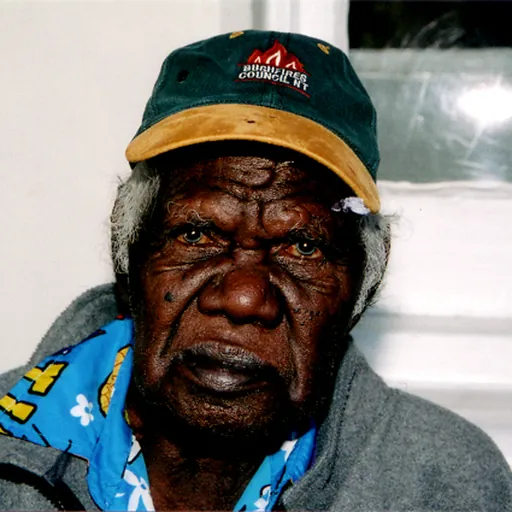
About Bardayal 'Lofty' Nadjamerrek
Lived 1926 – 2009 (aged 82–83). Bardayal 'Lofty' Nadjamerrek was an Australian painter and artist.
Maath Maralngurra, Bardayal Nadjamerrek and Donna Nadjamerrek at Mossenson Galleries, Melbourne, 2006. Bardayal "Lofty" Nadjamerrek (–2009) was a Kunwinjku Aboriginal artist of the Mok clan. He belonged to the Duwa moiety and spoke the Kundedjnjenghmi language. He is currently referred to by his skin and clan as "Wamud Namok", following the Kunwinjku custom of avoiding use of the name of deceased persons.
Bardayal Nadjamerrek was made an Officer of the Order of Australia (AO) in the 2004 Australia Day Honours for "service to the preservation of Indigenous culture as a Senior Traditional man and significant artist whose work documents the relationship of the land and its ancestral past via the Mimih Spirits of rock art". He is recognized as being very knowledgeable about country, environment, and the use of ochres. He helped map out places of "Aboriginal cultural significance, sacred sites that may have been lost had they not been documented."
Early life Bardayal “Lofty” Nadjamerrek, who was otherwise known as Wamud Namok, was born around 1926 in the upper Mann River region of Western Arnhem Land to his father, Yanjorluk. When Bardayal was young, he and his family spent time traveling the plateau, “developing his detailed knowledge of the stone country.”
Early career Nadjamerrek was first introduced to art, specifically rock art, by his father, Yanjorluk, in the early 1940s. His early rock art style learning was influenced by the traditional rock art style of Western Arnhem Land. This area of Australia contains some of the oldest evidence and remnants of rock art.
Before formally venturing into art, he had worked on a variety of different physical jobs, such as mining tin, chopping wood, gardening, and working as a stockman. With the influence of his father's teachings, Nadjamerrek translated his knowledge into the practice of bark paintings, beginning his work in the public domain in 1969.
During World War 2, Bardayal's apprenticeship in art was put on hold as he was indentured to timber cutting service for the war effort. Years later he continued to work in the non-artistic sphere, taking jobs as “a miner, stockman, buffalo shooter and market gardener.”
Bardayal Nadjamerrek and Community In his later life, Bardayal came to be one of the most respected elders not only in his clan, but also in the Western Arnhem Land region. In the 1970s, he was a main contributor in helping Indigenous families return to their traditional lands and establishing six outstations.
After almost two decades, he was finally able to return to his own clan estate. Unfortunately, during his time away the Australian government halted stage funding for outstations. With his prior experience with other clans, Nadjamerrek created the Kabulwarnamyo outstation by himself in the mid 1990s. For a while, contact art was especially seen as being untraditional, as it did not depict subject matter that was deemed "Indigenous" and culturally significant. They would paint new contact subject matter, like sailing vessels, buffalo, and firearms, in addition to their own spiritual stories. After first contact in Oenpelli in 1925, Aboriginal artists continue to transform and innovate rock art, showing it as a recurring means of expression and transmission of identity and cross-cultural knowledge. They prove as counter-colonial narratives to the dominant European story, while also showing small, vital moments of interaction and history. Nadjamerrek blends the traditional motif with an innovative landscape approach, making the spiritual and ecological come together. Nadjamerrek takes a more didactic and instructive approach, while Yirawala took more creative liberties in terms of the shape and interpretation of the Kunwinjku motif. It is clear how Nadjamerrek focused on the educational aspects, with his bark paintings meant to be seen by the Antipodean viewer, not putting the Contact and colonizing perspective to the center of their works and preserving their meanings.
Bardayal Nadjamerrek was awarded the Telstra Work on Paper Award in the 16th National Aboriginal & Torres Strait Islander Art Awards, 1999, for his work Ngalyangdoh.
In 2005, reproductions of Nadjamerrek's work, Kangaroo began appearing online with a statement claiming that upon successful sales, royalties would be paid to the artist. Upon investigation by pro-bono investigators and lawyers, it was discovered that the seller proclaimed to have a copyright license from Nadjamerrek. However, when Nadjamerrek and his daughter were spoken to about the license, Nadjamerrek, who does not read or write English, believed it to be a receipt for the sale of the painting and did not have the license adequately explained to him. The case was ultimately resolved after Bardayal's passing, but was found in favor of the artist because the seller was taking advantage of his limited English ability.
Nadjamerrek continued his bark paintings through the later half of his life, perfecting his craft and style with cultural ties before finally retiring from painting in the late 2000s.
Painting and style He was highly influenced by various styles, including his father's and relatives’ artworks and those more ancient from the Kunwinjku people rock art and “mimih” spirits. Many of Bardayals paintings are reminiscent or even replicas of art found on the rock walls from hundreds of years prior. His work, however, is incredibly original stylistically and in quality.
Bardayal painted using natural pigments and ochres, traditional stylistic elements of Aboriginal art, on a few different mediums, including Eucalyptus bark, paper, and canvas. His style resembled that of rock painting from the paintings of his ancestors found in the landscape. By the late 1980s, he had perfected his style both resembling his culture and his own personal take. Most of the work by Bardayal experiments with iconographic figures, such as the Ngalyod or Rainbow Serpent and other animals significant in Aboriginal culture.
Lofty's work is distinguished by high quality, intricacy, and fineness of his parallel line hatching. His medium involves rectangular bark with either a red or black background. Lofty Nadjamerrek does not use crosshatching but rather fine parallel line work. He is not allowed to do crosshatching because it is a sacred Mardayin hatching. Bark paintings tend to not be the easiest to transport or keep, due to the organic uses of bark and natural ochre pigments. Paper before was not seen as being a worthy enough material in which to place their clan designs and stories. He embraced the newly introduced large sheets of paper and fine materials to paint more detailed compositions. He wanted to represent the Kunwinjku cosmology and spiritual stories and motifs in a way not done before. He uses art as a basis for all his teachings. Bardayal remained eager to share his knowledge to Balanda (non-Aboriginal people) and Bininj (young indigenous people) to ensure the safety and preservation of the stories of his ancestors and cultural traditions. From a young age, this is something that he was passionate about in a family of artists. He would initiate creating artworks for teaching purposes. He once said that “They used to teach these stories to the children. Sometimes someone would go hunting and, upon their return, they would tell a story about what happened, and the children would say, 'paint it for me!' Parents wanted to explain things to their children."
Nadjamerrek died in 2009.
Collections Artbank, Sydney Australian Museum, Sydney Aboriginal Arts Board of the Australia Council, held by the National Museum of Australia in Canberra Berndt Museum of Anthropology, University of Western Australia Kluge-Ruhe Aboriginal Art Collection, University of Virginia Museum and Art Gallery of the Northern Territory, Darwin Museum of Contemporary Art, Arnott's Collection, Sydney National Gallery of Australia, Canberra National Gallery of Victoria, Melbourne The Holmes a Court Collection, Perth University of Queensland
Selected exhibitions
1975, “Australian Bark Painting”, From the Collection of Dr. Edward Ruhe (touring USA). 1982, “Aboriginal Art at the Top”, Museum and Art Gallery of the Northern Territory, Darwin. 1983, “Artists of Arnhem Land”, Canberra School of Arts, Canberra. 1984, “Kunwinjku Bim – Western Arnhem Land Paintings”, From the Collection of the Aboriginal Arts Board, National Gallery of Victoria. 1984, “The 1st annual National Aboriginal and Torres Strait Islander Art Award Exhibition”, Museum and Art Gallery of the Northern Territory, Darwin. 1985, “The 2nd annual National Aboriginal and Torres Strait Islander Art Award Exhibition”, Museum and Art Gallery of the Northern Territory, Darwin. 1986, “The 3rd annual National Aboriginal and Torres Strait Islander Art Award Exhibition”, Museum and Art Gallery of the Northern Territory, Darwin. 1986, “The Art of the First Australians”, Kobe City Museum Japan. 1987, “The 4th annual National Aboriginal and Torres Strait Islander Art Award Exhibition”, Museum and Art Gallery of the Northern Territory, Darwin. 1988, “Aboriginal Art of the Top End”, National Gallery of Victoria, Melbourne. 1988, “The Inspired Dream”, Museum and Gallery of the Northern Territory (touring internationally). 1990, “The 7th annual National Aboriginal and Torres Strait Islander Art Award Exhibition”, Museum and Art Gallery of the Northern Territory, Darwin. 1992, “The 9th annual National Aboriginal and Torres Strait Islander Art Award Exhibition”, Museum and Art Gallery of the Northern Territory, Darwin. 1993, 1994 “Power of the Land - Masterpieces of Aboriginal Art”, National Gallery of Victoria, Melbourne. 1993, Editions, Southbank, Melbourne. 1993, “The 10th annual National Aboriginal and Torres Strait Islander Art Award Exhibition”, Museum and Art Gallery of the Northern Territory, Darwin. 1994, Aboriginal and Tribal Art Gallery, Sydney. 1994, “The 11th annual National Aboriginal and Torres Strait Islander Art Award Exhibition”, Museum and Art Gallery of the Northern Territory, Darwin. 1995, “Moon, Rainbow and Sugarbag – The art of Mick Kubarkku, Bardayal Nadjamerrek”, Museum and Art Gallery of the Northern Territory, Darwin (touring nationally). 1995, “The 12th annual National Aboriginal and Torres Strait Islander Art Award Exhibition”, Museum and Art Gallery of the Northern Territory, Darwin. 1996, Framed Gallery, Darwin. 1998, “The 15th annual National Aboriginal and Torres Strait Islander Art Awards, Museum and Art Gallery of the Northern Territory, Darwin. 1999, Framed Gallery, Darwin. 1999, “The 16th annual National Aboriginal and Torres Strait islander Art Award Exhibition”, Museum and Art Gallery of the Northern Territory, Darwin. 2003, “New Works”, Annandale Gallery, Sydney. 2004, "Lofty Bardayal Nadjamerrek: New work on bark", Annandale Galleries, Sydney. 2006, “Bardayal ‘Lofty’ Nadjamerrek Late Works”, Annandale Gallery, Sydney.
Don’t just read it —
keep it.
Full-length biographies made to live with: read them, listen on the way to work, watch them tonight.
- E-book
- Audio
- Video
Instant download · yours to keep · every purchase keeps this site free
Important facts
People in Bardayal 'Lofty' Nadjamerrek's life
Named in this biography and alive at the same time

Related people
Same field, nearest in time



Contemporaries
People whose lives overlapped Bardayal 'Lofty' Nadjamerrek's


Frequently asked questions
Who was Bardayal 'Lofty' Nadjamerrek?
Australian painter (1926–2009)
When was Bardayal 'Lofty' Nadjamerrek born?
Bardayal 'Lofty' Nadjamerrek was born in 1926 in Arnhem Land.
When did Bardayal 'Lofty' Nadjamerrek die?
Bardayal 'Lofty' Nadjamerrek died in 2009 in Arnhem Land.
What was Bardayal 'Lofty' Nadjamerrek's occupation?
Bardayal 'Lofty' Nadjamerrek was a painter and artist.
What nationality was Bardayal 'Lofty' Nadjamerrek?
Bardayal 'Lofty' Nadjamerrek was Australian.
Sources & further reading
· Wikipedia: Bardayal 'Lofty' Nadjamerrek
· DBpedia: Bardayal 'Lofty' Nadjamerrek
Cite this page
APA: Biography.guide. (2026). Bardayal 'Lofty' Nadjamerrek. https://biography.guide/bardayal-lofty-nadjamerrek/
MLA: "Bardayal 'Lofty' Nadjamerrek." Biography.guide, https://biography.guide/bardayal-lofty-nadjamerrek/.
Chicago: "Bardayal 'Lofty' Nadjamerrek." Biography.guide. https://biography.guide/bardayal-lofty-nadjamerrek/.
Data last updated: 2026-09-24 · Spot an error? Report a correction.
Portrait: Wikimedia Commons · author & licence
Page generated 2026-09-27 05:09 UTC