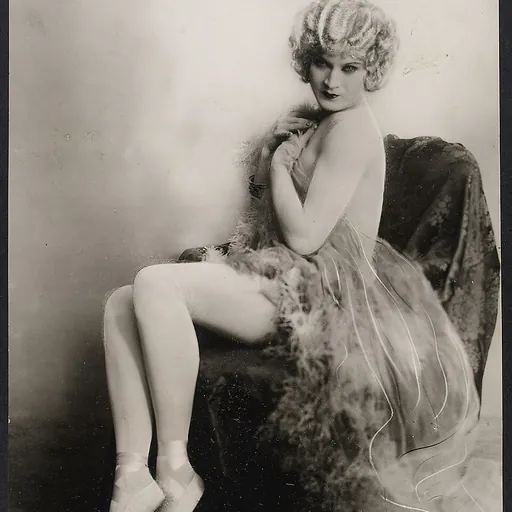
Barbette
American entertainer (between 1897 and 1899-1973)
About Barbette
Lived 1898 – 1973 (aged 74). Barbette was an American circus performer, performing artist, tightrope walker, trapeze artist, drag queen and female impersonator.
Vander Clyde Broadway (December 19, 1899 – August 5, 1973), stage name Barbette, was an American female impersonator, high-wire performer, and trapeze artist born in Texas. Barbette attained great popularity throughout the United States but his greatest fame came in Europe and especially Paris, in the 1920s and 1930s.
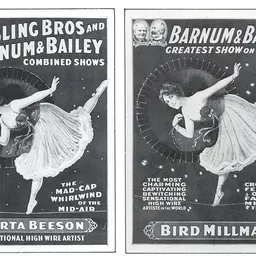
Barbette began performing as an aerialist at around the age of 14 as one-half of a circus act called The Alfaretta Sisters. After a few years of circus work, Barbette went solo and adopted his exotic-sounding pseudonym. He performed in full drag, revealing himself as male only at the end of his act.
Following a career-ending illness or injury (the sources disagree on the cause), which left him in constant pain, Barbette returned to Texas but continued to work as a consultant for motion pictures as well as training and choreographing aerial acts for a number of circuses. After years of dealing with chronic pain, Barbette took his own life on August 5, 1973. Both in life and following his death, Barbette served as an inspiration to a number of artists, including Jean Cocteau and Man Ray.
Early life and career Barbette (birth name cited as Vander Clyde and Vander Clyde Broadway His Draft Registration Card, dated 7 September 1918, states that his birthday was 19 December 1898.
Some confusion surrounds the name of Barbette's father. On a 1923 passport application, Barbette lists his father's name as "Henry Broadway" and notes him as deceased. The death certificate lists his mother's name as "Hattie Wilson;"
Hattie Broadway married, as her second husband, in 1906, Samuel E. Loving (1868–1953), who worked in a broom factory, and had five more children, sons Eugene Loving (1908–1971) and Sam Paschall Loving (1917–1996), and daughters Hugo Loving (1910–1912), Bonsilene Loving (born 1914), and Mary Martin Loving (1915–1997); after his mother's second marriage, Barbette was known as "Vander Loving".
Barbette's mother took him to the circus at an early age in Austin and he was fascinated by the wire act. "The first time she took me to the circus in Austin, I knew I would be a performer, and from then on I'd work in the fields during the cotton-picking season to earn money in order to go to the circus as often as possible." He graduated from high school at the age of 14. "She told me that women's clothes always make a wire act more impressive...and she asked me if I'd mind dressing as a girl. I didn't; and that's how it began." His solo debut was at the Harlem Opera House in 1919. Barbette performed trapeze and wire stunts in full drag, maintaining the illusion of femininity until the end of his act, when he would pull off his wig and strike exaggerated masculine poses. For the next several years he toured the Keith Vaudeville Circuit, advertised as a "versatile specialty."
The toast of Europe
Barbette made his European debut in 1923, having been sent by the William Morris Agency first to England and then to Paris. the Alhambra Theater and the Folies Bergère.
He returned to America in 1924 to appear in The Passing Show of 1924 which ran for four months beginning in September. Also in this timeframe he became a featured attraction with Ringling Bros. and Barnum & Bailey Circus and toured London, Brussels and Berlin. Cocteau calls upon his fellow artists to incorporate deliberately this effect that he believes for Barbette is instinctive.
Cocteau commissioned a series of photographs of Barbette by the Surrealist artist Man Ray, which captured not only aspects of Barbette's performance but also his process of transformation into his female persona. He also cast Barbette in his experimental first film Le sang d'un poète (The Blood of a Poet) (1930). Barbette appears in a scene in a theatre box with several extras, dressed in Chanel gowns, who burst into applause at the sight of a card game that ends in suicide. He replaced the Vicomtesse de Noailles, who along with her husband had originally shot the scene but were appalled upon seeing the finished film, as the card game/suicide had been shot separately.
Speaking of his preparation for the scene, Barbette, who knew he was replacing the Vicomtesse, said, I tried to imagine myself a descendant of the Marquis de Sade, of the Comtesse de Chevigné...and a long line of rich bankers – all of which the Vicomtesse was. For a boy from Round Rock, Texas, that demanded a lot of concentration – at least as much as working on the wire. Others in Barbette's European circle included Josephine Baker, Anton Dolin, Mistinguett and Sergei Diaghilev. Extremely rare film footage of Barbette appearing in Jumbo at the Hippodrome in New York City, 1935, exists and was shot as part of a publicity newsreel to advertise the show. There is also footage from the premiere showing famous first-nighters arriving at the Hippodrome. Barbette is filmed performing part of his acrobatic act during Jumbo.
End of performing career and later life Barbette continued to perform until the mid-to-late 1930s. Most sources report the year as 1938, while others as early as 1936 and as late as 1942. The end of Barbette's performing career is attributed to a number of causes including a fall, pneumonia, polio, or some combination of the three. All generally agree that whatever the cause, Barbette was left in extreme pain and in need of surgery and extensive rehabilitation to allow him to walk again. The Bird Cage Girls, The Swing High Girls, The Whirl Girls and the Cloud Swing Girls were among the female aerialist troupes whose routines were Barbette's specialty. He created the circus sequences for the Orson Welles-produced Broadway musical Around the World. and was hired to coach Jack Lemmon and Tony Curtis on gender illusion for the film Some Like It Hot (1959)
Barbette spent his last months in Texas, living in Round Rock and Austin with his sister, Mary Cahill, often in severe pain. He died by suicide aged 73, taking an overdose Barbette was cremated and his ashes were buried in Round Rock Cemetery. Viktor und Viktoria was remade in 1935 (First a Girl), 1957 (Viktor und Viktoria) and 1982 (Victor/Victoria, which inspired a 1995 Broadway musical of the same name).
Alfred Hitchcock based a character in the 1930 film Murder! on Barbette. It won the Voertman Poetry Award from the Texas Institute of Letters. In 1993, performance artist John Kelly, under commission from the Brooklyn Academy of Music, based his piece Light Shall Lift Them on him. Barbette's story is also told in the play, Barbette, written by Bill Lengfelder and David Goodwin and first presented in Dallas, Texas, in 2003.
Barbette appears on the cover of the 2022 edition of Goodbye to Berlin, by Christopher Isherwood. This edition was released as part of a series called 'Art Deco' which featured "nine blazing, daring novels to celebrate the 1920s – 100 years on" released by the imprint Vintage Classics of publisher Penguin Random House . Goodbye to Berlin is a notable work, and the inspiration the 1951 Broadway play I Am a Camera, the 1966 musical Cabaret, and the 1972 film of the same name.
In June 2026, a Texas Historical Marker was installed at Round Rock Cemetery to honor Barbette's life and legacy. The plaque is one of only a handful of state markers recognizing LGBTQ+ history.
Don’t just read it —
keep it.
Full-length biographies made to live with: read them, listen on the way to work, watch them tonight.
- E-book
- Audio
- Video
Instant download · yours to keep · every purchase keeps this site free
Important facts
People in Barbette's life
Named in this biography and alive at the same time


Related people
Same field, nearest in time

Contemporaries
People whose lives overlapped Barbette's




Frequently asked questions
Who was Barbette?
American entertainer (between 1897 and 1899-1973)
When was Barbette born?
Barbette was born on 19 December 1898 in Round Rock, Trickham.
When did Barbette die?
Barbette died on 5 August 1973 in Austin, Round Rock.
What was Barbette's occupation?
Barbette was a circus performer, performing artist, tightrope walker, trapeze artist, drag queen and female impersonator.
What nationality was Barbette?
Barbette was American.
Sources & further reading
· DBpedia: Barbette (performer)
Cite this page
APA: Biography.guide. (2026). Barbette. https://biography.guide/barbette/
MLA: "Barbette." Biography.guide, https://biography.guide/barbette/.
Chicago: "Barbette." Biography.guide. https://biography.guide/barbette/.
Data last updated: 2026-09-21 · Spot an error? Report a correction.
Portrait: Wikimedia Commons · author & licence
Page generated 2026-09-27 05:00 UTC