Bakenkhonsu
Ancient Egyptian High Priest of Amun
About Bakenkhonsu
Lived 1184 – 1226 (aged 41–42). Bakenkhonsu was an Egyptian ancient Egyptian priest, architect and high Priest of Amun.
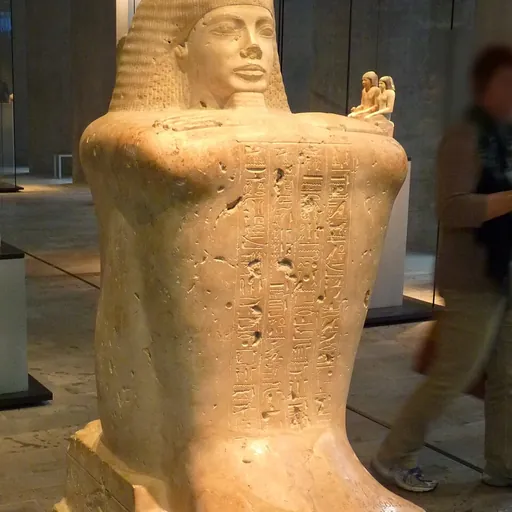
Bakenkhonsu ("Servant of Khonsu") was a High Priest of Amun in ancient Egypt during the reign of Pharaoh Ramesses II. Information about his life was found on the back of his block statue (which is now located in Munich). The information on the statue provides details about the education of young Egyptian noblemen at that time and the career of priests.
Bakenkhonsu is named for the god Khonsu, traveller, a Moon God of ancient Egypt and son of Amun.
Life According to the information inscribed on his statue, Bakenkhonsu was the son of Ipui, a priest of Amun (other sources suggest that he was the son of Roma, whose wife was also called Roma). His two younger brothers were Roma-Roi and Ipui. He spent four years at school, starting at the age of four, as was customary at that time. He then worked at the stables of Pharaoh Seti I for eleven years. There he learned to shoot with a bow and to drive a chariot. It is possible that he also served in the Pharaoh's army.
Bakenkhonsu's career as a priest then began when he joined Amun's priesthood in Thebes where his father already served as a priest (Ipui later became Second Prophet of Amun). Bakenkhonsu served as a wab priest (lowest priestly rank) for four years. He was then promoted to the rank of prophet and, twelve years later, he was the Third Prophet of Amun, the third highest ranking priest in the most powerful priesthood of the era. Later he was promoted to second, then to first prophet or high priest, a position he held for twenty-seven years. He died in the last regnal year of Ramesses II, at the age of ninety, and was succeeded as High Priest by his brother Roma-Roi.
Bakenkhonsu was responsible for several building projects for the Pharaoh, including the eastern temple in the Karnak Temple complex.
Bakenkhonsu was married to Meretseger, who held the titles of Chief of the Harem of Amun. Two of their sons, Paser and Amenmesse became governors of Thebes. Their daughter, Nefertari married Tjanefer, the Third Prophet of Amun and three of her sons and a grandson became high ranking priests (fourth, third, or second prophets of Amun). The family is related to another important family of priests which included Ramessesnakht, who was High Priest of Amun during the 20th dynasty, as Nefertari's son Amenemopet married Ramessesnakht's daughter Tamerit/Aatmerit.
Autobiographical texts Bakenkhons has left autobiographical inscriptions on statues from Karnak, one of which is now in a museum in Munich.
Bakenkhons outlines his life as follows: I spent 4 years as a promising youngster I spent 11 years as a youngster, when I was a trainee Stablemaster of King Menmare I was a wab-priest of Amun for 4 years I was a God's Father of Amun for 12 years I was a Third Prophet of Amun for 15 years I was a Second Prophet of Amun for 12 years He showed me favor, because he recognized the worth of my character. He appointed me High Priest of Amun for 27 years (already).
On another statue – from Cairo (CGC 42155) – Bakenkhons mentions that he came from Thebes and that his parents also were Thebans. He spent some years at the scribal school in the Temple of the Lady of Heaven, and he was taught to be a wab-priest by his own father in the House of Amun.
Burial Bakenkhons was buried in TT35 in Thebes. In the hallway there are several depictions of Bakenkhons and his wife Meretseger. A niche contains seated statues of Bakenkhons and his wife. The tomb also had a pyramid associated with it.
Bakenkhonsu's sarcophagus is now located in the World Museum Liverpool (M13864). Other finds from the tomb include a wooden scribe's palette in the form of a hes vase, which is now in the Louvre (N 3018), and a block statue, which is now in the Munich Staatliche Sammlung für Ägyptische Kunst. Victory Forever for the Soul, using the branch (hieroglyph) for 'victory', n-khet; Forever, h-Ra-h, (the h-(wick hieroglyph)), being in a hieroglyphic block for 'Eternity', and the 'Soul', in another block for: "for the soul of", or "for the spirit of", yielding: Victory Forever for the Soul.
Don’t just read it —
keep it.
Full-length biographies made to live with: read them, listen on the way to work, watch them tonight.
- E-book
- Audio
- Video
Instant download · yours to keep · every purchase keeps this site free
Important facts
Related people
Same field, nearest in time




Contemporaries
People whose lives overlapped Bakenkhonsu's





Frequently asked questions
Who was Bakenkhonsu?
ancient Egyptian High Priest of Amun
When was Bakenkhonsu born?
Bakenkhonsu was born in 1184.
When did Bakenkhonsu die?
Bakenkhonsu died in 1226.
What was Bakenkhonsu's occupation?
Bakenkhonsu was an ancient Egyptian priest, architect and high Priest of Amun.
What nationality was Bakenkhonsu?
Bakenkhonsu was Egyptian.
Sources & further reading
Cite this page
APA: Biography.guide. (2026). Bakenkhonsu. https://biography.guide/bakenkhonsu/
MLA: "Bakenkhonsu." Biography.guide, https://biography.guide/bakenkhonsu/.
Chicago: "Bakenkhonsu." Biography.guide. https://biography.guide/bakenkhonsu/.
Data last updated: 2026-09-23 · Spot an error? Report a correction.
Portrait: Wikimedia Commons · author & licence
Page generated 2026-09-27 05:07 UTC