Bagoas
Young Persian eunuch, favourite of Alexander the Great
About Bagoas
Lived 400 BC – 360 BC. Bagoas was a courtier and eunuch official.
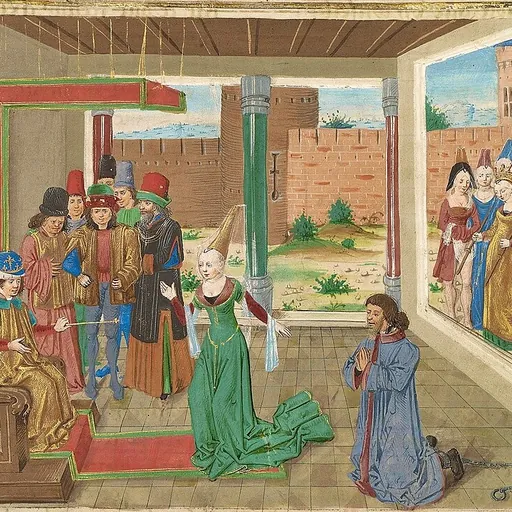
Bagoas pleads on behalf of Nabarzanes, by Master of the Jardin de vertueuse consolation and assistant (Flemish, active 3rd quarter of 15th century). (1450–1475)
Bagoas (; , ) was a eunuch in the court of the Persian Empire in the 4th century BC. Bagoas was a courtier of Darius III and later of Alexander the Great.
Historiography Bagoas is mentioned in three surviving sources and is distinct from Bagoas the Elder, who attempted to assassinate Darius III. In Plutarch's Parallel Lives, he is only briefly mentioned during a dance competition, but in the Histories of Alexander the Great by Quintus Curtius Rufus he is given a more elaborate role in Alexander's court. The 2nd-3rd century CE Egyptian Greek writer Athenaeus mentions Bagoas as well, but in the same context as Plutarch. Only the elder Bagoas is elaborated upon in the source by Diodorus Siculus.
Historian William Woodthorpe Tarn rejected the stories of Bagoas as fabricated in ancient times to defame Alexander, mainly referring to Rufus's fairly fictionalized biography of Alexander that criticized the Macedonian's "degeneration" in embracing foreign Persian customs. In 1958, Ernst Badian rejected Tarn's analysis, suggesting that Alexander was more of a ruthless dictator and that Tarn was blinded by bias. Author Mary Renault also addressed Rufus's biased animosity towards Alexander, stating: "[Rufus's account of Alexander] is bent that way by recourse to Athenian anti-Macedonian agitprop, written by men who never set eyes on him, and bearing about as much relation to objective truth as one would expect to find in a History of the Jewish People commissioned by Adolf Hitler."
Life Dance competition According to Plutarch, Bagoas won a dancing contest after the crossing of the Gedrosian Desert and the Macedonian troops applauded and demanded that drunk Alexander kiss Bagoas, and he did so.
Rufus account The fullest surviving account of Bagoas is given in the Latin Histories of Alexander the Great by Rufus, a first century Roman historian. Rufus focuses on the degeneration of Alexander, and illustrates this with an account of the machinations of his eunuch, Bagoas. Bagoas is described as "in the flower of his youth," and was appointed first by Darius III and later given to Alexander by Nabarzanes. In this account, Bagoas weaponizes his inherited place in Alexander's court to destroy his enemies. The Persian satrap Orxines earns the enmity of Bagoas by refusing to pay him respect in court, claiming it is not Persian custom to pay respect to men used as women, and refers to Bagoas as a whore. Bagoas thus manoeuvres to have Orxines accused of plundering the tomb of Cyrus the Great, and the satrap is executed for this crime. In his final words, Orxines decries the state of affairs: "I had heard that women were once rulers in Asia but this really is something new – a eunuch a king!".
In media Bagoas is the narrator and title character of The Persian Boy, the historical novel by Mary Renault, which portrays him sympathetically. He reappears in a smaller but still significant role in the sequel Funeral Games. He appears in Les Conquêtes d'Alexandre by Roger Peyrefitte. Peyrefitte's Bagoas rides to battle by the side of Darius. He is played by Francisco Bosch in the Oliver Stone film Alexander (2004), which is based in part on Renault's writings, and contains the dancing scene, although a love scene was cut from the film. He is also a major character in Jo Graham's novel Stealing Fire, part of her Numinous World series.
Don’t just read it —
keep it.
Full-length biographies made to live with: read them, listen on the way to work, watch them tonight.
- E-book
- Audio
- Video
Instant download · yours to keep · every purchase keeps this site free
Important facts
Related people
Same field, nearest in time






Contemporaries
People whose lives overlapped Bagoas's


Frequently asked questions
Who was Bagoas?
young Persian eunuch, favourite of Alexander the Great
When was Bagoas born?
Bagoas was born in 400 BC.
When did Bagoas die?
Bagoas died in 360 BC.
What was Bagoas's occupation?
Bagoas was a courtier and eunuch official.
Sources & further reading
Cite this page
APA: Biography.guide. (2026). Bagoas. https://biography.guide/bagoas-courtier/
MLA: "Bagoas." Biography.guide, https://biography.guide/bagoas-courtier/.
Chicago: "Bagoas." Biography.guide. https://biography.guide/bagoas-courtier/.
Data last updated: 2026-09-21 · Spot an error? Report a correction.
Portrait: Wikimedia Commons · author & licence
Page generated 2026-09-27 04:59 UTC