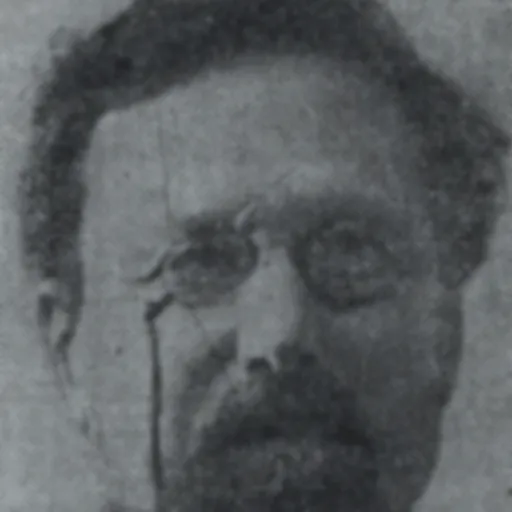
Axinte Frunză
Russian-born Romanian Latinist, politician, translator, and prose writer
About Axinte Frunză
Lived 1859 – 1933 (aged 73–74). Axinte Frunză was a Romanian and Russian revolutionary, latinist, novelist, translator, grammarian and teacher.
Axinte Frunză, first name also spelled as Axente, Axentie, Axenti or Auxentie (; 13 February 1859 – 9 June 1933), was a Bessarabian-born Romanian socialist militant and classical scholar, also noted as a schoolteacher, translator, and fiction writer. Originally a subject of the Russian Empire, he studied at Kishinev Theological Seminary, where he showed promise as a reader and speaker of Latin; embracing Romanian nationalism and rebelling against Tsarist autocracy, he was ultimately expelled from the institution. Frunză probably graduated from another school or university before settling in the Kingdom of Romania. He joined efforts with other radical emigrants in smuggling books across the Russian border, and, while in Northern Dobruja, set up his own agricultural co-operative. He identified as a Marxist, but remained an unusually radical one in the Romanian context, favoring "scientific communism" and justifying peasant revolts, though in conjunction with nationalist ideals. Frunză was therefore close to the doyen of Romanian anarchism, Zamfir Arbore, as well as to scholar Bogdan Petriceicu Hasdeu, a proponent of left-wing nationalism. At the height of his conflict with the National Liberal establishment in the 1900s, he was also an active member of the Conservative Party.
Frunză passed a state examination that entitled him to teach Latin in Romanian schools. He made his major career move in 1897, when he began working at Negruzzi Boarding School of Iași—afterwards integrating fully within Iași's left-leaning elite. He was well-liked by his students, among whom were several who later achieved fame as writers. In addition to his pedagogical skill and his familiarity with the classics, he was admired for his skill in translating Russian literature, which was a second profession for several decades of his life. He similarly turned to writing his own works of fiction, steeped in social realism and well-reviewed by contemporary critics. As an affiliate of the Viața Romînească circle before and after World War I, Frunză antagonized public opinion through his Germanophilia, identifying the Central Powers as Bessarabia's would-be saviors; though he lived during the union of Bessarabia with Romania, he was jaded by the outcome. Always an eccentric man-about-town who enjoyed social drinking, he attracted suspicion for his political activities. He and his wife Zoe harbored militants of the Romanian Socialist and Communist Parties in their home, supporting their activities. He lost his home during an unrelated legal battle, and moved to Bucharest, where he eventually died of angina. Many of his literary works were collected for print, but remained unpublished.
Biography Early life and Romanian arrival The future activist hailed from free peasants (răzeși), with family roots planted in the former principality of Moldavia. He was born at Scorțeni on 13 February 1859, though some records had 1860; the village was back then part of Russia's Bessarabia Governorate, as organized since 1812. According to statements by himself and by others who knew him, his more junior relatives included Mikhail Frunze, future leader of the Red Army. also joined by Petru Frățiman and Is. Fuchs. It was kept under watch by the imperial police, Various biographies report that he only emigrated after receiving his graduation diploma at a lyceum in Nikolayev (Mykolaiv) or at Kiev University. Upon settling in Romania, Frunză earned his living through manual labor, first as a farmhand in Northern Dobruja, where he reportedly set up the first local agricultural co-operative. He supported himself by working at a kefir factory in Bucharest, where he read out Latin literature while overseeing the curdling process, "covered in droplets of milk from head to toe"—and ruining a coat presented to him as a gift by a physician friend, Lazăr Dicescu.
In September 1890, after having received his certificate of graduation, Frunză became the inaugural headmaster and teacher of Latin at Tulcea's gymnasium. He taught there to 1894; while in Tulcea, he also met fellow schoolteacher Zoe Polihron (born 1870 in Slatina), who became his wife. Axinte also became active as a businessman, forming a company that bottled and sold kefir out of Northern Dobruja. The examining commission, presided upon by historian Bogdan Petriceicu Hasdeu, was reportedly stunned by his ability to not just converse in Latin, but also to alternate between the rhetorical styles of Cicero, Tacitus, and Livy.
Axinte and Zoe moved out to Râmnicu Sărat At Iași, Axinte and Zoe joined a thriving socialist group of intellectuals; additionally, Frunză earned admiration from academics, with Hasdeu, Alexandru Philippide and Izabela Sadoveanu all describing him as one of Romania's leading Latinists.
Iași period
Journalist Constantin René Ghiulea refers to Frunză's "superior art" of teaching and his "wonderful humor", which gave his listeners insight into a skeptical worldview; As a Negruzzi alumnus, Eugen C. Crăciun recalled that Frunză was both affable and distant, that he never laughed and only rarely smiled, and that he liked to keep his private life entirely out of the classroom. According to this source, he encouraged children to pursue their literary talents, and was pleasantly impressed to hear Emanuel Ciomac, the future academic, read out his rendition of Horace. His other pupils included poet Demostene Botez, who rated his lessons in Latin as one of his most beautiful experiences of childhood. Păstorel saw Frunză as a Classical Athenian "dressed up as a modern professor", indifferent to most student pranks, and overall lost among his contemporaries.
Frunză was for a while a teacher of Latin at the Humpel Institute for Girls, where he was remembered as lenient and congenial—allowing his pupils to sing, or regaling them with anecdotes about Catullus and Lycoris the mime. Though he had achieved a high standing through his Latin-focused education, he privately preferred Ancient Greek literature to its Roman equivalent, as he felt the latter was written by "ruffians". His teaching methods gave rise to controversy after his death. A Negruzzi alumnus, the future linguist Iorgu Iordan, was dissatisfied with his methods, noting that he had failed to learn proper Latin while at Negruzzi. By contrast, journalist Mihail Sevastos recalls that he was properly taught by Frunză during his final school years. As he reports, he and his class had originally studied under Frunză's friend Calistrat Hogaș, who had never tried to teach them Latin beyond vocabulary skills. Frunză, who cultivated egalitarian values and allowed his class to call him frate ("brother"), was nevertheless the first to teach them Latin syntax.
Frunză himself acknowledged that, once he became aware of the Bessarabian exiles' irrelevancy on the political scene, and of Romania's political culture (which he regarded as decadent and money-driven), he lost interest in even making Romanians aware of their irredenta. A nationalist reviewer, Onisifor Ghibu, argued that this attitude, which he sees as defeatist and self-indulgent, effectively delayed the advances of pan-Romanianism before World War I. In 1900, Frunză was safely counted among the democratic-minded, formerly socialist teachers, who stood up against conservatives affiliated with Junimea. Around January 1902, he himself made a turn to the right, obtaining membership in the Conservative Party. By July, he was speaking out against the National Liberal Party's program of reforms, as advanced by Education Minister Spiru Haret. As a result, the government newspaper Voința Națională, allegedly spurred on by Haret, described Frunză as the Conservatives' electoral agent, claiming that he had forfeited his teacher's calling. As reported in the Conservative press, his political affiliation resulted in his being removed from the examination board at Negruzzi, though he was mysteriously reinstated in September.
In November 1903, Frunză and his friend Hogaș appeared as Conservative inductees, welcoming the party's leadership for a rally at Iași. He spoke on the occasion, to denounce Haret's educational policies. During the Russian Revolution of 1905, which offered a moment of liberalization, Frunză reconnected with the Romanian Bessarabian elites. According to Frunză's own recollections, he joined Arbore, Hasdeu and Ioan C. Bibicescu in authoring an anti-Russian manifesto that was found alongside revolvers smuggled into Bessarabia (Frunză claims that Arbore negotiated with the Romanian authorities and, upon earning their favors, buried the looming scandal). Through his friendship with Arbore, he entered a polemic between the latter and the editor of a new liberal magazine in Kishinev, called Besarabskaya Zhizn. The latter's editor, Fyodor Zakharov, was publicly challenged by Arbore to a duel; tragedy was averted only when Frunză, who had been called in as a witness, sent a conciliatory letter to Zakharov. The document was sent in through Zakharov's aide, Alexis Nour, who was impressed by Frunză's erudition; they remained close friends. In summer of that year, he was among the political and cultural figures approached by a visiting Bessarabian activist, Ion Pelivan.
Around 1907, the scholar had withdrawn from political affairs, and was dedicating his free time to hiking, especially around the Ceahlău Massif and the other Bistrița Mountains. He confessed to Nour that he sometimes hid himself in his own house, instructing his servant to report that he was off to Paris. Shortly before World War I, Frunză joined the writing staff at Stere's left-of-center magazine, Viața Romînească—though, as historian Andrei Cușco notes, his views on society were too radical for that group's mainline Poporanism, making him a marginal. He was a contributor until his final year, with colleagues generally referring to him as fratele Axente ("brother Axente"), thus replicating his habit of addressing each one of them as frate. In 1916, Viața Romînească hosted his commentary about the need to incorporate Bessarabia within a future Greater Romania, also discussing the preservation of Romanians in Ukraine. The article, also republished as a brochure, is read by Cușco as evidencing a mixture of Germanophilia and, following Arbore, "a vision that was profoundly anti-statist (with hints of anarchism), populist, and virulently anti-Russian." As summarized by the same author, Frunză attacked the governing classes in both Russia and Romania by resorting to "ethnic primordialism", thus reviving some of the core thesis of his Narodnik youth—and celebrating rural Romanians as the healthy "barbarians" or "savages" from whom social change would eventually come. Cușco proposes that such samples of "organic nationalism [combined with] a social critique" stand out as an "extremely original" contribution among all period documents favoring an alliance between Romania and the Central Powers.
In its more conventionally nationalistic passages, Frunză's brochure discusses Russian imperialism as an existential threat for Romania as a whole, crediting The Will of Peter the Great as a real document of intent. As the author argued therein, Russia stood poised to annex Greater Moldavia and Northern Dobruja regardless of the war's outcome, but, as an "unreformed empire", was thankfully weakened from within. As Ghibu notes, Frunză, Stere and Arbore were all Germanophiles, who expected that Bessarabia would be liberated by the Central Powers, and who recommended a collaboration between the Romanians and the Ukrainians to hasten this outcome. Ghibu cites Frunză with a metaphorical description of Paul von Hindenburg, who was masterminding offensives in the Eastern Theater, as the Romanians' "God" and savior. Another Frunză piece, put out shortly after, talked about the two-party system under which Romania was at the time, and critiqued its stance on press freedom. He earned attention from his colleagues by exposing the hypocrisy of both Conservatives and National Liberals, comparing their advocacy of freedom while in opposition to their actual record in government. The text also mocked Westernization and its by-product, "Romanian democracy", comparing the Romanian society to a case he had witnessed in Buzău—in which one poor student, who had received a new uniform as a gift, had proceeded to terrorize his erstwhile peers.
In addition to Latin, Frunză could speak several of the Slavic languages, Seen by critic George Călinescu as definitive evidence of Frunză's "perfect linguistic skill", Frunză also provided acclaimed renditions of stories by Anton Chekhov (whom, according to Sevastos, he resembled both physically and "in his spiritual makeup"), which he had visited in 1909. According to Sevastos, these texts reveal him as a keen observer of the "most delicate nuances", "rich in fine, original observations", and still carrying traces of his "Moldavian peasant" background.
The Frunzăs continued to live in Iași during The Romanian Debacle, during which the city remained a provisional capital of Romania, as the southern regions, including Bucharest, had been occupied by the Central Powers. As argued by Ghibu, both Axinte Frunză, like his associate Nour, refused to visit Bessarabia immediately after the February Revolution had again liberalized Russia. Ghibu notes that Frunză never even left Iași, "not even when persistently called over to Chișinău" by the few groups of organized nationalists in the short-lived Moldavian Democratic Republic. The schoolteacher instead welcomed the October Revolution, informing his students about its historical importance. Frunză influenced Mironescu's progressive take on society during extensive conversations. In desperation at her husband's absence, Mironescu's wife once created a mock-tavern in her own home on Albineț Street, allowing them to see each other while she was still around. The room featured a bust of Frunză, done in plaster by Mironescu himself.
Zoe still participated in the defense of radical causes, and, as a figure in the "Socialist Red Cross", offered assistance to workers arrested during the general strike of 1920. She and Axinte also offered more direct protection to trade unionists sought after by the Siguranța, whom they sheltered in their home. Zoe joined the Romanian Communist Party (PCR or PCdR) on its creation in 1920, was elected on its regional committee for Western Moldavia in 1922, and remained affiliated with it even after the group as a whole was outlawed in 1924. The Sărăriei house continued to be used as a temporary and secretive base by the local communists, reportedly including Lucrețiu Pătrășcanu.
Axinte Frunză was forced into retirement from teaching in April 1926, but was called back during July and allowed to continue until 1932. He was still engaged with this project in early 1931, while also completing a version of Maxim Gorky's My Childhood, which he had purified of Gorky's own additions (while also restoring chapters not found in other translations); he complained to his editor, Ion Simionescu, about how "aggressive capitalism" had undermined his effort. Frunză began reconnecting with the Bessarabian literary milieu, which was by then shaped by localists such as Nicolai Costenco, who were virulently critical of Greater Romanian centralism. In January 1932, he was announced as a would-be collaborator for Costenco's new literary magazine, Viața Basarabiei. Nour reports that Frunză was by then skeptical about Leninism and the Soviet Union, arguing that he ought to have been there to evaluate the claims made in Soviet propaganda. He remained optimistic about the prospects of Soviet collectivization, ridiculing agribusiness, and insisting that a collectivization program was needed at home. They finally relocated to Bucharest later in 1932—once there, Zoe joined the PCR-led Anti-War Committee, as well as a series of antifascist organizations. As recalled by Călinescu, Axinte appeared to be dissatisfied with the move, and appeared often at Viața Romîneascăs offices to reconnect with other "Iași deportees". These included former pupils such as Păstorel and Alexandru A. Philippide—Frunză, who appeared generally young and spirited, had some trouble remembering them. The author died in Bucharest on 9 June 1933, According to Cazacu, he was not known to be ill, but had been greatly affected by Arbore's own death. It was attended by "the wife and a few of his friends", and by Viața Romîneascăs [Sadoveanu. He features as "Eudoxiu Bărbat" in Sadoveanu's novel Oameni din lună ("Moon-men")—an eccentric, noble and quiet figure, driven to despair by his devious tenants.
Zoe continued to participate in PCR front organizations, though her activity was greatly reduced by illness from 1937. She survived World War II and witnessed the inauguration of a Romanian communist regime, dying on 28 August 1949. A while after, a manuscript comprising her late husband's novellas was assigned for review and printing at Editura pentru literatură, but was probably mishandled, and was viewed as lost by 1969. His recollections of Mount Athos appeared in 2001 as a standalone edition, put out by Bucharest's Anastasia publishing house, and carrying an introduction by Virgil Cândea. In a 2015 overview, literary biographer Nicolae Scurtu noted that Frunză's biography is "insufficiently known even to specialists", that "sometimes erroneous" details had been published in reference works, and that his body of writings remained poorly catalogued.
Don’t just read it —
keep it.
Full-length biographies made to live with: read them, listen on the way to work, watch them tonight.
- E-book
- Audio
- Video
Instant download · yours to keep · every purchase keeps this site free
Important facts
People in Axinte Frunză's life
Named in this biography and alive at the same time




Related people
Same field, nearest in time


Contemporaries
People whose lives overlapped Axinte Frunză's



Frequently asked questions
Who was Axinte Frunză?
russian-born Romanian Latinist, politician, translator, and prose writer (1859–1933)
When was Axinte Frunză born?
Axinte Frunză was born on 25 February 1859 in Telenești District.
When did Axinte Frunză die?
Axinte Frunză died in 1933 in Bucharest.
What was Axinte Frunză's occupation?
Axinte Frunză was a revolutionary, latinist, novelist, translator, grammarian and teacher.
What nationality was Axinte Frunză?
Axinte Frunză was Romanian and Russian.
Sources & further reading
Cite this page
APA: Biography.guide. (2026). Axinte Frunză. https://biography.guide/axinte-frunza/
MLA: "Axinte Frunză." Biography.guide, https://biography.guide/axinte-frunza/.
Chicago: "Axinte Frunză." Biography.guide. https://biography.guide/axinte-frunza/.
Data last updated: 2026-09-23 · Spot an error? Report a correction.
Portrait: Wikimedia Commons · author & licence
Page generated 2026-09-27 05:07 UTC