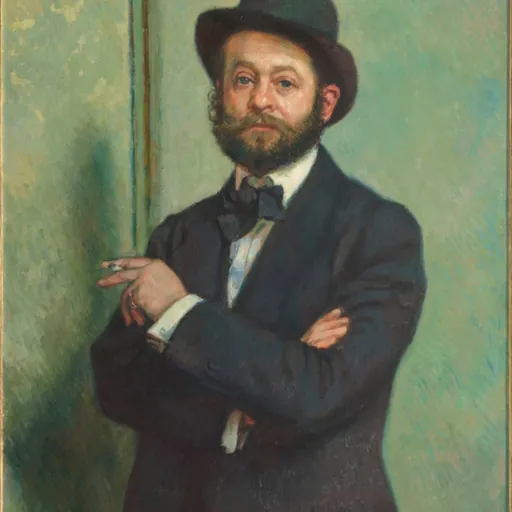
About Auguste Perret
Lived 1874 – 1954 (aged 80). Auguste Perret was a French architect, general contractor, teacher, designer and urban planner.
Auguste Perret (; 12 February 1874 – 25 February 1954) was a French architect and a pioneer of the architectural use of reinforced concrete. His major works include the Théâtre des Champs-Élysées, the first Art Deco building in Paris; the Church of Notre-Dame du Raincy (1922–23); the Mobilier National in Paris; and the French Economic, Social and Environmental Council building in Paris (1937–39). After World War II he designed a group of buildings in the centre of the port city of Le Havre, including St. Joseph's Church, Le Havre, to replace buildings destroyed by bombing during World War II. His reconstruction of the city is now a World Heritage Site for its exceptional urban planning and architecture.
Early life and experiments (1874–1912) Auguste Perret was born in Ixelles, Belgium, where his father, a stonemason, had taken refuge after the Paris Commune. He received his early education in architecture in the family firm. He was accepted in the architecture course of the École des Beaux-Arts in Paris, along with his two brothers, Gustave (1876–1952) and Claude (1880–1960). where he studied under Julien Guadet, a Beaux Arts neoclassicist who had collaborated with Charles Garnier on the construction of the Paris Opera. Beyond the neoclassical rationalism he learned from Gaudet, Perret's particular interest was the structure of buildings and the use of new materials, such as concrete. Though he was considered a brilliant student, he left school without obtaining a diploma and went to work for the family firm.
Perret immediately began experimenting with concrete. His first important project was an apartment building on rue Franklin in Paris (1903), where the concrete structure, instead of being concealed, was clearly visible and was a part of the exterior design. He made an even more radical experiment with the construction of a garage on rue de Ponthieu (1906) (now destroyed) with a simplified cubic structure expressing the interior, large bays of windows and a lack of decoration, which resembled the later International Style.
Perret also served as a juror with Florence Meyer Blumenthal in awarding the Prix Blumenthal, a grant given between 1919 and 1954 to young French painters, sculptors, decorators, engravers, writers, and musicians.
In 1998, the Perret Tower in Grenoble was declared a national heritage site by France.
In 2005, his reconstruction of Le Havre was declared a World Heritage Site by UNESCO.
List of major works Rue Franklin apartments, Paris, 1902–1904 Garage Ponthieu, Paris, 1907 Théâtre des Champs-Élysées, Paris, 1913 Concrete cathedral in Le Raincy, France, Église Notre-Dame du Raincy, 1923, with stained-glass work by Marguerite Huré Perret tower, Grenoble, 1925 La maison-ateliers Chana Orloff, 7 bis villa Seurat, Paris, 1926 Villa Aghion, Alexandria, 1928 (demolished between 2009 and 2016) Concert hall of the École Normale de Musique de Paris, 1929 Hôtel Saint-Georges, Beirut, Lebanon 1932 Immeuble Lange, 9 place de la Porte-de-Passy, Paris (1929–1932) Services Techniques des Constructions Navales, 8 boulevard du General-Martial-Valin (15th arron.) Paris, 1929–1932; an example of a framework of exposed concrete columns. Building, 51-55 rue Raynouard (16th arr.) Paris, (1932), where Perret had his offices Palais Iéna, Paris, 1937, originally built as the Museum of Public Works for the 1937 Paris Exposition, now home of the French Economic, Social and Environmental Council Extensions to the École nationale supérieure des Beaux-Arts, Paris, 1945 City Hall, St. Joseph's Church and further reconstruction of the French city of Le Havre after more than 80,000 inhabitants of that city were left homeless following World War II, 1949–1956 Restaurant #1 of CEA Paris-Saclay, 1952 Gare d'Amiens, 1955
Don’t just read it —
keep it.
Full-length biographies made to live with: read them, listen on the way to work, watch them tonight.
- E-book
- Audio
- Video
Instant download · yours to keep · every purchase keeps this site free
Important facts
People in Auguste Perret's life
Named in this biography and alive at the same time



Related people
Same field, nearest in time



Contemporaries
People whose lives overlapped Auguste Perret's

Frequently asked questions
Who was Auguste Perret?
French architect (1874–1954)
When was Auguste Perret born?
Auguste Perret was born on 12 February 1874 in Brussels.
When did Auguste Perret die?
Auguste Perret died on 25 February 1954 in Paris.
What was Auguste Perret's occupation?
Auguste Perret was an architect, general contractor, teacher, designer and urban planner.
What nationality was Auguste Perret?
Auguste Perret was French.
Sources & further reading
Cite this page
APA: Biography.guide. (2026). Auguste Perret. https://biography.guide/auguste-perret/
MLA: "Auguste Perret." Biography.guide, https://biography.guide/auguste-perret/.
Chicago: "Auguste Perret." Biography.guide. https://biography.guide/auguste-perret/.
Data last updated: 2026-09-21 · Spot an error? Report a correction.
Portrait: Wikimedia Commons · author & licence
Page generated 2026-09-27 04:59 UTC