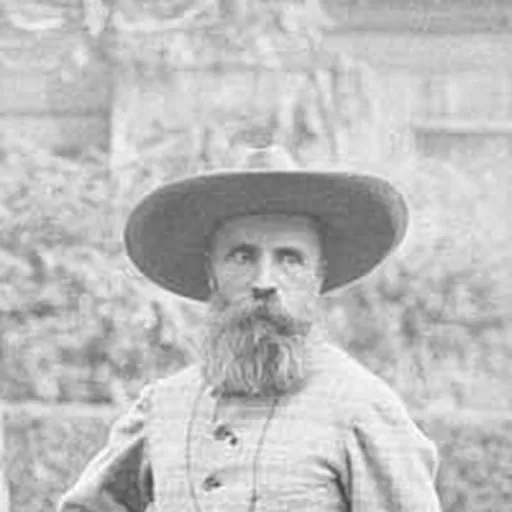
Auguste Pavie
French diplomat and explorer; active in French Indochina
About Auguste Pavie
Lived 1847 – 1925 (aged 77). Auguste Pavie was a French explorer, diplomat and politician, known for Laos and Luang Prabang.
Auguste Jean-Marie Pavie (31 May 1847 – 7 June 1925 ) was a French colonial civil servant, explorer and diplomat who was instrumental in establishing French control over Laos in the last two decades of the 19th century. After a long career in Cambodia and Cochinchina, Pavie became the first French vice-consul in Luang Prabang in 1886, eventually becoming the first Governor-General and plenipotentiary minister of the newly formed French colony of Laos.
Early career
Born in Dinan in Brittany, the son of a cabinet maker, Auguste Pavie did not have the usual makings of a diplomat. He had no training at all either as a military officer or in the grandes écoles. Instead, drawn by the prospect of adventure in distant lands, he joined the army in 1864 at the age of seventeen. In 1869, he was posted to Cochinchina as part of the Marine Infantry. He was called back for military service in France the following year during the Franco-Prussian War, where he reached the rank of sergeant-major. In 1871 he returned to Cochinchina as part of the local administration of the postal and telegraphic service. In 1876 he was put in charge of a small telegraphic office in the remote Cambodian port of Kampot, where he served for three years.
The posting at Kampot gave Pavie the opportunity to gain an in-depth knowledge of the Indochinese, their culture and language. One of very few Europeans in this settlement on the Kampot River beneath the Elephant Mountains, he "went native", mastering Cambodian, walking bare-foot and sporting a wide-brimmed hat, as he charted the backlands of Cambodia, recording all that he found of interest. Pavie's approach prompted mixed reactions: his immersion in Cambodian life was criticized by French officials in Cochinchina; however, a French officer remarked at the time that "beneath an appearance of physical weakness, there was a wealth of intelligence put to work with an energy and strength of will without equal." Pavie referred to this kind of diplomacy as la conquête des coeurs [the winning of hearts], which became the title of his autobiography.
In 1892, he became resident minister in Bangkok, and played an important role in the gunboat diplomacy of the Franco-Siamese crisis in 1893, which resulted in the establishment of the French protectorate over Laos. He was the first commissioner general of the government of the newly formed colony of Laos in 1894, before becoming plenipotentiary minister. At that time, Laos became a part of French Indochina, joining Annam, Tonkin, Cochinchina (which together form modern Vietnam) and the Kingdom of Cambodia; and the Mekong, long referred to as "our river" by French politicians and colonial lobbyists, became wholly controlled by France.
The first mission Pavie, from 1879 to 1885, covered the areas of Cambodia and Southern Siam as far as Bangkok. The second mission, from 1886 to 1889, covered Northeastern Laos and the exploration of the Black river in Tonkin as far as Hanoi. The third mission, from 1889 to 1891, involved the exploration of the Mekong river from Saigon to Luang Prabang. The fourth mission, from 1894 to 1895, involved the areas of Laos bordering with China and Burma on the left bank of the Mekong river, as far as the Red River.
Retirement On retiring from high office, he returned to France in 1904 and set to work preparing his recollections and observations for publication. Between 1898 and 1921 he produced the multi-volume work La mission Pavie, A la conquête des coeurs and Contes du Cambodge, du Laos et du Siam. In 1906 he was named a Grand Officer of the Légion d'honneur. He died in Thourie, Brittany.
Works Mission Pavie en Indochine, 1879–1895. 7 vols. Paris: Leroux, 1898–1919. A la conquête des coeurs: Le Pays des millions d'Eléphants. Paris, Presses Universitaires de France, 1942. Contes populaires du Cambodge, du Laos et du Siam. Paris: Leroux, 1903. The Pavie Mission Indochina Papers 1879-1895, Bangkok: White Lotus, 1996. 6 vols. English translation by Walter E. J. Tips of Vols. I-VI of Mission Pavie en Indochine. Pavie, Auguste: Mission Pavie, Indochine, 1879-1895. Géographie et Voyages VII. Journal de Marche (1888-1889). Evenements du Siam (1891-1893), Bangkok: White Lotus, 1999, reprint of Volume VII (1919) of Mission Pavie en Indochine.
Gallery
Don’t just read it —
keep it.
Full-length biographies made to live with: read them, listen on the way to work, watch them tonight.
- E-book
- Audio
- Video
Instant download · yours to keep · every purchase keeps this site free
Important facts
Related people
Same field, nearest in time



Contemporaries
People whose lives overlapped Auguste Pavie's




Frequently asked questions
Who was Auguste Pavie?
French diplomat and explorer; active in French Indochina (1847-1925)
When was Auguste Pavie born?
Auguste Pavie was born on 31 May 1847 in Dinan.
When did Auguste Pavie die?
Auguste Pavie died on 7 May 1925 in Thourie.
What was Auguste Pavie's occupation?
Auguste Pavie was an explorer, diplomat and politician.
What was Auguste Pavie known for?
Auguste Pavie was known for Laos and Luang Prabang.
What nationality was Auguste Pavie?
Auguste Pavie was French.
Sources & further reading
Cite this page
APA: Biography.guide. (2026). Auguste Pavie. https://biography.guide/auguste-pavie/
MLA: "Auguste Pavie." Biography.guide, https://biography.guide/auguste-pavie/.
Chicago: "Auguste Pavie." Biography.guide. https://biography.guide/auguste-pavie/.
Data last updated: 2026-09-22 · Spot an error? Report a correction.
Portrait: Wikimedia Commons · author & licence
Page generated 2026-09-27 04:58 UTC