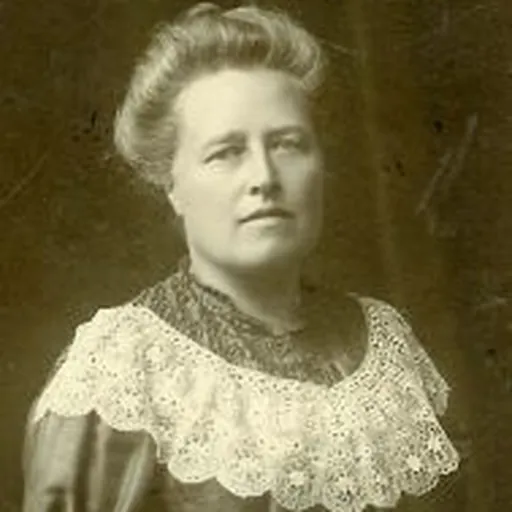
About Augusta Peaux
Lived 1859 – 1944 (aged 84). Augusta Peaux was a Dutch poet and writer.
Augusta Guerdina Peaux (2 November 1859 – 23 February 1944) was a Dutch poet. She began her publishing career as a writer of prose fiction, in literary magazines and in one collection, and in the early 1900s started publishing poetry, in magazines associated with the literary movement known as the Tachtigers, with whom she became associated. With her sister Johanna, she translated poetry by Dante Gabriel Rossetti and Algernon Charles Swinburne, and with her friend Truus, with whom she shared a love for Iceland and its literature, she translated stories from the Edda. Two volumes of her poetry were published; she never sought literary fame, though some fame came to her posthumously.
Biography Augusta Guerdina Peaux was born in Simonshaven, a small village in South Holland, where her father, Pieter Peaux (1835–1914), was a preacher, as were his father and grandfather; her mother was Louisa Cornelia Gerarda Prince (1834–1917). She was the oldest of five. In 1864 the family moved to the parish house of nearby Zwartewaal, and in 1868 to Etten and Hoeven in Brabant, where Pieter Peaux took over the position of his dead father. The children spent much of their time playing outside, in nature, and Augusta had the later poet Jacques Perk, the same age as she, as a playmate. Since they now lived in a predominantly Catholic area, the Peaux family occupied a special position, and the two girls were taught at home by teachers brought in from Holland. In 1893 the two published a translation of parts of Algernon Charles Swinburne's verse drama Chastelard (1864).
Literary career Peaux's publishing career started in 1892, when she began publishing short stories in Eigen Haard, a popular magazine published in Haarlem by Arie Cornelis Kruseman. From Gulpen she regularly sent poems to Albert Verwey, who published them in two of his magazines, Tweemaandelijksch Tijdschrift and De XXe eeuw, and praised her "little verses". She was hesitant to publish collections of her poems fearing a negative response, but did publish a collection of stories in 1899, Op Goudgrond. A negative review by Frans Coenen in De Kroniek made her refrain from collecting and publishing her own work, though she continued to publish prose fiction in Eigen Haard. She was drawn to Scandinavia and especially Iceland, where she imagined silent landscapes without people. Kloos praised her poetry in a lengthy review in De Nieuwe Gids, in which he recalled how Jacques Perk first alerted him to her work; at the time, he was puzzled by the fact that there were only two good young talented poets in the country, and Perk offered Peaux as a third. He spoke positively of her imagery and the lyrical quality of her poems, which he said come from an electric spark which only momentarily shows itself but is always palpable. Peaux, he said, is "one of the real poets, whose psychic impressions come from the inner soul, in the way in which they are conceived there by the mediation of the surrounding reality, and then come forth, carried by the mood which results from their coming into existence, uttering itself in song through the rhyme and measure of the verse". J. D. Bierens de Haan, in a short review, saw mostly short, "tasteful" poems, whose naivete was refreshing in troubling times. The collection was reprinted in 1923. In 1926 she published Nieuwe gedichten, also with Tjeenk Willink. But after 1930 life became more difficult for Peaux as her physical and mental health began to suffer, though her friend Truus Meuleman continued to support her. In 1935, Peaux suffered from depression, which would revisit her in 1942. She remained in Nijmegen, with a brief stay in The Hague in 1940. She died in a boarding house on 23 February 1944, of pneumonia, one day after the Americans bombed the city. She was buried at the cemetery Rustoord in Nijmegen, in the family grave; her name is not on the gravestone.
Publications Prose Op goudgrond (collection of stories, 1899) "Jeudgherinnering aan Jacques Perk" (1931) "J.R. Klein-Peaux, Geervliet 19 Januari 1864 – Oosterbeek 30 Juni 1933" (1935)
Poetry "Fragmenten uit Swinburne's Chastelard", with Johanna R. Klein-Peaux "Stadstuin", "Stemming", "De berk" (1911) "De herinnering" (1912) "Het lied van Thrym" (with G. E. G. Meuleman, 1917) "Bladvulling" (1926) "Weelde" (1930) "In laten herfst", "Het oerwoud", "De kolenkar", "De vogelvrij verklaarde" (1935)
Collections Gedichten (1918) Nieuwe gedichten (1926) De wilgen, de velden, het water – Augusta Peaux, ed. Mario Molegraaf (Dordrecht: Liverse, 2014)
Don’t just read it —
keep it.
Full-length biographies made to live with: read them, listen on the way to work, watch them tonight.
- E-book
- Audio
- Video
Instant download · yours to keep · every purchase keeps this site free
Important facts
People in Augusta Peaux's life
Named in this biography and alive at the same time


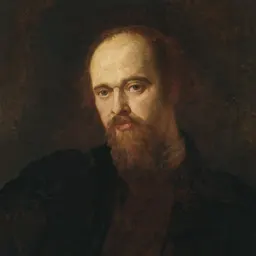
Related people
Same field, nearest in time
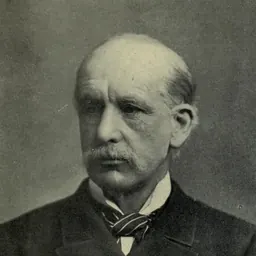
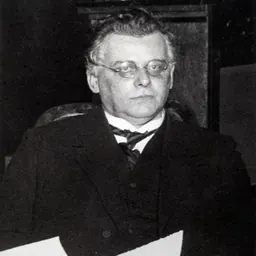
Contemporaries
People whose lives overlapped Augusta Peaux's



Frequently asked questions
Who was Augusta Peaux?
Dutch poet and writer (1859-1944)
When was Augusta Peaux born?
Augusta Peaux was born on 2 November 1859.
When did Augusta Peaux die?
Augusta Peaux died on 23 February 1944.
What was Augusta Peaux's occupation?
Augusta Peaux was a poet and writer.
What nationality was Augusta Peaux?
Augusta Peaux was Dutch.
Sources & further reading
Cite this page
APA: Biography.guide. (2026). Augusta Peaux. https://biography.guide/augusta-peaux/
MLA: "Augusta Peaux." Biography.guide, https://biography.guide/augusta-peaux/.
Chicago: "Augusta Peaux." Biography.guide. https://biography.guide/augusta-peaux/.
Data last updated: 2026-09-21 · Spot an error? Report a correction.
Portrait: Wikimedia Commons · author & licence
Page generated 2026-09-27 05:00 UTC