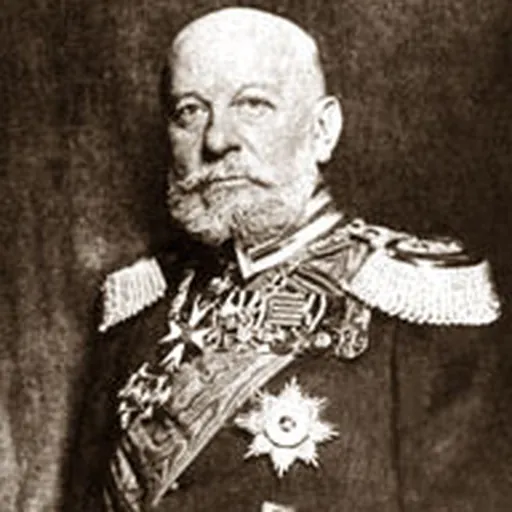
About August zu Eulenburg
Lived 1838 – 1921 (aged 82). August zu Eulenburg was a German politician.
August Ludwig Traugott Botho Graf zu Eulenburg (22 October 1838 – 16 June 1921) was an officer in the Prussian, and later German armies, and official in the Prussian royal court. He was the younger brother of Count Botho zu Eulenburg, who served as Minister-President of Prussia from 1892 to 1894, and a second cousin of Philipp, Prince of Eulenburg, the close friend of Kaiser Wilhelm II.
Biography Born into the Upper Saxon noble family of Eulenburg, August joined the army on 1 November 1856 as a grenadier in the 1st Foot Guard Regiment after his graduation from the Marienwerder Gymnasium. He was promoted to second lieutenant two years later on 13 April 1858, and between 1860 and 1862 he participated in the trade mission in East Asia as an attaché under his kinsman Friedrich Albrecht zu Eulenburg.
Upon his return to Prussia in 1865, Eulenburg pursued a career in the royal court; he was made a personal adjutant to the crown prince (the future Emperor Frederick III), before being appointed Marshal of the Royal Court in 1868, thus placing him in charge of the court's administrative affairs. He then served as a member of the General-Ordenskommission from 1879 to 1890, and served as Chief Master of Ceremonies between 1883 and 1914 and Grand Marshal of the Court and House (Oberhof- und Hausmarschall) to Kaiser Wilhelm II from 1890 to 1914. He was also a member of the Herrenhaus and Minister of the Royal House from 1907 to the end of Wilhelm II's reign in 1918.
Following Otto von Bismarck's dismissal in 1890, Eulenburg mediated the reconciliation between the emperor and former chancellor. Conversely, he encouraged the rift between his brother Botho and Caprivi, in the hopes that the former would replace the latter as chancellor, as Botho was seen in conservative circles as a bulwark against the rising threat of social democracy; Wilhelm II would ultimately appoint Prince Hohenlohe.
Eulenburg retired from active military service as a colonel in 1889, but was promoted to major-general in 1891 and lieutenant-general in 1895, before being made à la suite General of the Infantry on 18 October 1904. He continued to serve as Chief Representative (General-Bevollmächtigter) of the House of Hohenzollern after the November Revolution for the remainder of his life.
He died in 1921 in Berlin, and was buried in the Holy Trinity Cemetery in the Kreuzberg district alongside his family.
Honours German orders and decorations
Foreign orders and decorations Knight of the Iron Crown, 1st Class, 1872 Grand Cross of the Imperial Order of Leopold, 1889 Grand Cross of the Royal Hungarian Order of St. Stephen, 1897; in Brilliants, 1908 Grand Cordon of the Order of Leopold Grand Cross of the African Star Grand Cross of St. Alexander Grand Cross of Civil Merit, in Brilliants Grand Cross of the Dannebrog, 19 August 1873; in Brilliants, 29 June 1890 Knight of the Elephant, 3 April 1903 Kingdom of Greece: Grand Cross of the Redeemer Grand Cross of Saints Maurice and Lazarus Grand Cross of the Crown of Italy Tuscan Grand Ducal Family: Grand Cross of St. Joseph Holy See: Grand Cross of the Order of Pope Pius IX Grand Cordon of the Rising Sun Knight of the Gold Lion of Nassau Grand Cross of the Oak Crown Grand Cross of St. Charles Grand Cross of the Netherlands Lion Grand Cross of St. Olav, 2 July 1890 Order of Osmanieh, 1st Class Order of the Medjidie, 1st Class Order of Glory Persian Empire: Order of the August Portrait Order of the Lion and the Sun, 1st Class Grand Cross of Our Lady of Conception Grand Cross of the Royal Military Order of St. Benedict of Aviz Order of the Double Dragon, Class I Grade III Grand Cross of the Star of Romania Knight of St. Andrew Knight of St. Alexander Nevsky, in Brilliants Knight of St. Anna, 1st Class in Brilliants Knight of St. Vladimir, 2nd Class with Star Grand Cross of the White Eagle Grand Cross of the Cross of Takovo Siam: Grand Cross of the White Elephant Grand Cross of the Order of Charles III, with Collar, 12 July 1900 Commander Grand Cross of the Polar Star, 16 August 1873 Commander Grand Cross of the Order of Vasa, 31 August 1888 Knight of the Seraphim, 6 June 1908 Honorary Grand Cross of the Royal Victorian Order, 23 November 1899
Don’t just read it —
keep it.
Full-length biographies made to live with: read them, listen on the way to work, watch them tonight.
- E-book
- Audio
- Video
Instant download · yours to keep · every purchase keeps this site free
Important facts
People in August zu Eulenburg's life
Named in this biography and alive at the same time



Related people
Same field, nearest in time





Contemporaries
People whose lives overlapped August zu Eulenburg's



Frequently asked questions
Who was August zu Eulenburg?
German politician (1838-1921)
When was August zu Eulenburg born?
August zu Eulenburg was born on 22 October 1838 in Königsberg.
When did August zu Eulenburg die?
August zu Eulenburg died on 16 June 1921 in Berlin.
What was August zu Eulenburg's occupation?
August zu Eulenburg was a politician.
What nationality was August zu Eulenburg?
August zu Eulenburg was German.
Sources & further reading
· Wikipedia: August zu Eulenburg
· DBpedia: August zu Eulenburg
Cite this page
APA: Biography.guide. (2026). August zu Eulenburg. https://biography.guide/august-zu-eulenburg/
MLA: "August zu Eulenburg." Biography.guide, https://biography.guide/august-zu-eulenburg/.
Chicago: "August zu Eulenburg." Biography.guide. https://biography.guide/august-zu-eulenburg/.
Data last updated: 2026-09-20 · Spot an error? Report a correction.
Portrait: Wikimedia Commons · author & licence
Page generated 2026-09-27 04:57 UTC