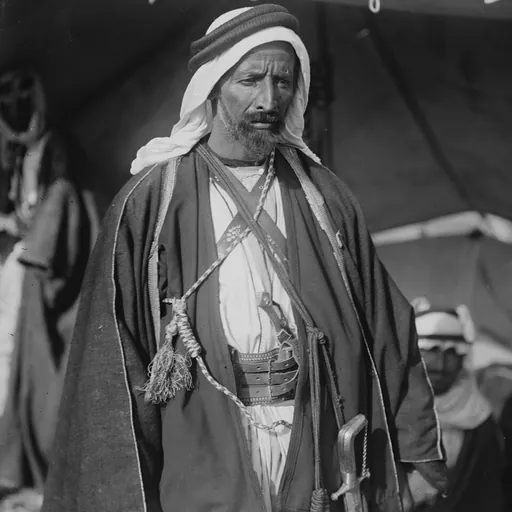
Auda ibu Tayi
Arab leader
About Auda ibu Tayi
Lived 1874 – 1924 (aged 50). Auda ibu Tayi was a combatant.
Auda Abu Tayeh or Awda Abu Tayih ( 11 January 1874 – 27 December 1924), nicknamed the Commander of the People or the Desert Falcon, was the Sheikh of a section of the Howeitat or Huwaytat tribe of Bedouin Arabs at the time of the Great Arab Revolt during the First World War. The Howeitat lived in what is now Saudi Arabia/Jordan.
Auda led the Arab forces in several battles, the most significant ones being the battle of Aqaba, where he managed to capture the city, seizing the entire Ottoman garrison, and the siege of Damascus, when he took the city alongside Faisal. He died in 1924 and was buried in Amman. He is considered a national hero in Jordan.
In the Arab world, he is seen as a generous and honorable man. However, outside of the Arab world, he is mainly known through his portrayal in T. E. Lawrence's 1926 autobiographical work Seven Pillars of Wisdom and from the fictionalised depiction of him in David Lean's 1962 film Lawrence of Arabia. Those accounts, which presented him as a greedy and slick man, have been criticized by historians.
Biography
Early life Auda was the son of Harb Abu Tayi (? – 1904). He was the fourth among five brothers and one sister and had a rough youth. His mother was particularly tough; during a confrontation with another tribe, Auda, still a child, pursued attackers and killed several. Auda had taken up the claims of his father, Harb abu Tayi (? – 1904), who had contested the tribe's chieftainship with Arar ibn Jazi. Tensions between them and the Ottoman administration had increased after an incident in 1908, when two soldiers were killed who had been sent to demand payment of a tax that Auda claimed to have already paid. thumb Auda Abu Tayi (marked with an X) of the Howeitat offers allegiance to the King; a soldier next to him bears the Arab flag. (1917)
According to historian Mahmoud Obeidat, Auda was the "only person among the tribal leaders whom the Turkish authorities were pursuing, the only person who rejected the decisions of the Turkish administration, and the only person who saw himself as far superior to the Ottoman governor".
According to Suleiman al-Mousa and Mahmoud Krishan, after killing these two Turkish soldiers, Auda was sought by the police. While secretly heading to Ma'an to visit a friend, the police received information about his presence and surrounded the house where he was hiding. He had thirteen grandchildren, all of whom live in Jordan.
Great Arab revolt
At the beginning of the Great Arab Revolt, he joined the Sharif of Mecca, Hussein bin Ali alongside the Howeitat tribe.
According to several researchers, his and his tribe's mobility and knowledge of the desert were significant factors contributing to the success of the Arab Revolt and stood out as one of their assets. He and his tribesmen were lead forces in the fall of Aqaba (July 1917) and Damascus (October 1918). thumb Al-Jafr castle in Jordan, 1927, this building was started by Auda Abu Tayi after WWI. However, he died before the completion of the building.
Auda abu Tayi is considered a hero of the Arab revolt. In reward for his services rendered, he received a sword from the hands of Hussein as a token of friendship.
About his role in the Great Arab Revolt, he declared: However, the expedition resulted in a disaster after their enemies spotted them near their arrival point and started depleting all water supplies, destroying the whole expedition except a small dozen of tribesmen, including Auda and his son Muhammad. Before it was completed, however, he died in 1924
Name His full genealogy was, in .
Legacy Historical legacy
He was presented by some people, on the account of the movie, and to a lesser extent on Seven Pillars of Wisdom as being a sly and greedy individual. Much of this modern-day presentation has been described by the historian Graham Dawson as being rooted in his sensationalised depiction by the American writer, broadcaster, and documentary filmmaker Lowell Thomas as a figure of anarchic, primitive masculine energy deliberately contrasted against the British imperial masculinity Thomas viewed Lawrence as embodying. However, historians have criticized these accounts of Auda, viewing them as misrepresenting him and wider Bedouin society in general.
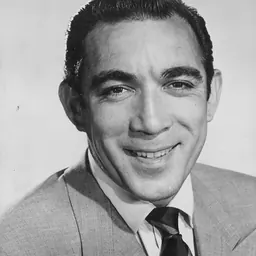
Cinema He was portrayed in the David Lean film Lawrence of Arabia by Anthony Quinn, which included various stereotypes against Arabs and his figure.
Auda was also featured as a supporting character in Terence Rattigan's Lawrence-themed play Ross.
He is also portrayed in 2009 Qatari film Auda abu Tayeh, which talks about his life in Arabia to Arab Revolt, and his death. In 2008, there was also a series about him produced and filmed in Jordan.
Family His granddaughter, Evon Abu-Taieh, served as the head of the Computer Information Systems and Business Technology faculties at the Aqaba branch of the University of Jordan. In 2005, she earned her PhD in Computer Information Systems from the Arab Academy for Banking and Financial Sciences in Amman, Jordan.
Don’t just read it —
keep it.
Full-length biographies made to live with: read them, listen on the way to work, watch them tonight.
- E-book
- Audio
- Video
Instant download · yours to keep · every purchase keeps this site free
Important facts
People in Auda ibu Tayi's life
Named in this biography and alive at the same time



Related people
Same field, nearest in time

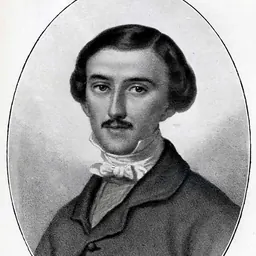

Contemporaries
People whose lives overlapped Auda ibu Tayi's
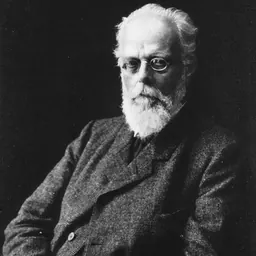
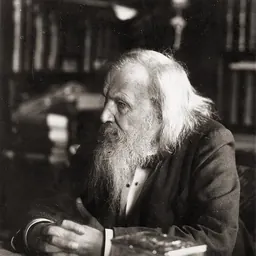
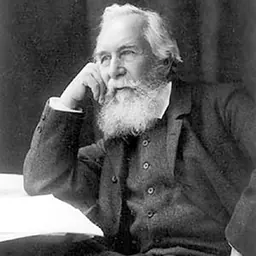

Frequently asked questions
Who was Auda ibu Tayi?
Arab leader (1874–1924)
When was Auda ibu Tayi born?
Auda ibu Tayi was born on 17 May 1874 in Hejaz.
When did Auda ibu Tayi die?
Auda ibu Tayi died on 22 July 1924 in Amman.
What was Auda ibu Tayi's occupation?
Auda ibu Tayi was a combatant.
Sources & further reading
Cite this page
APA: Biography.guide. (2026). Auda ibu Tayi. https://biography.guide/auda-ibu-tayi/
MLA: "Auda ibu Tayi." Biography.guide, https://biography.guide/auda-ibu-tayi/.
Chicago: "Auda ibu Tayi." Biography.guide. https://biography.guide/auda-ibu-tayi/.
Data last updated: 2026-09-24 · Spot an error? Report a correction.
Portrait: Wikimedia Commons · author & licence
Page generated 2026-09-27 05:08 UTC