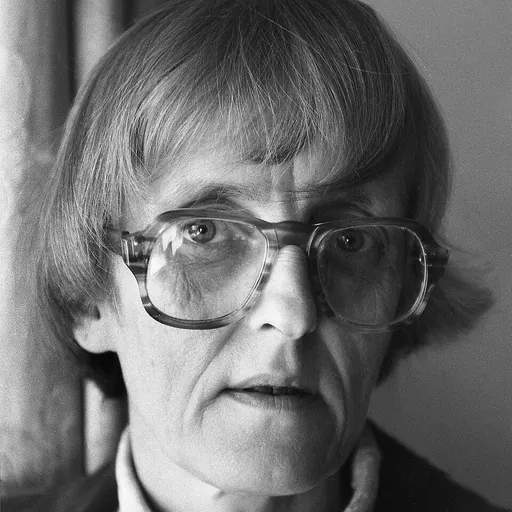
About Astrid Reinla
Lived 1948 – 1995 (aged 46–47). Astrid Reinla was an Estonian writer and translator.
Astrid Reinla (born Astrid Kuningas; 1 March 1948, in Tallinn – 1 January 1995, in Tallinn) was an Estonian writer.
Reinla was born in Tallinn. Her father was literary scholar, literary and theatre critic, cultural historian and translator Oskar Kuningas. Her older sister was chess player and journalist Merike Rõtova and her first cousin was actress Helle Kuningas.
Besides books she wrote also worked as a screenwriter for the television programs, including the Eesti Televisioon drama series Õnne 13.
Biography She studied at Tallinn secondary schools no. 29 (1955–1961) and 7 (1961–1966) and at Tartu State University (1969–1974) from where she graduated as an Estonian philologist.
Reinla's first piece of writing was published in a periodical in 1969. The most fertile creative period in her less than 50 years of life fell into the 1980s when she published collections of both poetry and short stories but also children's books and plays. The latter include, e.g., Naeris naeris (‘The Turnip Laughed’, 1984), which was staged at the Estonian Puppet Theatre, and Koduabiline (‘Domestic Helper’, 1986) which was staged at the Ugala Theatre.
Although Reinla's creation had an essential role in her time, and critic Aivar Kull has called her “a balancing, reconciling force that mitigated tensions in that time's cultural life”, today she is best known as a children's writer. Several generations have grown up with her mythological character Pätu (1988) whom no one has seen, but who can be made responsible for any mischief that has happened at home. In 1990, the book was screened as a television play; an audio cassette with Pätu's songs was also released. The painfully realistic story about the forsaken cat Teofrastus (1985), which reflects the value judgements and sore points of that time's society, may have inspired several younger writers’ children's books about cats and given a new dimension to the local identity of the Mustamäe district in Tallinn and the South Estonian village Peedu. Teofrastus was made into a puppet film as late as in 2018, which proves the strong impact the book had on children when was published, and how it continues to live on in their memories. Teofrastus has been translated into German and English (both 1989).
Many Estonians remember Reinla as the author of the idea and the first scriptwriter of the popular television series Õnne 13 (Meie elu lood) (‘13 Õnne Street (The Stories of Our Life)’). Although the scriptwriters of the series initiated by her in 1993 have changed for several times, being always well-known Estonian writers, the series is still popular and has continued uninterruptedly for several decades. In 1995, Reinla posthumously received the Literature Endowment Annual Award for Õnne 13.
Reinla translated various works into Estonian, including the collection of science-fiction stories by the Russian writer Andrei Balabukha Eelkäijad (Forerunners, 1978), Ella Fonyakova's story for young adults Tolle talve leib (‘The Bread of That Winter’, 1979), Teekond teise ilma ehk suur palverännak (‘Journey into the Other World or Great Pilgrimage’, 1980) by the Tajik writer Fazlidin Mukhamadiev and Helen Keller's novel Minu elu lugu (‘The Story of My Life’, 1995).
Works 1982: collection of short stories "Inimestega" 1985: children's book "Teofrastus" 1987: collection of short stories "Plekk-katus" 1988: children's book "Pätu" 1989: children's book "Miikael" 1994: children's book "Lumeelevant. Krooksjalad"
Don’t just read it —
keep it.
Full-length biographies made to live with: read them, listen on the way to work, watch them tonight.
- E-book
- Audio
- Video
Instant download · yours to keep · every purchase keeps this site free
Important facts
People in Astrid Reinla's life
Named in this biography and alive at the same time


Related people
Same field, nearest in time


Contemporaries
People whose lives overlapped Astrid Reinla's

Frequently asked questions
Who was Astrid Reinla?
Estonian writer (1948-1995)
When was Astrid Reinla born?
Astrid Reinla was born on 1 March 1948 in Tallinn.
When did Astrid Reinla die?
Astrid Reinla died in 1995 in Tallinn.
What was Astrid Reinla's occupation?
Astrid Reinla was a writer and translator.
What nationality was Astrid Reinla?
Astrid Reinla was Estonian.
Sources & further reading
Cite this page
APA: Biography.guide. (2026). Astrid Reinla. https://biography.guide/astrid-reinla/
MLA: "Astrid Reinla." Biography.guide, https://biography.guide/astrid-reinla/.
Chicago: "Astrid Reinla." Biography.guide. https://biography.guide/astrid-reinla/.
Data last updated: 2026-09-20 · Spot an error? Report a correction.
Portrait: Wikimedia Commons · author & licence
Page generated 2026-09-27 04:57 UTC