
Asher Wright
American Presbyterian missionary
About Asher Wright
Lived 1803 – 1875 (aged 71). Asher Wright was a British.
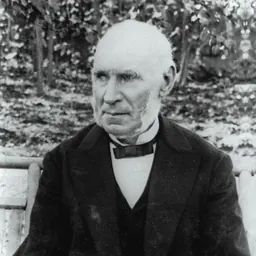
Asher Wright (September 7, 1803 – April 13, 1875) was an American Friends (Quaker) missionary, who worked among the people of the Seneca Nation, of the native Iroquois of the northeastern United States from 1831 to 1875. His most notable work was the extensive translation and linguistics work he did among the Seneca people.
Early life and education Wright was born in Hanover, New Hampshire, on September 7, 1803. He was educated at Dartmouth College between 1826 and 1829, registered in the medical school alongside studying Ancient Languages. At the same time, Wright was enrolled at the Andover Theological Seminary, where he graduated in 1831 and was ordained in the same year. Prior to his appointment as a missionary at Buffalo Creek Reservation, Wright married Martha Edgerton in 1831. Martha died on January 7, 1831, from illness and ongoing poor health, aged 23. On January 21, 1833, Wright married Laura Maria Sheldon, a school teacher from Vermont, whom he had corresponded with through letter after being introduced to by their mutual friend Rev. Clark Perry.
Missionary work
Linguistics and anthropological work Wright's missionary work began in 1831 after graduating seminary, moving to Buffalo Creek to work among the Seneca people. The Mission at Buffalo Creek had been established in 1811, 20 years prior to Wright's commencement there, where translation work had already been started on hymns, the Gospel of Luke and other portions of the Bible.
In 1842, Wright published A Spelling Book in the Seneca Language With English Definitions, a work which compiled Wright's linguistic efforts in developing a Seneca alphabet, work which involved self-devised phonetic systems and other linguistic methods. The journal, titled the Mental Elevator, was also edited by the Wrights, and was a part of their wider collection of translation work including the Gospels, dictionaries, hymnals, primers, spelling books and tracts.
Throughout 1874, Wright sent several letters containing his observations, specifically focusing on social organisation and ceremony within Seneca clans, to the anthropologist Lewis Henry Morgan in response to a request for data to aid in research for his book, Ancient Society.
It is suggested that Wright, along with the assistance of Laura, provided medical assistance to the people of the reservation, using the knowledge he acquired from his time at Dartmouth College. The two were supposedly widely sought on the reservation, and would provide medical attention, caring for people both spiritually and physically in their role as missionaries on the reservation.
Removal of the Seneca from Buffalo Creek In 1838 the Treaty of Buffalo Creek was signed, which decreed that the four Seneca reservations would be sold off to the Ogden Land Company and intended for the Seneca people to be removed to Kansas. Wright was among many who considered the proceedings surrounding the treaty corrupt, along with the majority of the community at Buffalo Creek, due to the bribery of Seneca Chiefs by the land developers. Wright corresponded with a Quaker committee who were acting against the treaty and provided letters and witnessed testimonials opposing the treaty. While the opposition to the treaty led to a compromise treaty being drafted and signed in 1842, the opponents were unable to reclaim Seneca ownership to the Buffalo Creek Reservation. The result of this treaty saw the majority of the Seneca of Buffalo Creek relocate to the Cattaraugus Reservation, a Seneca reservation that had been returned to the people as a part of the compromise treaty.
The Wrights relocated to the Cattaraugus Reservation along with the majority of the Buffalo Creek Seneca, where the Seneca Church was reestablished in 1845.
The impact of the treaties and relocations was considered a setback of missionary work by Wright. He wrote about the increased hostility to Christianity after the removal to Cattaraugus. The pagan portion of the two Reservations availed themselves of the opportunity of union to build up and strengthen their cause against Christianity... The influence of Christianity had been almost paralyzed by the intense excitement of the popular mind during the treaty struggle; there was alienation between brethren, bitter enmity among neighbors and kindred, and thorough scorn of the Christian profession among pagans and impenitent sinners.
Thomas Asylum for Orphan and Destitute Children
In September 1847, the Seneca suffered an epidemic of typhoid, in which approximately 70 of them died. The Wrights began taking in the orphaned children left behind by the outbreak. By 1854, the number of orphans and destitute children in the reserve had exceeded fifty. Due to the lack of any charitable institution to assist with this, the Wrights appealed to the Society of Friends, the New York State Legislature, and businessman Philip E. Thomas in order to fund the establishment of an orphanage. Thomas had previously voiced his support of the Seneca cause after the Wright and the Quakers had helped the Seneca people retain some of their land in the compromise treaty. Thomas' name was used for the Asylum due to his financial support towards its cause. The institution had the capacity to house 100 children, and a schoolhouse was soon built on the property where 'these children received the advantages of a district school." Wright held the position of director until his death in 1875. In the same year, control of the asylum passed to the State Board of Charities due to financial difficulties. The result of this was that they believed that "this new religion (Christianity)... must be bad, since those who embraced it could be so dishonest, so unjust, so cruel."
The impeding opposition to Wright's mission during these trials was considered a hindrance to the work of mission by Wright. The minimal growth that he saw in the church and the periods of decline during the time of opposition has even lead to the suggestion that Wright considered his mission in terms of seeing converts made of the Seneca a failure.
Legacy Wright's work as a linguist among the Seneca saw the language develop from a spoken language to a language of literacy. His work is still used as a basis for Seneca translation and written work, and has still been considered the best source on the Seneca language. He notes that Wright's example assists in questioning the stereotype of western missionaries being colonial in intention.
The United Missions Church on the Cattaraugus Reservation where Wright ministered was renamed the Wright Memorial Church in 1957, in remembrance of Asher and Laura Wright and their missionary work among the Seneca people.
Don’t just read it —
keep it.
Full-length biographies made to live with: read them, listen on the way to work, watch them tonight.
- E-book
- Audio
- Video
Instant download · yours to keep · every purchase keeps this site free
Important facts
Family & relationships
People in Asher Wright's life
Named in this biography and alive at the same time
Contemporaries
People whose lives overlapped Asher Wright's






Frequently asked questions
Who was Asher Wright?
American Presbyterian missionary
When was Asher Wright born?
Asher Wright was born on 7 September 1803 in Hanover (NH).
When did Asher Wright die?
Asher Wright died on 13 April 1875 in Cattaraugus, New York, United States.
What nationality was Asher Wright?
Asher Wright was British.
Sources & further reading
Cite this page
APA: Biography.guide. (2026). Asher Wright. https://biography.guide/asher-wright/
MLA: "Asher Wright." Biography.guide, https://biography.guide/asher-wright/.
Chicago: "Asher Wright." Biography.guide. https://biography.guide/asher-wright/.
Data last updated: 2026-09-20 · Spot an error? Report a correction.
Page generated 2026-09-27 05:27 UTC