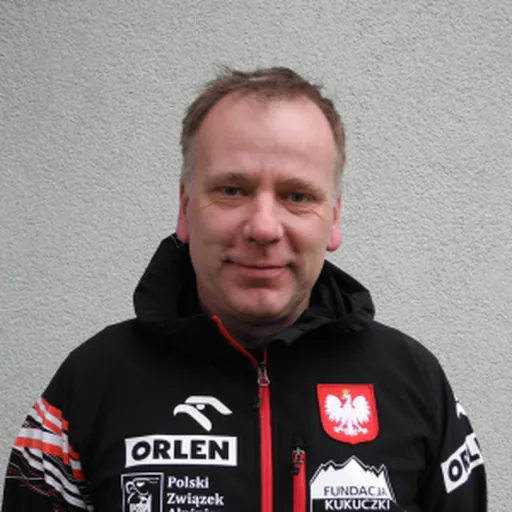
About Artur Hajzer
Lived 1962 – 2013 (aged 51). Artur Hajzer was a Polish mountaineer, entrepreneur and himalayist.
Artur Henryk "Słon” Hajzer (28 June 1962 – 7 July 2013) was a Polish mountaineer. Hajzer summitted seven eight-thousanders, several via new routes (Manaslu’s NE face in 1986, Shishapangma’s east ridge in 1987) and made the first winter climb of Annapurna on February 3, 1987.
Life Hajzer began climbing at age 14 with the Tatra Scout club. At 16, he completed the COS Betlejemka climbing course in the High Tatras, then going on to climb routes in the Alps on Mont Blanc, including Petit Dru in 1981. As a teenager, he acquired the nickname "the elephant" (Słoń in Polish) for his climbing ability and endurance.
At age 20 he began climbing in the Himalayas. At age 21, he summitted Tirich Mir (7,708m) in the Hindu Kush, Pakistan.
In 1985 during a club expedition to Lhotse, he lost his then climbing partner, Rafał Chołda in an accident, and where he met his future climbing partner, Jerzy Kukuczka, who would have a considerable impact on Hajzer. Kukuczka and Hajzer would climb together through the rest of the 1980s, making a number of pivotal climbs together, including Manaslu, Shishapangma and the first ascent of Annapurna in winter in 1987.
He also summited Annapurna East (8010m) via a new route up the SE face in 1988. All these climbs were done alpine-style, without supplemental oxygen or Sherpa support.
In 1989, Hajzer organized a successful rescue operation on Mount Everest’s West Ridge for Andrzej Marciniak in 1989, supported by Sherpas Zangbu and Shiwa and New Zealanders Rob Hall and Gary Ball. The rescue earned him a "Fair Play" award from the Polish Olympic committee.
Hajzer returned to attempt Lhotse's South Face three times, reaching 8200 m in 1985, 8300 m in 1987 and 7200 m (alpine style) in 1989. In October 1989, Hajzer's partner Jerzy Kukuczka died in an accident on Lhotse. It was the second time he had lost a climbing partner to that mountain, and left a considerable impact, saying later it took "15 years" for him to get over the death, and gave up climbing.
Return to climbing and the Polish Winter Himalayan Mountaineering Project In 2005, he returned to climbing, heading first to a summit attempt at Broad Peak, where he broke his leg.
After meeting with younger climbers, Hajzer developed a proposal to the Polish Alpine Association and the Polish Ministry of Sports: the Polish Winter Himalayan Mountaineering Project. The project aimed to support the next generation of Polish climbers to make the first winter ascents on the remaining eight-thousanders unclimbed in the winter season. Hajzer became the expedition lead for the project, and in May 2010, the first expedition to Nanga Parbat was a success, with summits by Hajzer, Robert Szymczak and Marcin Kaczan. On September 30, 2011, he summited Makalu with Adam Bielecki and Tomasz Wolfart.
In 2012, as part of the Winter Mountaineering Project, he organized the first winter ascent attempt on Gasherbrum I, with summits by team members Adam Bielecki and Janusz Gołąb. The summit was successful, but came at a cost, with the loss of two climbers. While Hajzer was not the expedition leader of the attempt, as the organizer and architect of the winter mountaineering program, Hajzer received intense criticism for the program after the deaths, and took full responsibility for them.
Final climb In July 2013, Hajzer died after falling in the Japanese Couloir on Gasherbrum I. The events of the accident where Hajzer lost his life are unclear, with suggestions from a technical accident, fatigue-related hallucinations, to suicide being theorized.
Ascents on the eight-thousanders Memorial of Polish Himalayan Mountaineers, Namche Bazaar, Nepal. Artur's name and date of death is inscribed on the memorial. 1986 - Manaslu (new route, North East Face) 1986 - Kangchenjunga (did not attempt summit) 1987 - Annapurna (first winter ascent) 1988 - Annapurna East (new route) 2008 - Dhaulagiri 2010 - Nanga Parbat 2011 - Makalu
Climbing Books by Artur Hajzer Attack of Despair (in Polish Atak Rozpaczy) The Crown of the Earth (in Polish Korona Ziemi)
Don’t just read it —
keep it.
Full-length biographies made to live with: read them, listen on the way to work, watch them tonight.
- E-book
- Audio
- Video
Instant download · yours to keep · every purchase keeps this site free
Important facts
People in Artur Hajzer's life
Named in this biography and alive at the same time



Related people
Same field, nearest in time




Contemporaries
People whose lives overlapped Artur Hajzer's





Frequently asked questions
Who was Artur Hajzer?
Polish mountain climber (1962–2013)
When was Artur Hajzer born?
Artur Hajzer was born on 28 June 1962 in Zielona Góra.
When did Artur Hajzer die?
Artur Hajzer died on 7 July 2013 in Gasherbrum.
What was Artur Hajzer's occupation?
Artur Hajzer was a mountaineer, entrepreneur and himalayist.
What nationality was Artur Hajzer?
Artur Hajzer was Polish.
Sources & further reading
Cite this page
APA: Biography.guide. (2026). Artur Hajzer. https://biography.guide/artur-hajzer/
MLA: "Artur Hajzer." Biography.guide, https://biography.guide/artur-hajzer/.
Chicago: "Artur Hajzer." Biography.guide. https://biography.guide/artur-hajzer/.
Data last updated: 2026-09-22 · Spot an error? Report a correction.
Portrait: Wikimedia Commons · author & licence
Page generated 2026-09-27 05:00 UTC