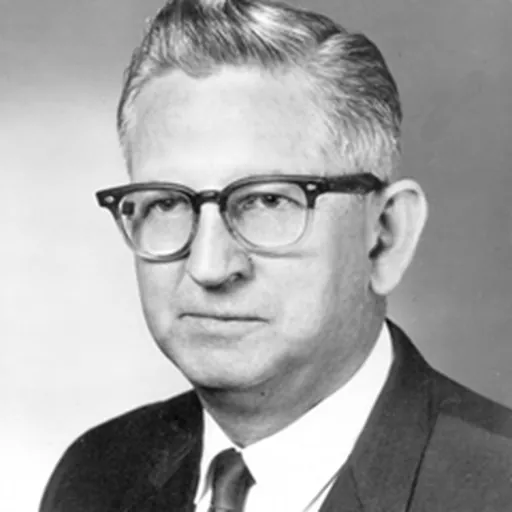
About Arthur Wallace
Lived 1919 – 2008 (aged 89). Arthur Wallace was an American agronomist, university of California and los Angeles.
Arthur Wallace (January 4, 1919 – October 11, 2008), was a soil scientist.
Biography
Schooling Wallace received a B.S. from Utah State University (chemistry) in 1943 and at Ph.D. from Rutgers University in 1949 (soils and plant nutrition).
Professor He was a professor of Plant Physiology at University of California, Los Angeles (1949–1989).
Accomplishments Wallace was elected Fellow of the American Society of Agronomy, of the Soil Science Society of American, of the Crop Science Society of America, and of the American Society for Horticultural Science.
Work & Publications
Dr. Iron
Wallace was known as "Dr. Iron" for his research and studies on chelated iron. At a meeting in Berkeley, California, held on December 11, 1953, he formulated the structure of EDDHA which was synthesized by his friend, Harry Kroll and which was commercialized by Geigy as Fe-EDDHA and Sequestrene 138. At that time, EDTA, HEEDTA and DTPA were known. Fe-EDTA was effective in the acidic Florida soils but failed in California giving chelates a poor reputation later reversed with the astounding success of Fe-EDDHA.
He helped organize the biannual international iron nutrition and interactions symposia which have been held since 1979. Wallace hosted the first one at UCLA.
Working in the Middle East and Africa He worked with plant mineral nutrition problems in the Middle East and Africa. He made 30 visits to Egypt working with Yossef Wiley, minister of agriculture, to solve some of their agricultural production problems.
Law of the Maximum Wallace is known for his Law of the Maximum in lieu of Liebig's law of the minimum. The Law of the Maximum predicts plant yield based on the additivity of nutrients, growth factors and stress factors. He formulated 13 sound rules for the use of fertilizers.
P.A.M. / Soil Conditioner Wallace is responsible for the current implementation and success of the soil conditioner – linear, water-soluble, anionic polyacrylamide. Monsanto launched the technology of synthetic and natural polyelectrolytes as soil conditions for the formation of water-stable soil aggregates in 1952. The introduction was written by Firman E. Bear, Arthur’s major professor at Rutgers. The product was marketed under the trade name "Krilium." The product technically successful but commercially failed due to the high cost of manufacturing and difficulty of use. Krilium became an example of a scientifically successful product but an economical failure. The technology became an embarrassment with an aversion and hesitance to resolve the causes of failure. Dr. Wallace resolved the technical problems, answering the Krilium problem. PAM was reported to be an economic solution of Krilium to condition soil, to reduce soil erosion, to prevent crusting, to help ameliorate sodic soils and to increase crop yield. Various cries were heard such as – "Do not forget the Krilium failure." PAM is currently fully accepted as a BMP and is used for erosion control such as in burned areas and an economical agricultural soil conditioner.
Don’t just read it —
keep it.
Full-length biographies made to live with: read them, listen on the way to work, watch them tonight.
- E-book
- Audio
- Video
Instant download · yours to keep · every purchase keeps this site free
Important facts
Related people
Same field, nearest in time





Contemporaries
People whose lives overlapped Arthur Wallace's




Frequently asked questions
Who was Arthur Wallace?
American soil scientist
When was Arthur Wallace born?
Arthur Wallace was born on 4 January 1919 in Bear River City.
When did Arthur Wallace die?
Arthur Wallace died on 11 October 2008 in Santa Monica.
What was Arthur Wallace's occupation?
Arthur Wallace was an agronomist, university of California and los Angeles.
What nationality was Arthur Wallace?
Arthur Wallace was American.
Sources & further reading
Cite this page
APA: Biography.guide. (2026). Arthur Wallace. https://biography.guide/arthur-wallace/
MLA: "Arthur Wallace." Biography.guide, https://biography.guide/arthur-wallace/.
Chicago: "Arthur Wallace." Biography.guide. https://biography.guide/arthur-wallace/.
Data last updated: 2026-09-20 · Spot an error? Report a correction.
Page generated 2026-09-27 05:09 UTC