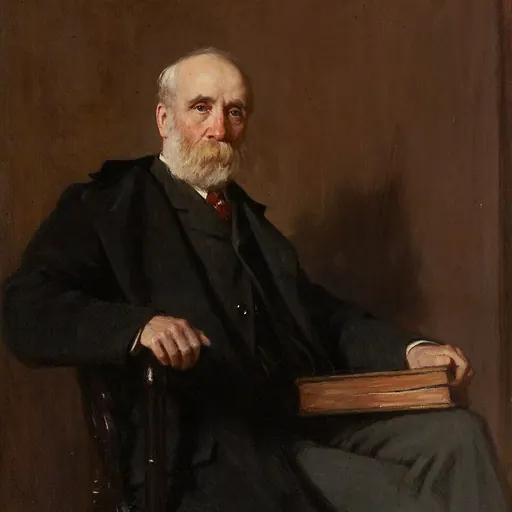
About Arthur Mitchell
Lived 1826 – 1909 (aged 82–83). Arthur Mitchell was a British epidemiologist, historian and physician.
Sir Arthur Mitchell MD LLD (19 January 1826 – 12 October 1909) was a Scottish doctor involved in the study and care of patients with mental illness. He served on several public commissions, and wrote widely on history and anthropology.
Life Mitchell was born in Elgin, Moray, the son of George Mitchell, a civil engineer, and his wife, Elizabeth Cant. He was educated at Elgin Academy. He studied at the University of Aberdeen, graduating MA in 1845 and MD in 1850. He did further postgraduate studies in Paris, Berlin and Vienna.
Physician From at least 1856 Mitchell was based at Larbert Hospital, Scotland's largest hospital specialising in mental health. He lived in Edinburgh, a short train journey away, at 7 Laverockbank Villas in the Trinity district.
In 1857 Mitchell was appointed Deputy Commissioner of Lunacy with the newly established General Board of Lunacy for Scotland, acting as deputy to William A.F. Browne. His appointment closely followed the publication of a report by the Scottish Lunacy Commission that prompted a greater understanding of the care of the insane. The appointment was controversial at the time, as he was still relatively inexperienced. His work included a study of individuals in private care, which was described in his publication The Insane in Private Dwellings. He reported that in 1862 there were 3628 insane persons in private care in Scotland, out of a total of 8207 (44%). While he recorded many cases of neglect and abuse in this setting, he argued that private care, if properly supervised, had an important part to play in the management of the insane. This suggestion was not in accord with the thrust of the 1857 report, which emphasised the role of district asylums. Susser (2010) gives a modern evaluation of this work, describing the methods used as going "well beyond the practices of his own time, and, in some respects, were better than the methods used in such investigations today.
The Insane in Private Dwellings included a great deal of statistical data, and this was to be a feature of much of his work. In 1865-1866 he published a series of papers examining the effects of consanguinous marriages on the offspring. This area was highly contentious, but much of the comment was based on anecdotal evidence or assertions without supporting evidence. While Mitchell's study was not conclusive, he identified the weaknesses of the existing work, and described in clear terms the two types of study that could resolve the issue: the first taking a large, representative, sample of defective births and comparing the parentage with that in the general population; the second, to collect family histories of everyone in a particular locality and follow up those with consaginuous marriages compared to unrelated marriages – in modern terms a cohort study. While he never carried out such studies, his evaluation of the evidence was the best that was available at the time, and his proposals for study design sound.
In 1870 Mitchell became Commissioner for Lunacy, a post he held until 1895. He continued with his research, and in 1877 published Contribution to the statistics of insanity which described a cohort study which followed all first asylum admissions in Scotland in the year 1858 for up to 12 years, to 1870. The total number of patients in the cohort was 1297. The study documented both those who remained within asylums, and those who left. In the latter case re-admissions, recoveries and deaths were recorded as far as possible. This was one of the first prospective studies carried out in psychiatry. and on a large collection of "rude stone implements" from Shetland. The stone implements were found in a variety of locations: on the surface; in subterranean structures; in the heart of a large tumulus; outside a stone coffin; or inside a kistvaen. Mitchell pointed out that the relatively crude workmanship could indicate an early origin, but could equally represent more recent work as an old skill declined. He used a similar argument in describing some of his finds in the communities of the Scottish islands, for example spindle whorls, and craggans, unglazed and usually undecorated clay pots. Mitchell not only saw these in use, but in several cases saw them being made. He commented that if they were found in an archeological excavation they might well be thought to be from the Stone Age. He also recorded the customs and practices of the places he visited, in particular regional superstitions. In 1876 he became the first Rhind lecturer, and described many of his findings in a series of six lectures, which were published as The Past in the Present: What is Civilisation?. His conclusion was that the difference in the essential characteristics of modern and early peoples are imperceptible, that civilisation was due to accumulated knowledge rather than an inherent superiority of its individual members.
Mitchell's paper On various superstitions in the north-west highlands and islands of Scotland, especially in relation to lunacy Mitchell refers to "disgusting superstitions", for example the burial of a live cock as a cure for epilepsy. But while he regarded such customs as backward and ignorant, he sympathised with the distress of those who sought such cures. Discussing the adoration of wells, where supplicants would bathe a sick child in the waters, drop an offering in the well, and attach a bit of clothing to a nearby bush, he wrote: "Part of a bib or little pinafore tells the sad story of a sorrowing mother and a suffering child, and makes the heart grieve that nothing better than a visit to one of these wells had been found to relieve the sorrow and remove the suffering".
He held positions with the Society of Antiquaries of Scotland, the Scottish Meteorological Society, the Early Scottish Text Society, and council member of the Scottish History Society. He was a professor of ancient history to the Royal Scottish Academy. Other works included A List of Travels in Scotland 1296—1900. He received an honorary LLD from the University of Aberdeen in 1875. In 1886 Mitchell was made a Companion of the Bath (CB) by Queen Victoria, and was raised to the rank of Knight Commander of the Order of the Bath (KCB) the following year. He became an Honorary Fellow of the Royal College of Physicians of Ireland in 1891.
Unconnected to his medical life he was Chairman of the Scottish Life Assurance Company in Edinburgh. His managerial colleagues included David Paulin as Manager and James Sorley as Treasurer (who together had founded the company).
He retired in 1895 and died at home 34 Drummond Place in Edinburgh's New Town, on 12 October 1909. He was buried at Rosebank Cemetery, Edinburgh.
Their only child was Sydney Mitchell (1856–1930), a successful Edinburgh architect who was commissioned by Arthur to design Craig House as an asylum in 1887.
He was uncle to George Arthur Mitchell FRSE.
Publications
Volume 1; Volume 2.
Volume 1; Volume 2; Volume 3.
Don’t just read it —
keep it.
Full-length biographies made to live with: read them, listen on the way to work, watch them tonight.
- E-book
- Audio
- Video
Instant download · yours to keep · every purchase keeps this site free
Important facts
People in Arthur Mitchell's life
Named in this biography and alive at the same time




Related people
Same field, nearest in time




Contemporaries
People whose lives overlapped Arthur Mitchell's






Frequently asked questions
Who was Arthur Mitchell?
British doctor
When was Arthur Mitchell born?
Arthur Mitchell was born in 1826 in Moray.
When did Arthur Mitchell die?
Arthur Mitchell died on 12 October 1909.
What was Arthur Mitchell's occupation?
Arthur Mitchell was an epidemiologist, historian and physician.
What nationality was Arthur Mitchell?
Arthur Mitchell was British.
Sources & further reading
· DBpedia: Arthur Mitchell (physician)
Cite this page
APA: Biography.guide. (2026). Arthur Mitchell. https://biography.guide/arthur-mitchell-epidemiologist/
MLA: "Arthur Mitchell." Biography.guide, https://biography.guide/arthur-mitchell-epidemiologist/.
Chicago: "Arthur Mitchell." Biography.guide. https://biography.guide/arthur-mitchell-epidemiologist/.
Data last updated: 2026-09-24 · Spot an error? Report a correction.
Portrait: Wikimedia Commons · author & licence
Page generated 2026-09-27 05:08 UTC