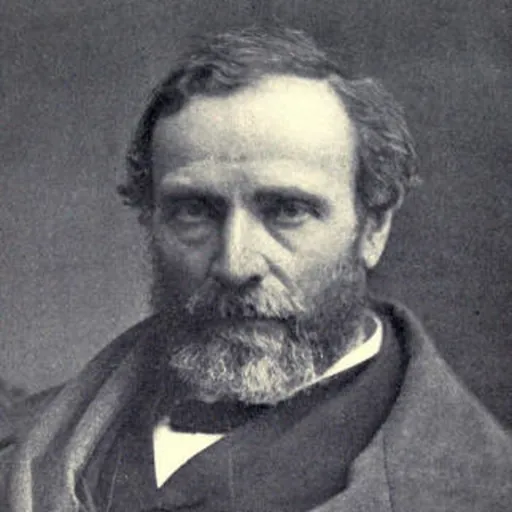
About Arthur Hobhouse, 1st Baron Hobhouse
Lived 1819 – 1904 (aged 85). Arthur Hobhouse, 1st Baron Hobhouse was a British lawyer, judge, politician, aristocrat, barrister and jurist.
Arthur Hobhouse, 1st Baron Hobhouse, (10 November 18196 December 1904) was an English lawyer and judge.
Background and education
Born at Hadspen House, Somerset, Hobhouse was the fourth and youngest son of Henry Hobhouse, permanent under-secretary of state in the Home Office, by his wife Harriet, sixth daughter of John Turton of Sugnall Hall, Stafford. Edmund Hobhouse, Bishop of Nelson, and Reginald Hobhouse (1818–95), Archdeacon of Bodmin, were elder brothers. Passing at eleven from a private school to Eton, he remained there seven years (1830–7). In 1837 he went to Balliol College, Oxford, graduated B.A. in 1840 with a first class in classics, and proceeded M.A. in 1844. Entering at Lincoln's Inn on 22 April 1841, he was called to the bar on 6 May 1845, and soon acquired a large chancery and conveyancing practice.
Early legal career In 1862 he became a Queen's Counsel and a bencher of his inn, serving the office of treasurer in 1880–1 and practised in the Rolls Court (the civil division of the Court of Appeal). A severe illness in 1866 led him to retire from practice and accept the appointment of charity commissioner. Hobhouse threw himself into the work with energy. He was not only active in administration but advocated a reform of the law governing charitable endowments. The Endowed Schools Act, 1869, was a first step in that direction, and under that act Lord Lyttelton, Hobhouse, and Canon H. G. Robinson were appointed commissioners with large powers of reorganising endowed schools. Much was accomplished in regard to endowed schools, but the efforts of Hobhouse and his fellow commissioners received a check in 1871, when the House of Lords rejected their scheme for remodelling the Emanuel Hospital, Westminster. There followed a controversy which was distasteful to Hobhouse, and with little regret he retired in 1872 in order to succeed Sir James Fitzjames Stephen as law member of the council of the Governor-General of India. Hobhouse had meanwhile served on the royal commission on the operation of the Land Transfer Act in 1869. with a view to assisting in the judicial work of the House of Lords, but a statutory qualification by which only judges of the high courts of the United Kingdom could sit to hear appeals had been overlooked. In 1887 the disqualification was removed by Act of Parliament in regard to members of the Judicial Committee; but Hobhouse did not take up the work of a judge in the House of Lords. He only sat there to try three cases, in two of which, Russell v. Countess of Russell (1897 Appeal Cases 395) and the Kempton Park case (1899 Appeal Cases 143), he was in a dissenting minority. As a judge Hobhouse, who was always careful and painstaking, invariably stated the various arguments fully and fairly, but he was tenacious of his deliberately formed opinion. Henry's grandson John Hobhouse, Baron Hobhouse of Woodborough was a judge and law lord.
Appreciation and publications To the last an advanced liberal and constructive legal reformer, Hobhouse, all of whose judicial work was done gratuitously, urged many legal changes, which won adoption very slowly. Much influence is assignable to an address by him before the Social Science Congress at Birmingham in 1868 on the law relating to the property of married women (1869; new edition 1870), and to The Dead Hand (1880), a collection of addresses on endowments and settlements of property (reprinted from the Transactions of the Social Science Association).
Don’t just read it —
keep it.
Full-length biographies made to live with: read them, listen on the way to work, watch them tonight.
- E-book
- Audio
- Video
Instant download · yours to keep · every purchase keeps this site free
Important facts
People in Arthur Hobhouse, 1st Baron Hobhouse's life
Named in this biography and alive at the same time




Related people
Same field, nearest in time
Contemporaries
People whose lives overlapped Arthur Hobhouse, 1st Baron Hobhouse's
Frequently asked questions
Who was Arthur Hobhouse, 1st Baron Hobhouse?
English lawyer and judge (1819-1904)
When was Arthur Hobhouse, 1st Baron Hobhouse born?
Arthur Hobhouse, 1st Baron Hobhouse was born on 10 November 1819 in Hadspen house and garden.
When did Arthur Hobhouse, 1st Baron Hobhouse die?
Arthur Hobhouse, 1st Baron Hobhouse died on 6 December 1904 in Greater London.
What was Arthur Hobhouse, 1st Baron Hobhouse's occupation?
Arthur Hobhouse, 1st Baron Hobhouse was a lawyer, judge, politician, aristocrat, barrister and jurist.
What nationality was Arthur Hobhouse, 1st Baron Hobhouse?
Arthur Hobhouse, 1st Baron Hobhouse was British.
Sources & further reading
· Wikipedia: Arthur Hobhouse, 1st Baron Hobhouse
· DBpedia: Arthur Hobhouse, 1st Baron Hobhouse
Cite this page
APA: Biography.guide. (2026). Arthur Hobhouse, 1st Baron Hobhouse. https://biography.guide/arthur-hobhouse-1st-baron-hobhouse/
MLA: "Arthur Hobhouse, 1st Baron Hobhouse." Biography.guide, https://biography.guide/arthur-hobhouse-1st-baron-hobhouse/.
Chicago: "Arthur Hobhouse, 1st Baron Hobhouse." Biography.guide. https://biography.guide/arthur-hobhouse-1st-baron-hobhouse/.
Data last updated: 2026-09-25 · Spot an error? Report a correction.
Portrait: Wikimedia Commons · author & licence
Page generated 2026-10-04 10:25 UTC